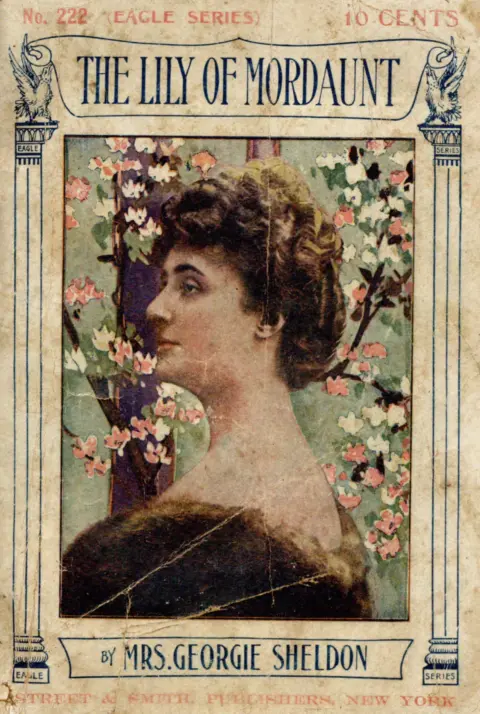
The lily of Mordaunt
Georgie, Mrs. Sheldon
THE CLASSIC COLLECTION · 1890
"Wedded by Fate: or Sister Angela" by Mrs. Georgie Sheldon is a novel written in the late 19th century. The story centers on Salome Howland, a young woman of refinement who, despite tragic circumstances and her own mysterious past, seeks employment as a nurse at Boston's City Hospital. The book appears to explore themes of sacrifice, love, social class, and personal redemption, with Salome and Dr. Truman Winthrop emerging as the main characters whose lives become unexpectedly intertwined. The opening of the novel introduces Salome Howland as a veiled, sorrowful young woman arriving at the hospital to answer an advertisement for nurses. Despite her delicacy and lack of references, she impresses the staff and excels in her work, quickly earning respect and affection. When Dr. Truman Winthrop, a visiting physician, is brought in near death from coal gas poisoning, Salome heroically donates her blood to save him, forging a deep, almost fateful connection. As Salome recovers from the ordeal, she and Dr. Winthrop form a strong emotional bond, leading to a whirlwind romance and a tender, secretive wedding. The narrative immerses readers in Salome's emotional struggles, her yearning for belonging, and the blossoming love between two lives united by chance and sacrifice.
Introduction adapted from the source catalogue; source summaries may be automatically generated.
Free to read · English · 140,950 words · No account needed
MAKE TIME FOR A GOOD BOOK
On by default. Untick to stop anonymous reading totals. Each page counts after 10 seconds in view. How this works.
Anonymous counting is on unless you have switched it off.
Dr. Winthrop’s lip curled with scorn as he thought how his sister had played the spy upon his pure-minded, innocent wife. How utterly contemptible it seemed to him, and how simple the circumstances of the meeting, although, as his mother had represented it, there had seemed to be something perplexing and suspicious connected with it.
“I blame myself very much, Salome, for leaving you behind when I was called abroad to my father,” he said regretfully. “If I had only listened to your pleadings and taken you with me, I could have saved you all these wretched experiences. But I feared the voyage for you in the dead of winter, for you were far from strong. I knew if you took cold and were ill again it would go hard with you; so, though it nearly unmanned me to refuse you and leave you, I believed it was the only right thing for me to do.”
“I know you acted as you thought best, True, and I never thought of blaming you,” Salome answered. “The only thing that I rebelled against and questioned, was your apparently harsh judgment of me in sending me from your home, as if you regretted having ever brought me there; but now, knowing that you never received my letter, and understanding why you sent me away, I can see that I misjudged you.”
“It is not strange at all,” Dr. Winthrop said, feeling that she had been very lenient in her estimate of his apparent injustice. Then he added, with some curiosity:
“How do you account, Salome, for the fact that Miss Rochester has been masquerading under your name and position.”
“That is very easily explained,” the young wife answered. “They were excessively alarmed after I ran away from them, for of course they realized that upon me depended the hope of their ultimately coming into the possession of the income of the fifty thousand dollars mentioned in my father’s will. All this, you understand, I learned from them during my illness at the chateau. They believed me to be dead—they had seen a notice in a London paper, shortly after my disappearance, of the death of a girl bearing my name and answering to my description, a friendless girl, who had met with an accident, and been carried to the Home for the Friendless—and Mrs. Rochester conceived the plan of representing Sarah as the Rochester heiress, marrying her to the Hamilton heir, and thus securing, a fine position and great wealth for her daughter, besides the handsome income referred to in my father’s will for herself. Sarah was very readily changed to Sadie, and to inquisitive people, who had known that there were two Miss Rochesters, it was easy to say that she had lost her own daughter, and her only companion was now her husband’s child. We had been abroad for years, consequently had grown out of the remembrance of our old acquaintances, and no one would be the wiser for the deception. It was a very cunning plot and very cleverly developed, as you know, while if they had failed in making you their victim, they would still have had the fifty thousand dollars, provided I never made my appearance to claim it. The first intimation they had that I was not the girl who had died in London, was upon being told whom you had married by Madame Winthrop, but they thought they were safe again upon hearing that I had lost my life in that fire, and they believed that if they could secure you they would never have anything to fear hereafter. You can perhaps imagine their astonishment and dismay when, upon removing my cap and spectacles, after I had fainted before their door, in the chateau, they discovered who I was. Of course they recognized me instantly, and when they found I was too ill to be removed, they planned to conceal me in Sarah’s room until I should be well enough to be secretly sent away. Even then, I did not know that you were the heir of my father’s friend. Your mother and sister had represented to me that you had been pledged to some one else at the time of our marriage, but they did not tell me to whom, and I had no idea that you were in any way concerned until Sarah Rochester herself told me, on the day that she discovered my identity. It seemed as if the knowledge must kill me—as if everything in my life had gone at cross purposes. I was already the wife of the man whom my father had willed I should marry—the man whom I had fled from because I feared he would be odious to me, but whom fate had decreed that I should love with my whole soul. It seemed to me then as if I had recklessly thrown my life and my happiness away, for if I had remained quietly with Mrs. Rochester, you would ultimately have come to us, we should have been mutually attracted, and there would have been nothing to interfere with our future happiness. Of course, when they told me this, I understood all their plot at once. I knew why Sarah’s name had been changed to Sadie—why they were travelling with you, and the end they hoped to attain. I could understand, too, what a marplot they must regard me—that they must fear that I would betray their secret and spoil all their plans. It would be a terrible thing for Mrs. Rochester, after having carried her deception so far to be obliged to confess that she had been palming off her own daughter as the child of her husband, just to get his money and secure her a brilliant position in life. When they discovered, however, that I had no intention of revealing my identity to you, they recovered themselves somewhat, but I did not dream that they were plotting to shut me up in that dreadful place.”
Your reading position is saved on this browser. Take it to another device with a library code. Reading pages adapt to text, rather than matching a printed edition.
Georgie, Mrs. Sheldon
Georgie, Mrs. Sheldon
Georgie, Mrs. Sheldon
Georgie, Mrs. Sheldon
BEHIND THE BOOK
This eBook is for the use of anyone anywhere in the United States and most other parts of the world at no cost and with almost no restrictions whatsoever. You may copy it, give it away or re-use it under the terms of the Project Gutenberg License included with this eBook or online at www.gutenberg.org. If you are not located in the United States, you will have to check the laws of the country where you are located before using this eBook. Read the source licence.
The original source file, including credits and licence, is retained by this library. Request an original-format copy at no charge. Please include the book title and Project Gutenberg identifier #76066.
KEEP YOUR CURIOSITY GOING
Coulson Kernahan

Maurice Baring
Frances Wright
Cécile Tormay

Frederic Jesup Stimson

W. H. P. (William Henry Pope) Jarvis