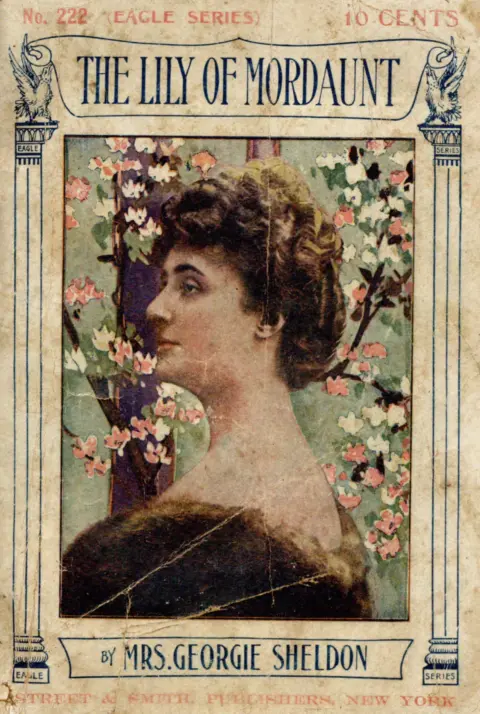
The lily of Mordaunt
Georgie, Mrs. Sheldon
THE CLASSIC COLLECTION · 1890
"Wedded by Fate: or Sister Angela" by Mrs. Georgie Sheldon is a novel written in the late 19th century. The story centers on Salome Howland, a young woman of refinement who, despite tragic circumstances and her own mysterious past, seeks employment as a nurse at Boston's City Hospital. The book appears to explore themes of sacrifice, love, social class, and personal redemption, with Salome and Dr. Truman Winthrop emerging as the main characters whose lives become unexpectedly intertwined. The opening of the novel introduces Salome Howland as a veiled, sorrowful young woman arriving at the hospital to answer an advertisement for nurses. Despite her delicacy and lack of references, she impresses the staff and excels in her work, quickly earning respect and affection. When Dr. Truman Winthrop, a visiting physician, is brought in near death from coal gas poisoning, Salome heroically donates her blood to save him, forging a deep, almost fateful connection. As Salome recovers from the ordeal, she and Dr. Winthrop form a strong emotional bond, leading to a whirlwind romance and a tender, secretive wedding. The narrative immerses readers in Salome's emotional struggles, her yearning for belonging, and the blossoming love between two lives united by chance and sacrifice.
Introduction adapted from the source catalogue; source summaries may be automatically generated.
Free to read · English · 140,950 words · No account needed
MAKE TIME FOR A GOOD BOOK
On by default. Untick to stop anonymous reading totals. Each page counts after 10 seconds in view. How this works.
Anonymous counting is on unless you have switched it off.
“MY DEAR HUSBAND,” it began, but tears sprang to his eyes, and so blurred was his sight that for a few moments he could not go on with his reading. “Let me call you so for this last time,” he read when he could see again; “yes, for the last time, for I am going away from you forever. I can see now that it was a great mistake, your marrying me. I was afraid at the time that you were influenced merely by gratitude. I am so sorry now that I had not strength to say no when you urged me to be your wife. If you had but told me truly that it was not love, but pity for my desolate condition and a desire to care for me when I was unable to take care of myself, it would have been so much easier and better every way. Then, too, you were pledged to another, and that made a triple wrong. It breaks my heart to think of it and that some other poor girl, who loved you as blindly, perhaps, as I have done, has been grieving over your broken troth. And now you have banished me from your home, as if you believed me unworthy to remain there. What is my offence, True? Did I not make my explanations clear enough in the letter I wrote you a little more than a week ago? Is it true that because I withheld my true surname—and, True, I had almost forgotten I had any other save that of Howland—is it true, as your mother says, that our marriage was illegal—that I am no wife? Is that why you have sent me away? If you had only written to me and explained, instead of sending me that dreadful cable message. Instead of the word I begged for—stay—you have told me to go. Perhaps you will write now, but since you were in such a hurry to have me go; since you appear to fear a scandal, and I know that you did not love me—though you seemed to—I shall not wait for any cold, cruel letter confirming my fate, but take myself utterly away from you at once. I wrote you all the truth and only truth, True. Did what I told you seem too dreadful, too humiliating, to be overlooked and forgiven? Then I could not help the meeting with that miserable man, whom I detested and feared—indeed, I could not, although your mother insists I have compromised you all by the encounter. It was just as I told you in my letter, and you must know that I could never associate with such a man. I am sorry—so sorry to have brought discord into your family; my own are all dead—father, mother, and sister—and I should have been so glad if I could have stood in the light of a daughter and sister to your friends. But I have written all this before—how useless to repeat it! I merely meant to tell you that I cannot go to that hotel and register myself as your wife, when they tell me that I am not, and when I am in doubt as to what my future is to be—no, not doubt, for they say you will never forgive the deception that made our marriage illegal. If you are not really already free, the law will free you from a runaway wife.” And here a little of her pride and spirit blazed forth. “I should not come back here if you did find me; I cannot forgive you that, while you were pledged to another, you pretended to love me, and married me to repay an imaginary debt. But—I love you—I love you, and I would have been true and faithful to you all my life. Forgive me for breaking down thus, but my poor aching heart would make its last lament. How I shall live without you I cannot tell; perhaps I shall not live long; I think I shall be glad if I do not, and then you will be free indeed. Try to think as kindly of me as you can. I have not willingly deceived you; you know I wanted to tell you everything in the first place, but you would not let me. You were very kind to me the little time we spent together, and when I began to believe that you were growing to love me, as I love you, I was happier than I can express. I shall leave everything, save what I have brought with me. The diamonds and other jewelry I have arranged to send to the safe deposit vault, with the silver; also the check-book you gave me, and which I have not made use of at all. The money that you gave me at the same time—or what there is left after paying the servants—I will keep, for I may not be able to go to work just yet to earn for myself. I have tried to arrange everything as I thought you would like; I hope you will find all in good order when you return. Good-by, True—O True!”
Your reading position is saved on this browser. Take it to another device with a library code. Reading pages adapt to text, rather than matching a printed edition.
Georgie, Mrs. Sheldon
Georgie, Mrs. Sheldon
Georgie, Mrs. Sheldon
Georgie, Mrs. Sheldon
BEHIND THE BOOK
This eBook is for the use of anyone anywhere in the United States and most other parts of the world at no cost and with almost no restrictions whatsoever. You may copy it, give it away or re-use it under the terms of the Project Gutenberg License included with this eBook or online at www.gutenberg.org. If you are not located in the United States, you will have to check the laws of the country where you are located before using this eBook. Read the source licence.
The original source file, including credits and licence, is retained by this library. Request an original-format copy at no charge. Please include the book title and Project Gutenberg identifier #76066.
KEEP YOUR CURIOSITY GOING
Coulson Kernahan

Maurice Baring
Frances Wright
Cécile Tormay

Frederic Jesup Stimson

W. H. P. (William Henry Pope) Jarvis