The Devil
Leo, graf Tolstoy
THE CLASSIC COLLECTION · 1869
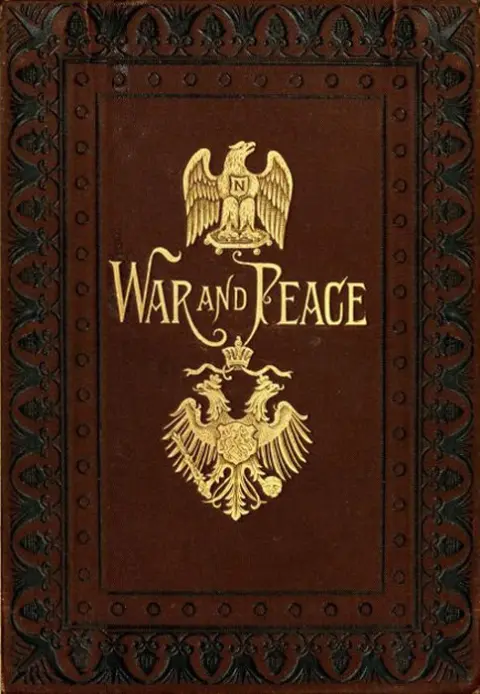
"War and Peace" by graf Leo Tolstoy is a literary work published in 1869. Set during the Napoleonic Wars, it chronicles the French invasion of Russia through five interlocking narratives following different Russian aristocratic families. The work blends fictional storytelling with philosophical discussions about history, war, and power. Tolstoy himself hesitated to classify it, saying it is "not a novel, even less is it a poem, and still less a historical chronicle." It remains one of the most praised classics of world literature.
Introduction adapted from the source catalogue; source summaries may be automatically generated.
Free to read · English · 581,653 words · No account needed
MAKE TIME FOR A GOOD BOOK
On by default. Untick to stop anonymous reading totals. Each page counts after 10 seconds in view. How this works.
Anonymous counting is on unless you have switched it off.
“Well, mon cher, have you got the manifesto?” asked the old count. “The countess has been to Mass at the Razumóvskis’ and heard the new prayer. She says it’s very fine.”
“Yes, I’ve got it,” said Pierre. “The Emperor is to be here tomorrow... there’s to be an Extraordinary Meeting of the nobility, and they are talking of a levy of ten men per thousand. Oh yes, let me congratulate you!”
“Yes, yes, thank God! Well, and what news from the army?”
“We are again retreating. They say we’re already near Smolénsk,” replied
Pierre.
“O Lord, O Lord!” exclaimed the count. “Where is the manifesto?”
“The Emperor’s appeal? Oh yes!”
Pierre began feeling in his pockets for the papers, but could not find them. Still slapping his pockets, he kissed the hand of the countess who entered the room and glanced uneasily around, evidently expecting Natásha, who had left off singing but had not yet come into the drawing room.
“On my word, I don’t know what I’ve done with it,” he said.
“There he is, always losing everything!” remarked the countess.
Natásha entered with a softened and agitated expression of face and sat down looking silently at Pierre. As soon as she entered, Pierre’s features, which had been gloomy, suddenly lighted up, and while still searching for the papers he glanced at her several times.
“No, really! I’ll drive home, I must have left them there. I’ll
certainly...”
“But you’ll be late for dinner.”
“Oh! And my coachman has gone.”
But Sónya, who had gone to look for the papers in the anteroom, had found them in Pierre’s hat, where he had carefully tucked them under the lining. Pierre was about to begin reading.
“No, after dinner,” said the old count, evidently expecting much enjoyment from that reading.
At dinner, at which champagne was drunk to the health of the new chevalier of St. George, Shinshín told them the town news, of the illness of the old Georgian princess, of Métivier’s disappearance from Moscow, and of how some German fellow had been brought to Rostopchín and accused of being a French “spyer” (so Count Rostopchín had told the story), and how Rostopchín let him go and assured the people that he was “not a spire at all, but only an old German ruin.”
“People are being arrested...” said the count. “I’ve told the countess she should not speak French so much. It’s not the time for it now.”
Your reading position is saved on this browser. Take it to another device with a library code. Reading pages adapt to text, rather than matching a printed edition.
Leo, graf Tolstoy
Leo, graf Tolstoy
Leo, graf Tolstoy
Leo, graf Tolstoy
BEHIND THE BOOK
This eBook is for the use of anyone anywhere in the United States and most other parts of the world at no cost and with almost no restrictions whatsoever. You may copy it, give it away or re-use it under the terms of the Project Gutenberg License included with this eBook or online at www.gutenberg.org. If you are not located in the United States, you will have to check the laws of the country where you are located before using this eBook. Read the source licence.
The original source file, including credits and licence, is retained by this library. Request an original-format copy at no charge. Please include the book title and Project Gutenberg identifier #2600.
KEEP YOUR CURIOSITY GOING
Cécile Tormay

Moritz Busch
Coulson Kernahan
John L. Ransom

Maurice Baring
Frances Wright