The Devil
Leo, graf Tolstoy
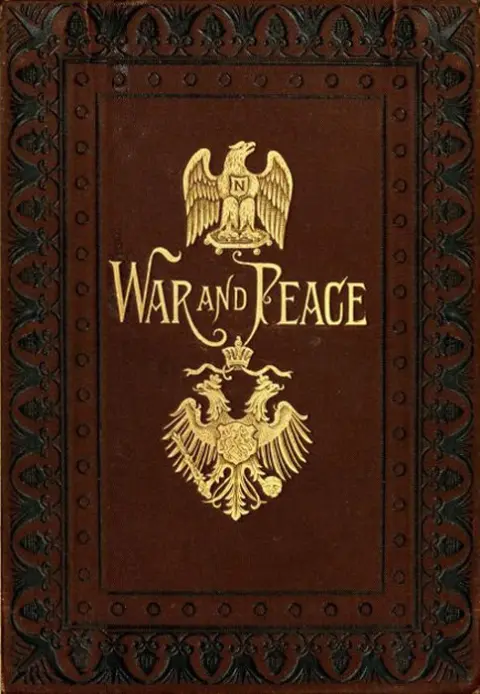
THE CLASSIC COLLECTION · 1869
"War and Peace" by graf Leo Tolstoy is a literary work published in 1869. Set during the Napoleonic Wars, it chronicles the French invasion of Russia through five interlocking narratives following different Russian aristocratic families. The work blends fictional storytelling with philosophical discussions about history, war, and power. Tolstoy himself hesitated to classify it, saying it is "not a novel, even less is it a poem, and still less a historical chronicle." It remains one of the most praised classics of world literature.
Introduction adapted from the source catalogue; source summaries may be automatically generated.
Free to read · English · 581,653 words · No account needed
MAKE TIME FOR A GOOD BOOK
On by default. Untick to stop anonymous reading totals. Each page counts after 10 seconds in view. How this works.
Anonymous counting is on unless you have switched it off.
On the day the count left, Sónya and Natásha were invited to a big dinner party at the Karágins’, and Márya Dmítrievna took them there. At that party Natásha again met Anatole, and Sónya noticed that she spoke to him, trying not to be overheard, and that all through dinner she was more agitated than ever. When they got home Natásha was the first to begin the explanation Sónya expected.
“There, Sónya, you were talking all sorts of nonsense about him,” Natásha began in a mild voice such as children use when they wish to be praised. “We have had an explanation today.”
“Well, what happened? What did he say? Natásha, how glad I am you’re not angry with me! Tell me everything—the whole truth. What did he say?”
Natásha became thoughtful.
“Oh, Sónya, if you knew him as I do! He said... He asked me what I had promised Bolkónski. He was glad I was free to refuse him.”
Sónya sighed sorrowfully.
“But you haven’t refused Bolkónski?” said she.
“Perhaps I have. Perhaps all is over between me and Bolkónski. Why do you think so badly of me?”
“I don’t think anything, only I don’t understand this...”
“Wait a bit, Sónya, you’ll understand everything. You’ll see what a man he is! Now don’t think badly of me or of him. I don’t think badly of anyone: I love and pity everybody. But what am I to do?”
Sónya did not succumb to the tender tone Natásha used toward her. The more emotional and ingratiating the expression of Natásha’s face became, the more serious and stern grew Sónya’s.
“Natásha,” said she, “you asked me not to speak to you, and I haven’t spoken, but now you yourself have begun. I don’t trust him, Natásha. Why this secrecy?”
“Again, again!” interrupted Natásha.
“Natásha, I am afraid for you!”
“Afraid of what?”
“I am afraid you’re going to your ruin,” said Sónya resolutely, and was herself horrified at what she had said.
Anger again showed in Natásha’s face.
“And I’ll go to my ruin, I will, as soon as possible! It’s not your business! It won’t be you, but I, who’ll suffer. Leave me alone, leave me alone! I hate you!”
“Natásha!” moaned Sónya, aghast.
“I hate you, I hate you! You’re my enemy forever!” And Natásha
ran out of the room.
Your reading position is saved on this browser. Take it to another device with a library code. Reading pages adapt to text, rather than matching a printed edition.
Leo, graf Tolstoy
Leo, graf Tolstoy
Leo, graf Tolstoy
Leo, graf Tolstoy
BEHIND THE BOOK
This eBook is for the use of anyone anywhere in the United States and most other parts of the world at no cost and with almost no restrictions whatsoever. You may copy it, give it away or re-use it under the terms of the Project Gutenberg License included with this eBook or online at www.gutenberg.org. If you are not located in the United States, you will have to check the laws of the country where you are located before using this eBook. Read the source licence.
The original source file, including credits and licence, is retained by this library. Request an original-format copy at no charge. Please include the book title and Project Gutenberg identifier #2600.
KEEP YOUR CURIOSITY GOING
Cécile Tormay

Moritz Busch
Coulson Kernahan
John L. Ransom

Maurice Baring
Frances Wright