The Devil
Leo, graf Tolstoy
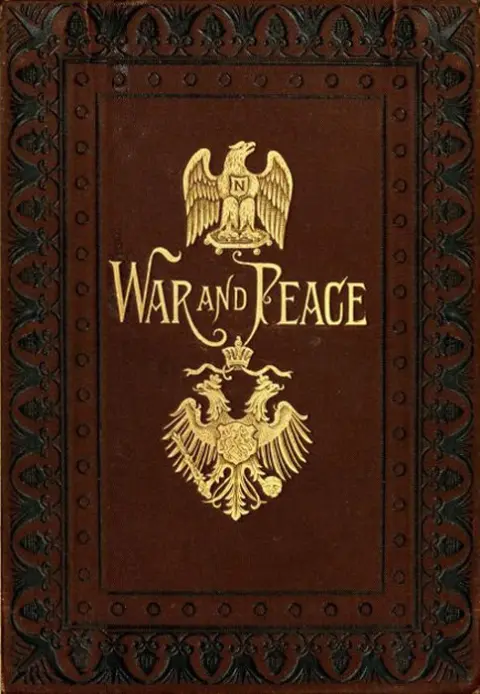
THE CLASSIC COLLECTION · 1869
"War and Peace" by graf Leo Tolstoy is a literary work published in 1869. Set during the Napoleonic Wars, it chronicles the French invasion of Russia through five interlocking narratives following different Russian aristocratic families. The work blends fictional storytelling with philosophical discussions about history, war, and power. Tolstoy himself hesitated to classify it, saying it is "not a novel, even less is it a poem, and still less a historical chronicle." It remains one of the most praised classics of world literature.
Introduction adapted from the source catalogue; source summaries may be automatically generated.
Free to read · English · 581,653 words · No account needed
MAKE TIME FOR A GOOD BOOK
On by default. Untick to stop anonymous reading totals. Each page counts after 10 seconds in view. How this works.
Anonymous counting is on unless you have switched it off.
In the third circle, Narýshkin was speaking of the meeting of the Austrian Council of War at which Suvórov crowed like a cock in reply to the nonsense talked by the Austrian generals. Shinshín, standing close by, tried to make a joke, saying that Kutúzov had evidently failed to learn from Suvórov even so simple a thing as the art of crowing like a cock, but the elder members glanced severely at the wit, making him feel that in that place and on that day, it was improper to speak so of Kutúzov.
Count Ilyá Rostóv, hurried and preoccupied, went about in his soft boots between the dining and drawing rooms, hastily greeting the important and unimportant, all of whom he knew, as if they were all equals, while his eyes occasionally sought out his fine well-set-up young son, resting on him and winking joyfully at him. Young Rostóv stood at a window with Dólokhov, whose acquaintance he had lately made and highly valued. The old count came up to them and pressed Dólokhov’s hand.
“Please come and visit us... you know my brave boy... been together out there... both playing the hero... Ah, Vasíli Ignátovich... How d’ye do, old fellow?” he said, turning to an old man who was passing, but before he had finished his greeting there was a general stir, and a footman who had run in announced, with a frightened face: “He’s arrived!”
Bells rang, the stewards rushed forward, and—like rye shaken together in a shovel—the guests who had been scattered about in different rooms came together and crowded in the large drawing room by the door of the ballroom.
Bagratión appeared in the doorway of the anteroom without hat or sword, which, in accord with the club custom, he had given up to the hall porter. He had no lambskin cap on his head, nor had he a loaded whip over his shoulder, as when Rostóv had seen him on the eve of the battle of Austerlitz, but wore a tight new uniform with Russian and foreign Orders, and the Star of St. George on his left breast. Evidently just before coming to the dinner he had had his hair and whiskers trimmed, which changed his appearance for the worse. There was something naïvely festive in his air, which, in conjunction with his firm and virile features, gave him a rather comical expression. Bekleshëv and Theodore Uvárov, who had arrived with him, paused at the doorway to allow him, as the guest of honor, to enter first. Bagratión was embarrassed, not wishing to avail himself of their courtesy, and this caused some delay at the doors, but after all he did at last enter first. He walked shyly and awkwardly over the parquet floor of the reception room, not knowing what to do with his hands; he was more accustomed to walk over a plowed field under fire, as he had done at the head of the Kursk regiment at Schön Grabern—and he would have found that easier. The committeemen met him at the first door and, expressing their delight at seeing such a highly honored guest, took possession of him as it were, without waiting for his reply, surrounded him, and led him to the drawing room. It was at first impossible to enter the drawing room door for the crowd of members and guests jostling one another and trying to get a good look at Bagratión over each other’s shoulders, as if he were some rare animal. Count Ilyá Rostóv, laughing and repeating the words, “Make way, dear boy! Make way, make way!” pushed through the crowd more energetically than anyone, led the guests into the drawing room, and seated them on the center sofa. The bigwigs, the most respected members of the club, beset the new arrivals. Count Ilyá, again thrusting his way through the crowd, went out of the drawing room and reappeared a minute later with another committeeman, carrying a large silver salver which he presented to Prince Bagratión. On the salver lay some verses composed and printed in the hero’s honor. Bagratión, on seeing the salver, glanced around in dismay, as though seeking help. But all eyes demanded that he should submit. Feeling himself in their power, he resolutely took the salver with both hands and looked sternly and reproachfully at the count who had presented it to him. Someone obligingly took the dish from Bagratión (or he would, it seemed, have held it till evening and have gone in to dinner with it) and drew his attention to the verses.
Your reading position is saved on this browser. Take it to another device with a library code. Reading pages adapt to text, rather than matching a printed edition.
Leo, graf Tolstoy
Leo, graf Tolstoy
Leo, graf Tolstoy
Leo, graf Tolstoy
BEHIND THE BOOK
This eBook is for the use of anyone anywhere in the United States and most other parts of the world at no cost and with almost no restrictions whatsoever. You may copy it, give it away or re-use it under the terms of the Project Gutenberg License included with this eBook or online at www.gutenberg.org. If you are not located in the United States, you will have to check the laws of the country where you are located before using this eBook. Read the source licence.
The original source file, including credits and licence, is retained by this library. Request an original-format copy at no charge. Please include the book title and Project Gutenberg identifier #2600.
KEEP YOUR CURIOSITY GOING
Cécile Tormay

Moritz Busch
Coulson Kernahan
John L. Ransom

Maurice Baring
Frances Wright