The Devil
Leo, graf Tolstoy
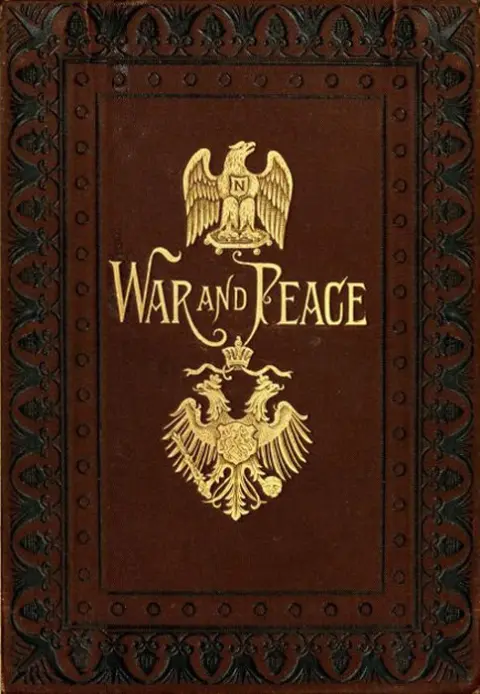
THE CLASSIC COLLECTION · 1869
"War and Peace" by graf Leo Tolstoy is a literary work published in 1869. Set during the Napoleonic Wars, it chronicles the French invasion of Russia through five interlocking narratives following different Russian aristocratic families. The work blends fictional storytelling with philosophical discussions about history, war, and power. Tolstoy himself hesitated to classify it, saying it is "not a novel, even less is it a poem, and still less a historical chronicle." It remains one of the most praised classics of world literature.
Introduction adapted from the source catalogue; source summaries may be automatically generated.
Free to read · English · 581,653 words · No account needed
MAKE TIME FOR A GOOD BOOK
On by default. Untick to stop anonymous reading totals. Each page counts after 10 seconds in view. How this works.
Anonymous counting is on unless you have switched it off.
Yet it was she, dressed in a new gown which he did not know, made since he had left. All the others let him go, and he ran to her. When they met, she fell on his breast, sobbing. She could not lift her face, but only pressed it to the cold braiding of his hussar’s jacket. Denísov, who had come into the room unnoticed by anyone, stood there and wiped his eyes at the sight.
“Vasíli Denísov, your son’s friend,” he said, introducing himself to the count, who was looking inquiringly at him.
“You are most welcome! I know, I know,” said the count, kissing and embracing Denísov. “Nicholas wrote us... Natásha, Véra, look! Here is Denísov!”
The same happy, rapturous faces turned to the shaggy figure of Denísov.
“Darling Denísov!” screamed Natásha, beside herself with rapture, springing to him, putting her arms round him, and kissing him. This escapade made everybody feel confused. Denísov blushed too, but smiled and, taking Natásha’s hand, kissed it.
Denísov was shown to the room prepared for him, and the Rostóvs all gathered round Nicholas in the sitting room.
The old countess, not letting go of his hand and kissing it every moment, sat beside him: the rest, crowding round him, watched every movement, word, or look of his, never taking their blissfully adoring eyes off him. His brother and sisters struggled for the places nearest to him and disputed with one another who should bring him his tea, handkerchief, and pipe.
Rostóv was very happy in the love they showed him; but the first moment of meeting had been so beatific that his present joy seemed insufficient, and he kept expecting something more, more and yet more.
Next morning, after the fatigues of their journey, the travelers slept
till ten o’clock.
In the room next to their bedroom there was a confusion of sabers, satchels, sabretaches, open portmanteaus, and dirty boots. Two freshly cleaned pairs with spurs had just been placed by the wall. The servants were bringing in jugs and basins, hot water for shaving, and their well-brushed clothes. There was a masculine odor and a smell of tobacco.
“Hallo, Gwíska—my pipe!” came Vasíli Denísov’s husky voice.
“Wostóv, get up!”
Rostóv, rubbing his eyes that seemed glued together, raised his disheveled head from the hot pillow.
“Why, is it late?”
Your reading position is saved on this browser. Take it to another device with a library code. Reading pages adapt to text, rather than matching a printed edition.
Leo, graf Tolstoy
Leo, graf Tolstoy
Leo, graf Tolstoy
Leo, graf Tolstoy
BEHIND THE BOOK
This eBook is for the use of anyone anywhere in the United States and most other parts of the world at no cost and with almost no restrictions whatsoever. You may copy it, give it away or re-use it under the terms of the Project Gutenberg License included with this eBook or online at www.gutenberg.org. If you are not located in the United States, you will have to check the laws of the country where you are located before using this eBook. Read the source licence.
The original source file, including credits and licence, is retained by this library. Request an original-format copy at no charge. Please include the book title and Project Gutenberg identifier #2600.
KEEP YOUR CURIOSITY GOING
Cécile Tormay

Moritz Busch
Coulson Kernahan
John L. Ransom

Maurice Baring
Frances Wright