The Devil
Leo, graf Tolstoy
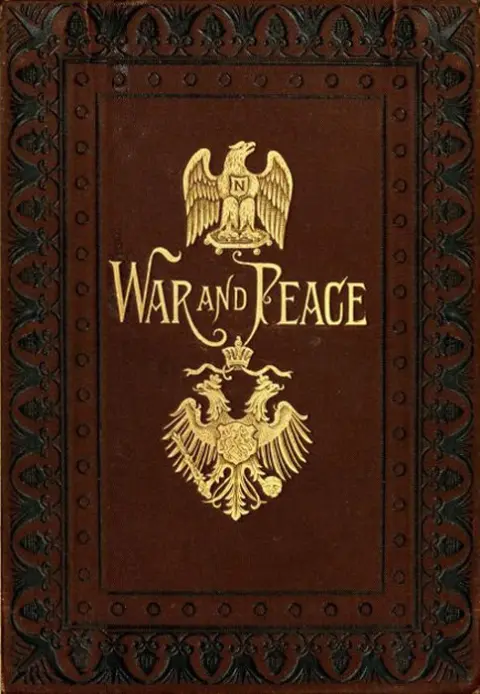
THE CLASSIC COLLECTION · 1869
"War and Peace" by graf Leo Tolstoy is a literary work published in 1869. Set during the Napoleonic Wars, it chronicles the French invasion of Russia through five interlocking narratives following different Russian aristocratic families. The work blends fictional storytelling with philosophical discussions about history, war, and power. Tolstoy himself hesitated to classify it, saying it is "not a novel, even less is it a poem, and still less a historical chronicle." It remains one of the most praised classics of world literature.
Introduction adapted from the source catalogue; source summaries may be automatically generated.
Free to read · English · 581,653 words · No account needed
MAKE TIME FOR A GOOD BOOK
On by default. Untick to stop anonymous reading totals. Each page counts after 10 seconds in view. How this works.
Anonymous counting is on unless you have switched it off.
Bonaparte, having come up at a gallop, stopped his horse.
“Which is the senior?” he asked, on seeing the prisoners.
They named the colonel, Prince Repnín.
“You are the commander of the Emperor Alexander’s regiment of Horse Guards?” asked Napoleon.
“I commanded a squadron,” replied Repnín.
“Your regiment fulfilled its duty honorably,” said Napoleon.
“The praise of a great commander is a soldier’s highest reward,”
said Repnín.
“I bestow it with pleasure,” said Napoleon. “And who is that young
man beside you?”
Prince Repnín named Lieutenant Sukhtélen.
After looking at him Napoleon smiled.
“He’s very young to come to meddle with us.”
“Youth is no hindrance to courage,” muttered Sukhtélen in a failing
voice.
“A splendid reply!” said Napoleon. “Young man, you will go far!”
Prince Andrew, who had also been brought forward before the Emperor’s eyes to complete the show of prisoners, could not fail to attract his attention. Napoleon apparently remembered seeing him on the battlefield and, addressing him, again used the epithet “young man” that was connected in his memory with Prince Andrew.
“Well, and you, young man,” said he. “How do you feel, mon
brave?”
Though five minutes before, Prince Andrew had been able to say a few words to the soldiers who were carrying him, now with his eyes fixed straight on Napoleon, he was silent.... So insignificant at that moment seemed to him all the interests that engrossed Napoleon, so mean did his hero himself with his paltry vanity and joy in victory appear, compared to the lofty, equitable, and kindly sky which he had seen and understood, that he could not answer him.
Everything seemed so futile and insignificant in comparison with the stern and solemn train of thought that weakness from loss of blood, suffering, and the nearness of death aroused in him. Looking into Napoleon’s eyes Prince Andrew thought of the insignificance of greatness, the unimportance of life which no one could understand, and the still greater unimportance of death, the meaning of which no one alive could understand or explain.
The Emperor without waiting for an answer turned away and said to one of the officers as he went: “Have these gentlemen attended to and taken to my bivouac; let my doctor, Larrey, examine their wounds. Au revoir, Prince Repnín!” and he spurred his horse and galloped away.
His face shone with self-satisfaction and pleasure.
The soldiers who had carried Prince Andrew had noticed and taken the little gold icon Princess Mary had hung round her brother’s neck, but seeing the favor the Emperor showed the prisoners, they now hastened to return the holy image.
Your reading position is saved on this browser. Take it to another device with a library code. Reading pages adapt to text, rather than matching a printed edition.
Leo, graf Tolstoy
Leo, graf Tolstoy
Leo, graf Tolstoy
Leo, graf Tolstoy
BEHIND THE BOOK
This eBook is for the use of anyone anywhere in the United States and most other parts of the world at no cost and with almost no restrictions whatsoever. You may copy it, give it away or re-use it under the terms of the Project Gutenberg License included with this eBook or online at www.gutenberg.org. If you are not located in the United States, you will have to check the laws of the country where you are located before using this eBook. Read the source licence.
The original source file, including credits and licence, is retained by this library. Request an original-format copy at no charge. Please include the book title and Project Gutenberg identifier #2600.
KEEP YOUR CURIOSITY GOING
Cécile Tormay

Moritz Busch
Coulson Kernahan
John L. Ransom

Maurice Baring
Frances Wright