The Devil
Leo, graf Tolstoy
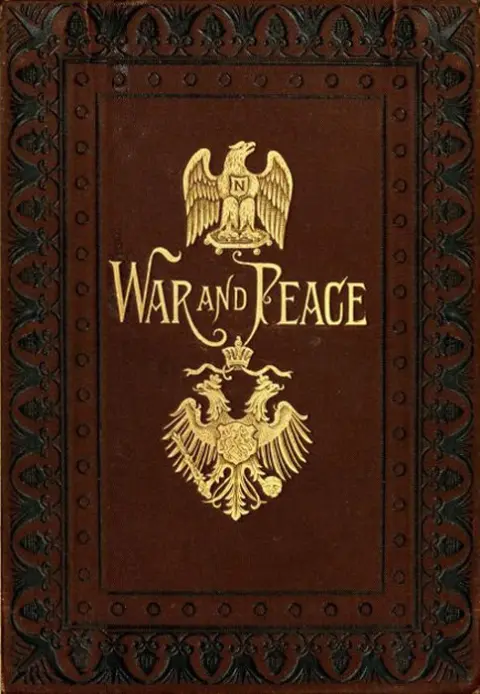
THE CLASSIC COLLECTION · 1869
"War and Peace" by graf Leo Tolstoy is a literary work published in 1869. Set during the Napoleonic Wars, it chronicles the French invasion of Russia through five interlocking narratives following different Russian aristocratic families. The work blends fictional storytelling with philosophical discussions about history, war, and power. Tolstoy himself hesitated to classify it, saying it is "not a novel, even less is it a poem, and still less a historical chronicle." It remains one of the most praised classics of world literature.
Introduction adapted from the source catalogue; source summaries may be automatically generated.
Free to read · English · 581,653 words · No account needed
MAKE TIME FOR A GOOD BOOK
On by default. Untick to stop anonymous reading totals. Each page counts after 10 seconds in view. How this works.
Anonymous counting is on unless you have switched it off.
“They say the ball will be very good,” replied the princess, drawing up her downy little lip. “All the pretty women in society will be there.”
“Not all, for you will not be there; not all,” said Prince Hippolyte smiling joyfully; and snatching the shawl from the footman, whom he even pushed aside, he began wrapping it round the princess. Either from awkwardness or intentionally (no one could have said which) after the shawl had been adjusted he kept his arm around her for a long time, as though embracing her.
Still smiling, she gracefully moved away, turning and glancing at her husband. Prince Andrew’s eyes were closed, so weary and sleepy did he seem.
“Are you ready?” he asked his wife, looking past her.
Prince Hippolyte hurriedly put on his cloak, which in the latest fashion reached to his very heels, and, stumbling in it, ran out into the porch following the princess, whom a footman was helping into the carriage.
“Princesse, au revoir,” cried he, stumbling with his tongue as well
as with his feet.
The princess, picking up her dress, was taking her seat in the dark carriage, her husband was adjusting his saber; Prince Hippolyte, under pretense of helping, was in everyone’s way.
“Allow me, sir,” said Prince Andrew in Russian in a cold, disagreeable tone to Prince Hippolyte who was blocking his path.
“I am expecting you, Pierre,” said the same voice, but gently and
affectionately.
The postilion started, the carriage wheels rattled. Prince Hippolyte laughed spasmodically as he stood in the porch waiting for the vicomte whom he had promised to take home.
“Well, mon cher,” said the vicomte, having seated himself beside Hippolyte in the carriage, “your little princess is very nice, very nice indeed, quite French,” and he kissed the tips of his fingers. Hippolyte burst out laughing.
“Do you know, you are a terrible chap for all your innocent airs,” continued the vicomte. “I pity the poor husband, that little officer who gives himself the airs of a monarch.”
Hippolyte spluttered again, and amid his laughter said, “And you were saying that the Russian ladies are not equal to the French? One has to know how to deal with them.”
Pierre reaching the house first went into Prince Andrew’s study like one quite at home, and from habit immediately lay down on the sofa, took from the shelf the first book that came to his hand (it was Caesar’s Commentaries), and resting on his elbow, began reading it in the middle.
Your reading position is saved on this browser. Take it to another device with a library code. Reading pages adapt to text, rather than matching a printed edition.
Leo, graf Tolstoy
Leo, graf Tolstoy
Leo, graf Tolstoy
Leo, graf Tolstoy
BEHIND THE BOOK
This eBook is for the use of anyone anywhere in the United States and most other parts of the world at no cost and with almost no restrictions whatsoever. You may copy it, give it away or re-use it under the terms of the Project Gutenberg License included with this eBook or online at www.gutenberg.org. If you are not located in the United States, you will have to check the laws of the country where you are located before using this eBook. Read the source licence.
The original source file, including credits and licence, is retained by this library. Request an original-format copy at no charge. Please include the book title and Project Gutenberg identifier #2600.
KEEP YOUR CURIOSITY GOING
Cécile Tormay

Moritz Busch
Coulson Kernahan
John L. Ransom

Maurice Baring
Frances Wright