The Devil
Leo, graf Tolstoy
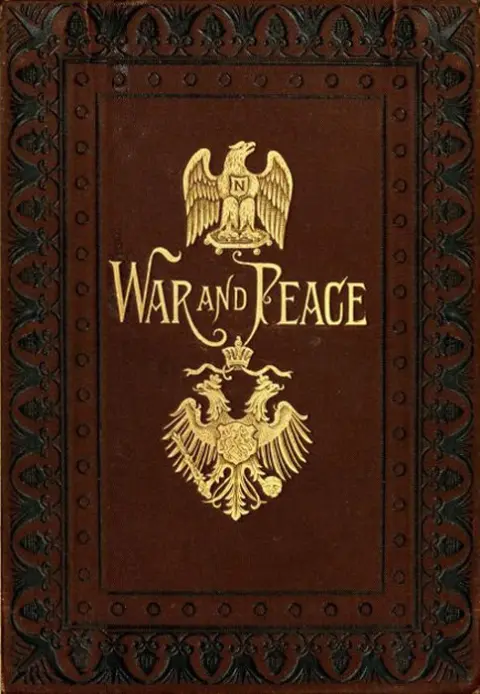
THE CLASSIC COLLECTION · 1869
"War and Peace" by graf Leo Tolstoy is a literary work published in 1869. Set during the Napoleonic Wars, it chronicles the French invasion of Russia through five interlocking narratives following different Russian aristocratic families. The work blends fictional storytelling with philosophical discussions about history, war, and power. Tolstoy himself hesitated to classify it, saying it is "not a novel, even less is it a poem, and still less a historical chronicle." It remains one of the most praised classics of world literature.
Introduction adapted from the source catalogue; source summaries may be automatically generated.
Free to read · English · 581,653 words · No account needed
MAKE TIME FOR A GOOD BOOK
On by default. Untick to stop anonymous reading totals. Each page counts after 10 seconds in view. How this works.
Anonymous counting is on unless you have switched it off.
Pierre looked intently at her.
“Yes, and nothing more,” said Natásha.
“It’s not true, not true!” cried Pierre. “I am not to blame for being alive and wishing to live—nor you either.”
Suddenly Natásha bent her head, covered her face with her hands, and
began to cry.
“What is it, Natásha?” said Princess Mary.
“Nothing, nothing.” She smiled at Pierre through her tears. “Good night! It is time for bed.”
Pierre rose and took his leave.
Princess Mary and Natásha met as usual in the bedroom. They talked of what Pierre had told them. Princess Mary did not express her opinion of Pierre nor did Natásha speak of him.
“Well, good night, Mary!” said Natásha. “Do you know, I am often afraid that by not speaking of him” (she meant Prince Andrew) “for fear of not doing justice to our feelings, we forget him.”
Princess Mary sighed deeply and thereby acknowledged the justice of Natásha’s remark, but she did not express agreement in words.
“Is it possible to forget?” said she.
“It did me so much good to tell all about it today. It was hard and painful, but good, very good!” said Natásha. “I am sure he really loved him. That is why I told him... Was it all right?” she added, suddenly blushing.
“To tell Pierre? Oh, yes. What a splendid man he is!” said Princess
Mary.
“Do you know, Mary...” Natásha suddenly said with a mischievous smile such as Princess Mary had not seen on her face for a long time, “he has somehow grown so clean, smooth, and fresh—as if he had just come out of a Russian bath; do you understand? Out of a moral bath. Isn’t it true?”
“Yes,” replied Princess Mary. “He has greatly improved.”
“With a short coat and his hair cropped; just as if, well, just as if he had come straight from the bath... Papa used to...”
“I understand why he” (Prince Andrew) “liked no one so much as him,”
said Princess Mary.
“Yes, and yet he is quite different. They say men are friends when they are quite different. That must be true. Really he is quite unlike him—in everything.”
“Yes, but he’s wonderful.”
“Well, good night,” said Natásha.
And the same mischievous smile lingered for a long time on her face as if it had been forgotten there.
Your reading position is saved on this browser. Take it to another device with a library code. Reading pages adapt to text, rather than matching a printed edition.
Leo, graf Tolstoy
Leo, graf Tolstoy
Leo, graf Tolstoy
Leo, graf Tolstoy
BEHIND THE BOOK
This eBook is for the use of anyone anywhere in the United States and most other parts of the world at no cost and with almost no restrictions whatsoever. You may copy it, give it away or re-use it under the terms of the Project Gutenberg License included with this eBook or online at www.gutenberg.org. If you are not located in the United States, you will have to check the laws of the country where you are located before using this eBook. Read the source licence.
The original source file, including credits and licence, is retained by this library. Request an original-format copy at no charge. Please include the book title and Project Gutenberg identifier #2600.
KEEP YOUR CURIOSITY GOING
Cécile Tormay

Moritz Busch
Coulson Kernahan
John L. Ransom

Maurice Baring
Frances Wright