The Devil
Leo, graf Tolstoy
THE CLASSIC COLLECTION · 1869
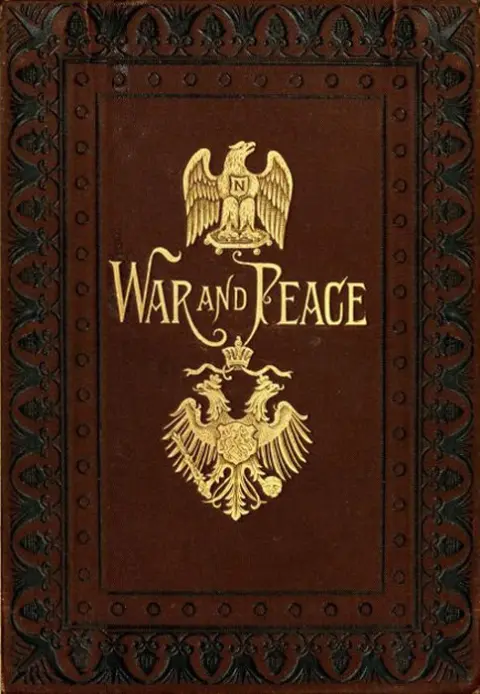
"War and Peace" by graf Leo Tolstoy is a literary work published in 1869. Set during the Napoleonic Wars, it chronicles the French invasion of Russia through five interlocking narratives following different Russian aristocratic families. The work blends fictional storytelling with philosophical discussions about history, war, and power. Tolstoy himself hesitated to classify it, saying it is "not a novel, even less is it a poem, and still less a historical chronicle." It remains one of the most praised classics of world literature.
Introduction adapted from the source catalogue; source summaries may be automatically generated.
Free to read · English · 581,653 words · No account needed
MAKE TIME FOR A GOOD BOOK
On by default. Untick to stop anonymous reading totals. Each page counts after 10 seconds in view. How this works.
Anonymous counting is on unless you have switched it off.
“You won’t bear me a grudge, Prokhór Ignátych?” said the regimental commander, overtaking the third company on its way to its quarters and riding up to Captain Timókhin who was walking in front. (The regimental commander’s face now that the inspection was happily over beamed with irrepressible delight.) “It’s in the Emperor’s service... it can’t be helped... one is sometimes a bit hasty on parade... I am the first to apologize, you know me!... He was very pleased!” And he held out his hand to the captain.
“Don’t mention it, General, as if I’d be so bold!” replied the captain, his nose growing redder as he gave a smile which showed where two front teeth were missing that had been knocked out by the butt end of a gun at Ismail.
“And tell Mr. Dólokhov that I won’t forget him—he may be quite easy. And tell me, please—I’ve been meaning to ask—how is he behaving himself, and in general...”
“As far as the service goes he is quite punctilious, your excellency; but his character...” said Timókhin.
“And what about his character?” asked the regimental commander.
“It’s different on different days,” answered the captain. “One day he is sensible, well educated, and good-natured, and the next he’s a wild beast.... In Poland, if you please, he nearly killed a Jew.”
“Oh, well, well!” remarked the regimental commander. “Still, one must have pity on a young man in misfortune. You know he has important connections... Well, then, you just...”
“I will, your excellency,” said Timókhin, showing by his smile that he understood his commander’s wish.
“Well, of course, of course!”
The regimental commander sought out Dólokhov in the ranks and, reining in his horse, said to him:
“After the next affair... epaulettes.”
Dólokhov looked round but did not say anything, nor did the mocking
smile on his lips change.
“Well, that’s all right,” continued the regimental commander. “A cup of vodka for the men from me,” he added so that the soldiers could hear. “I thank you all! God be praised!” and he rode past that company and overtook the next one.
“Well, he’s really a good fellow, one can serve under him,” said Timókhin to the subaltern beside him.
“In a word, a hearty one...” said the subaltern, laughing (the regimental commander was nicknamed King of Hearts).
The cheerful mood of their officers after the inspection infected the soldiers. The company marched on gaily. The soldiers’ voices could be heard on every side.
“And they said Kutúzov was blind of one eye?”
Your reading position is saved on this browser. Take it to another device with a library code. Reading pages adapt to text, rather than matching a printed edition.
Leo, graf Tolstoy
Leo, graf Tolstoy
Leo, graf Tolstoy
Leo, graf Tolstoy
BEHIND THE BOOK
This eBook is for the use of anyone anywhere in the United States and most other parts of the world at no cost and with almost no restrictions whatsoever. You may copy it, give it away or re-use it under the terms of the Project Gutenberg License included with this eBook or online at www.gutenberg.org. If you are not located in the United States, you will have to check the laws of the country where you are located before using this eBook. Read the source licence.
The original source file, including credits and licence, is retained by this library. Request an original-format copy at no charge. Please include the book title and Project Gutenberg identifier #2600.
KEEP YOUR CURIOSITY GOING
Cécile Tormay

Moritz Busch
Coulson Kernahan
John L. Ransom

Maurice Baring
Frances Wright