
Highways and Byways in the Border Illustrated
Andrew Lang & John Lang
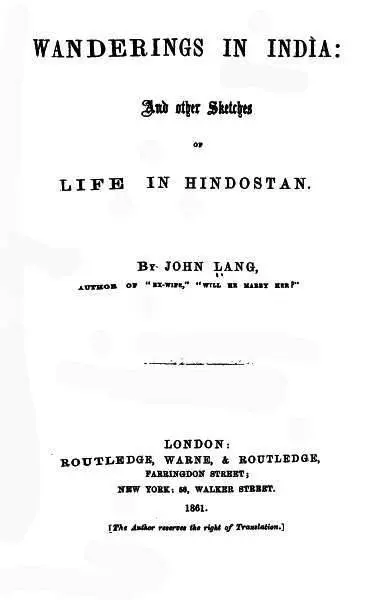
THE CLASSIC COLLECTION · 1861
"Wanderings in India, and Other Sketches of Life in Hindostan" by John Lang is a collection of observational essays written in the mid-19th century. The work provides a vivid portrayal of life in India during British colonial rule, with particular emphasis on the social dynamics in the hill station of Mussoorie, highlighting the interactions among British expatriates, their families, and the challenges they face in this exotic locale. The opening of the book introduces readers to the Himalaya Club, a retreat for British officials and their families looking to escape the oppressive heat of the Indian plains. It sets a leisurely tone as the narrator describes the club's social scene filled with idlers, intricate relationships, and casual gossip, emphasizing the vibrancy of life in the hills. Through the eyes of the narrator, we meet several characters, including grass widows and military officers engaging in various social activities, from breakfasts to morning rides, all while wrestling with personal issues and pressing societal expectations. The beginning sketches an intimate slice of colonial life, blending humor and keen social commentary that captures the complexities of 19th-century Anglo-Indian society.
Introduction adapted from the source catalogue; source summaries may be automatically generated.
Free to read · English · 101,170 words · No account needed
MAKE TIME FOR A GOOD BOOK
On by default. Untick to stop anonymous reading totals. Each page counts after 10 seconds in view. How this works.
Anonymous counting is on unless you have switched it off.
I would treat culprits like Tantia Topee, Nena Sahib, Bahadoor Khan, the Nawab of Bandah, &c., much in the same way as the convicts of Norfolk Island were treated in former days--make death the first favour for which they should crave, and the last which should be granted unto them; but with this difference, that if they murdered each other, the hope of ending their days for the deed should be a vain one. To hang such men is to frustrate the end and real object of all punishment, which is to deter others from the commission of the same offence. When such men are exterminated they are speedily forgotten, and their end is not regarded as an example for the prevention of evil; but so long as they are living, and suffering what to them is far worse than death, the case is otherwise. Be it known, however, that I am not an advocate for the abolition of capital punishment in this country for the crime of murder. The gallows, judiciously used, is, in my humble judgment, a very wholesome terror.
Transcriber's Notes
Obvious errors of punctuation and diacritics repaired.
The following alternate spellings have not been changed: "sanitarium" / "sanatarium", "Hindostan(ee)" / "Hindoostan(ee)".
Variants of "Goorkha" were changed to that spelling (pp. 21, 311, 409).
Hyphen removed: Deyrah Dhoon (p. 26), mantelpiece (p. 106).
Hyphen added: band-stand (p. 256), head-quarters (p. 313), mem-Sahib
(p. 116), mid-day (p. 127).
The following phrases are spelled both with and without hyphens and have not been changed: "a-year", "a-month", "a-day".
P. 11: "hand" changed to "hard" (becomes a hard gallop).
P. 28: added "a" (became eventually a marker at a billiard-room).
P. 72: "way" changed to "was" (he was playing one morning).
P. 82: "Duleep Singh" changed to "Dulleep Singh".
P. 83: "contures" changed to "conjectures" (There were many
conjectures).
P. 107: "the" added (dinner was on the table).
P. 123: added "a" (two thousand a year).
P. 140: "far" changed to "for" (for the trial of offenders).
P. 165: duplicated "not" removed (who not only deposited with him the
child).
P. 179: "Mogul Emperors" changed to "Moghul Emperors".
P. 230: "followship" changed to "fellowship" (the scene of
good-fellowship and good-feeling).
P. 234: "af" changed to "of" (military men of all grades).
P. 288: "hunded" changed to "hundred" (one hundred and fifty men).
P. 300: "develope" changed to "develop" (develop the resources of
India).
P. 335: "sirbar" changed to "sirdar" (our host of the sirdar-bearer).
P. 336: "he" changed to "be" (he might be put into his vehicle).
P. 362: "chesnut" changed to "chestnut" (His chestnut wig).
P. 362: "died" changed to "dyed" (his whiskers were dyed so adroitly).
P. 412: "and" added (English gentlemen and ladies, and was personally).
Your reading position is saved on this browser. Take it to another device with a library code. Reading pages adapt to text, rather than matching a printed edition.
Andrew Lang & John Lang
John Lang & Jean Lang
BEHIND THE BOOK
This eBook is for the use of anyone anywhere in the United States and most other parts of the world at no cost and with almost no restrictions whatsoever. You may copy it, give it away or re-use it under the terms of the Project Gutenberg License included with this eBook or online at www.gutenberg.org. If you are not located in the United States, you will have to check the laws of the country where you are located before using this eBook. Read the source licence.
The original source file, including credits and licence, is retained by this library. Request an original-format copy at no charge. Please include the book title and Project Gutenberg identifier #43997.
KEEP YOUR CURIOSITY GOING
Wilfrid Scawen Blunt
Wilfrid Scawen Blunt

E. W. (Edgar Watson) Howe

David Patterson (Spirit) Hatch

David Patterson (Spirit) Hatch

David Patterson (Spirit) Hatch