
Highways and Byways in the Border Illustrated
Andrew Lang & John Lang
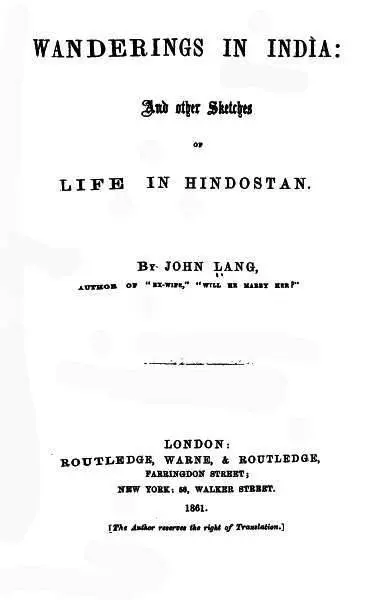
THE CLASSIC COLLECTION · 1861
"Wanderings in India, and Other Sketches of Life in Hindostan" by John Lang is a collection of observational essays written in the mid-19th century. The work provides a vivid portrayal of life in India during British colonial rule, with particular emphasis on the social dynamics in the hill station of Mussoorie, highlighting the interactions among British expatriates, their families, and the challenges they face in this exotic locale. The opening of the book introduces readers to the Himalaya Club, a retreat for British officials and their families looking to escape the oppressive heat of the Indian plains. It sets a leisurely tone as the narrator describes the club's social scene filled with idlers, intricate relationships, and casual gossip, emphasizing the vibrancy of life in the hills. Through the eyes of the narrator, we meet several characters, including grass widows and military officers engaging in various social activities, from breakfasts to morning rides, all while wrestling with personal issues and pressing societal expectations. The beginning sketches an intimate slice of colonial life, blending humor and keen social commentary that captures the complexities of 19th-century Anglo-Indian society.
Introduction adapted from the source catalogue; source summaries may be automatically generated.
Free to read · English · 101,170 words · No account needed
MAKE TIME FOR A GOOD BOOK
On by default. Untick to stop anonymous reading totals. Each page counts after 10 seconds in view. How this works.
Anonymous counting is on unless you have switched it off.
When the Court resumed its sitting, I observed that some of the members of the Court became drowsy, and dropped off to sleep, opening one eye occasionally, for a second or two; others became fidgety, impetuous, and argumentative. The President inquired if the members of the Court would like to ask the witness any questions. Several responded in the affirmative, and began to write their questions on slips of paper. Blade, however, was the first to throw his slip across the table to the Deputy-Judge-Advocate-General, who, having read it, handed it across to the President, who showed it to the officers on either side of him, who nodded assent. The question was then handed back to the Deputy-Judge-Advocate-General, who proceeded to read it aloud.
"You have stated that the prisoners were under the influence of wine, but that they were not drunk. What do you mean?"
"I mean," said the Senior Captain, "that they--"
"Not so quick, please," said the Deputy-Judge-Advocate-General. "You mean that?--Yes--I am quite ready."
"I mean," said the witness, "that though they had both been partaking freely of wine, they were not--"
"Freely of wine--don't be in a hurry," said the Deputy-Judge-Advocate-General, repeating each word that he took down.
"Mind, he says 'Freely,'" said Blade. "'Freely of wine.' The word
'freely' is important--very important. Have you got down the word
freely?"
"Yes," said the Deputy-Judge-Advocate-General, having put down his pen to ascertain the fact, and make it known to his interrogator.
"Very well," said Blade. "Then put the rest of the answer down, at your earliest convenience. I am in no particular hurry."
"Well?" said the Deputy-Judge-Advocate-General to the witness--"they
were not--not what?"
"Not drunk," said the witness.
"There is nothing about drunkenness in the charges," said the President; "where are the charges?"
"Here, sir," said the Deputy-Judge-Advocate-General. "But, please let me write down your remark before we go any further."
"What remark?" inquired the President.
"That there is nothing about drunkenness in the charges. According to the last general order by his Excellency the Commander-in-Chief, on the last court martial held in this station, everything that transpires should be recorded." And the Deputy-Judge-Advocate-General then resumed his writing in the slowest and most provoking manner imaginable. Several of the audience walked out of the Court, and went into the room where the refreshments were. I followed them. We remained absent for more than ten minutes; but, when we came back, the Deputy-Judge-Advocate-General had not yet written up to the desired point, previous to going on with Blade's question. This at length accomplished, he looked at the President and said, "Yes, sir?"
Your reading position is saved on this browser. Take it to another device with a library code. Reading pages adapt to text, rather than matching a printed edition.
Andrew Lang & John Lang
John Lang & Jean Lang
BEHIND THE BOOK
This eBook is for the use of anyone anywhere in the United States and most other parts of the world at no cost and with almost no restrictions whatsoever. You may copy it, give it away or re-use it under the terms of the Project Gutenberg License included with this eBook or online at www.gutenberg.org. If you are not located in the United States, you will have to check the laws of the country where you are located before using this eBook. Read the source licence.
The original source file, including credits and licence, is retained by this library. Request an original-format copy at no charge. Please include the book title and Project Gutenberg identifier #43997.
KEEP YOUR CURIOSITY GOING
Wilfrid Scawen Blunt
Wilfrid Scawen Blunt

E. W. (Edgar Watson) Howe

David Patterson (Spirit) Hatch

David Patterson (Spirit) Hatch

David Patterson (Spirit) Hatch