
Highways and Byways in the Border Illustrated
Andrew Lang & John Lang
THE CLASSIC COLLECTION · 1861
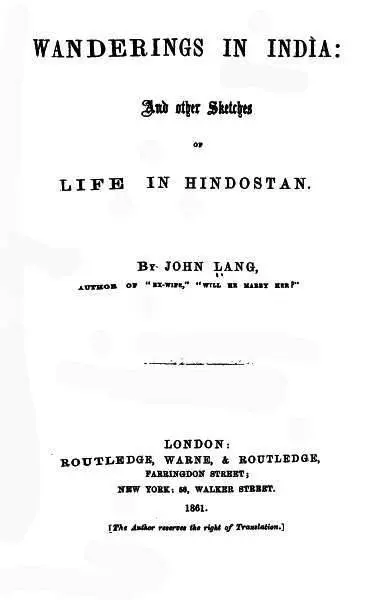
"Wanderings in India, and Other Sketches of Life in Hindostan" by John Lang is a collection of observational essays written in the mid-19th century. The work provides a vivid portrayal of life in India during British colonial rule, with particular emphasis on the social dynamics in the hill station of Mussoorie, highlighting the interactions among British expatriates, their families, and the challenges they face in this exotic locale. The opening of the book introduces readers to the Himalaya Club, a retreat for British officials and their families looking to escape the oppressive heat of the Indian plains. It sets a leisurely tone as the narrator describes the club's social scene filled with idlers, intricate relationships, and casual gossip, emphasizing the vibrancy of life in the hills. Through the eyes of the narrator, we meet several characters, including grass widows and military officers engaging in various social activities, from breakfasts to morning rides, all while wrestling with personal issues and pressing societal expectations. The beginning sketches an intimate slice of colonial life, blending humor and keen social commentary that captures the complexities of 19th-century Anglo-Indian society.
Introduction adapted from the source catalogue; source summaries may be automatically generated.
Free to read · English · 101,170 words · No account needed
MAKE TIME FOR A GOOD BOOK
On by default. Untick to stop anonymous reading totals. Each page counts after 10 seconds in view. How this works.
Anonymous counting is on unless you have switched it off.
"Then just spill some into this glass. Ours is not good, certainly, but it would not do to say so before the Colonel. Ah!" sighed the lieutenant, after taking a draught: "that is excellent! Yes. Drink is the topic on which I intend to walk into you, practically. And be very careful how you answer, or you will have the Commander-in-Chief down upon you with five-and-twenty notes of admiration at the end of every sentence of his general order; thirty-five notes of interrogation in the same; and every other word in italics, or capitals, in order to impress the matter of his decision firmly on our minds. 'Was the Court raving mad? Witness ought to be tried!!! folly! imbecility! childishness! The veriest schoolboy ought to know better! Deputy-Judge-Advocate ignorant of his duty!!! The President insane!!!! Confirmed, but not approved!!!"
"What are you making such a noise about, Blade?" inquired the Colonel of his regiment, good-naturedly.
"Nothing, Colonel," said Blade. "No noise. But here is a man who has the audacity, in our own mess-house, to asperse the character of our Madeira." And, taking up the Senior Captain's own bottle, and holding it before the Senior Captain's face, he exclaimed,--looking at the Colonel, "He positively refuses to taste it, even."
"Nonsense," said the cavalry Colonel, approaching them with a serious air, and with an empty glass in his hand. "Nonsense! Do you really mean to say that our Madeira is not good--excellent?"
"No, Colonel," said the Senior Captain of the Royal Infantry regiment.
"Taste it, and say what you think of it, Colonel," said Blade, filling the Colonel's glass, which was held up to receive the liquid, with a willingness which imparted some mirth to the beholders. "Taste it. There."
"I have tasted it," said the Colonel, "and pronounce it to be the best I ever drank in my life, and, in my judgment, infinitely superior to that of any other mess."
"So I say," said Blade, filling his glass; "but the misfortune is, he
won't believe me."
"Order a fresh bottle of our wine for him, Blade," said the Colonel, "and let him taste the top of it."
"No, thank you, Colonel," said the Senior Captain; "I would rather not. Remember, I have to conclude my examination."
"Ah, so you have," said the Colonel, moving away. "But take my word for it, that better Madeira than ours was never grown or bottled."
Your reading position is saved on this browser. Take it to another device with a library code. Reading pages adapt to text, rather than matching a printed edition.
Andrew Lang & John Lang
John Lang & Jean Lang
BEHIND THE BOOK
This eBook is for the use of anyone anywhere in the United States and most other parts of the world at no cost and with almost no restrictions whatsoever. You may copy it, give it away or re-use it under the terms of the Project Gutenberg License included with this eBook or online at www.gutenberg.org. If you are not located in the United States, you will have to check the laws of the country where you are located before using this eBook. Read the source licence.
The original source file, including credits and licence, is retained by this library. Request an original-format copy at no charge. Please include the book title and Project Gutenberg identifier #43997.
KEEP YOUR CURIOSITY GOING
Wilfrid Scawen Blunt
Wilfrid Scawen Blunt

E. W. (Edgar Watson) Howe

David Patterson (Spirit) Hatch

David Patterson (Spirit) Hatch

David Patterson (Spirit) Hatch