
The Writing of News A Handbook with Chapters on Newspaper Correspondence and Copy Reading
Charles G. (Charles Griffith) Ross
THE CLASSIC COLLECTION · 1899
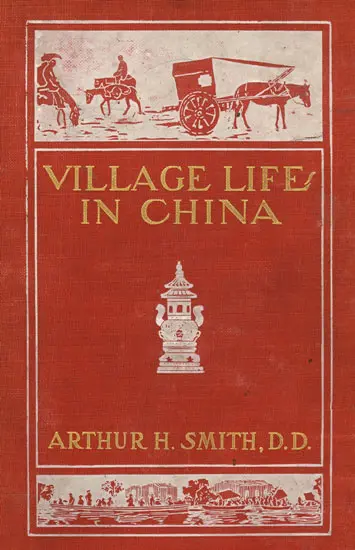
"Village Life in China: A Study in Sociology" by Arthur H. Smith is a sociological examination written in the late 19th century. This work dives into the intricacies of Chinese village life, exploring topics like family structures, social institutions, and cultural practices, aiming to foster a deeper understanding of the Chinese people and their way of life. Smith presents the Chinese village as a microcosm of the broader Chinese society, emphasizing both its unique characteristics and the impact of foreign influences. The opening of the book provides a foreword that reveals the author's extensive experience in China, highlighting his respect and admiration for Chinese culture and the challenges faced by its people. Smith sets the stage for the discussion by raising questions about the daily lives and thoughts of the vast rural population, contrasting it with the common misconceptions of China. He acknowledges the complexity and variety of village life while suggesting that a detailed survey of one village can yield significant insights into the entire country, preparing the reader for a thorough exploration of Chinese villages, their institutions, and the fabric of familial and communal life.
Introduction adapted from the source catalogue; source summaries may be automatically generated.
Free to read · English · 123,085 words · No account needed
MAKE TIME FOR A GOOD BOOK
On by default. Untick to stop anonymous reading totals. Each page counts after 10 seconds in view. How this works.
Anonymous counting is on unless you have switched it off.
Weddings:
a "joyful event," 179;
wedding contributions, 179;
bride's arrival the essence of the wedding, 180;
exposition of the "share" principle, 180;
account-keeping at weddings, 181;
duties of the wedding committee, 182;
city and village caterers, 182, 183;
three "wedding committees," 183;
"borrowing" provisions, 184;
opium smoking stewards, 184;
poor relatives at weddings, 185;
"drawing friends," 191;
pranks at, 251.
Week, unique survival of the, 192.
Wells, manner of digging, 44, 45;
driven wells, 45;
occasions of feuds, 45;
unpopular people forbidden to use, 45;
Western ideas needed for Chinese well-diggers, 46;
how a force pump was refused by a village, 46-48.
Western Learning Edict, 134, 135.
Wife of Tao-t'ai envying a dog, 262, note.
Woman (See Girls and women).
Women have no name, 241;
terms used, 241.
Writing Chinese very difficult, 87, 88.
Yellow River, "China's Sorrow," 172, 173.
Footnotes:
[1] A consideration of the important crisis through which the Chinese Empire is passing at the close of the century, does not fall within the scope of a work like the present. All who are interested in that subject should not omit to read attentively Mr. Colquhoun's "China in Transformation," London and New York, 1898, embodying the matured convictions of an accomplished traveller, and an experienced Oriental administrator, with an exceptional first-hand acquaintance with China.
[2] A Chinese woman for many years employed in the writer's family, remarked that for a long time after she was married she was never allowed to leave the narrow courtyard in her hamlet. The wife of a Tao-t'ai told a foreign lady that in her next existence she hoped to be born a dog, that she might go where she chose!
[3] We have known occasional instances in which a betrothed girl was not required to attend the funeral of her future father-in-law or mother-in-law, a trying ordeal which she must be glad to escape. Sometimes when she does attend, she merely kneels to the coffin, but does not "lament," for usage is in this, as in other particulars, very capricious.
[4] A Chinese woman whose parents are living, is constantly referred to not only as a "girl," but as an unmarried girl (ku-niang), although she may be herself the mother of half-a-dozen children.
[5] See a small pamphlet on "The Status of Woman in China," by Dr. Ernst Faber, Shanghai, 1889, containing many illustrative classical citations.
[6] For ample illustration of this subject see Dr. Ernst Faber's "The Famous Women of China," Shanghai, 1890, and "Typical Women of China," by the late Miss A. C. Safford, an abridged translation of a famous and authoritative Chinese work.
Your reading position is saved on this browser. Take it to another device with a library code. Reading pages adapt to text, rather than matching a printed edition.
BEHIND THE BOOK
This eBook is for the use of anyone anywhere in the United States and most other parts of the world at no cost and with almost no restrictions whatsoever. You may copy it, give it away or re-use it under the terms of the Project Gutenberg License included with this eBook or online at www.gutenberg.org. If you are not located in the United States, you will have to check the laws of the country where you are located before using this eBook. Read the source licence.
The original source file, including credits and licence, is retained by this library. Request an original-format copy at no charge. Please include the book title and Project Gutenberg identifier #33485.
KEEP YOUR CURIOSITY GOING
Charles G. (Charles Griffith) Ross
Hannah Webster Foster

Emily Lawless
Edwin Hamlin Carr

Charles De Lano Hine
Andrew Ure