THE CLASSIC COLLECTION✦An outlaw’s diary: the CommuneCLASSIC FREE BOOKS
An outlaw’s diary: the Commune
Cécile Tormay
THE CLASSIC COLLECTION · 1890
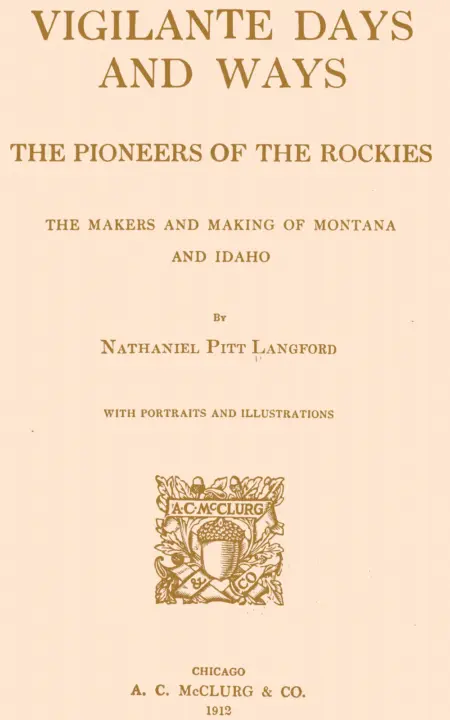
"Vigilante Days and Ways" by Nathaniel Pitt Langford is a historical account written in the late 19th century that explores lawlessness and the rise of vigilante justice during the early settlement of Montana and Idaho. The narrative delves into the tumultuous lives in mining camps fraught with crime, as individuals band together to establish order in a society plagued by violence and corruption. The opening chapters introduce key characters such as the notorious gambler Henry Plummer, leading the criminal underworld, and Patrick Ford, a figure who advocates for law and order amidst the chaos. At the start of the narrative, Langford provides a vivid picture of the mining town of Lewiston, highlighting its rapid growth and the moral degradation that followed the gold rush. The community is depicted as being in constant threat from bandits, with Plummer forming a gang that ravages the area. As crime escalates, the citizens, desperate for safety, consider taking justice into their own hands, culminating in the formation of a Vigilance Committee after a series of violent robberies. This establishes the groundwork for a dramatic conflict between the lawless elements and those striving for justice, setting the stage for the tensions and moral ambiguities that will unfold throughout the rest of the book.
Introduction adapted from the source catalogue; source summaries may be automatically generated.
Free to read · English · 164,131 words · No account needed
MAKE TIME FOR A GOOD BOOK
On by default. Untick to stop anonymous reading totals. Each page counts after 10 seconds in view. How this works.
Anonymous counting is on unless you have switched it off.
The leader now said to him, “John, you can never do it, for you knew of a man lying dead here, close to your home, for nine days, and never reported his murder. You deserve hanging for that alone. Why didn’t you come and tell the people of Virginia City?”
“I was afraid,” said John. “It would have been as much as my life was worth to have done it. I dared not.”
“Afraid? Of whom?” inquired the leader.
“I was afraid of the men around here,” he answered.
“What men? Who are they?” persisted the leader.
“I dare not tell who they are,” said John, in a frightened tone: “there’s one of them around here.”
“But you must tell, if you would save yourself. Where is the one you
speak of?”
“There’s one at the wakiup,—the one that killed Nick Tiebalt.”
“Who is he? What’s his name?”
“George Ives,” said John, after a moment’s hesitation.
“Is he down at the wakiup?”
“Yes. I left him there when I came out.”
“Men,” said the leader, addressing them, “stay here and keep watch over John, while I go down and arrest Ives.”
Selecting from the number at the wakiup a person answering the description of Ives, he asked his name, which was very promptly given.
“I want you,” said the leader.
“What do you want me for?” inquired Ives.
“To go to Virginia City,” rejoined the leader.
“All right,” said Ives: “I expect I’ll have to go.” He was immediately taken in charge by the guard.
“Old Tex” was standing near by at the time, and the leader turning to
him, said,
“I believe we shall want you, too.” The ruffian made an impudent reply, to which the leader simply rejoined,
“You must consider yourself under arrest,”—words whose fearful import he understood too well to disobey.
The other men now emerged from their blankets. They were Alex Carter, Bob Zachary, Whiskey Bill, and Johnny Cooper, and two inoffensive persons who had fallen in with them the evening before, and craved permission to pass the night under their protection. Fortunately, these confiding persons had no money, and escaped assassination; but when told of the character of their entertainers, one of them, pointing to Carter, remarked,
“There’s one good man, anyhow. I knew him on the other side of the mountains, where he was a packer, and there was no better man on the Pacific slope.”
Just at this moment, the leader saw some movement which indicated to him that a rescue of the three prisoners would be attempted by their comrades, and in a loud tone of command, said,
Your reading position is saved on this browser. Take it to another device with a library code. Reading pages adapt to text, rather than matching a printed edition.
BEHIND THE BOOK
This eBook is for the use of anyone anywhere in the United States and most other parts of the world at no cost and with almost no restrictions whatsoever. You may copy it, give it away or re-use it under the terms of the Project Gutenberg License included with this eBook or online at www.gutenberg.org. If you are not located in the United States, you will have to check the laws of the country where you are located before using this eBook. Read the source licence.
The original source file, including credits and licence, is retained by this library. Request an original-format copy at no charge. Please include the book title and Project Gutenberg identifier #64135.
KEEP YOUR CURIOSITY GOING
Cécile Tormay

Moritz Busch
John L. Ransom
Frances Wright
Cécile Tormay

Mabel Potter Daggett