THE CLASSIC COLLECTION✦An outlaw’s diary: the CommuneCLASSIC FREE BOOKS
An outlaw’s diary: the Commune
Cécile Tormay
THE CLASSIC COLLECTION · 1890
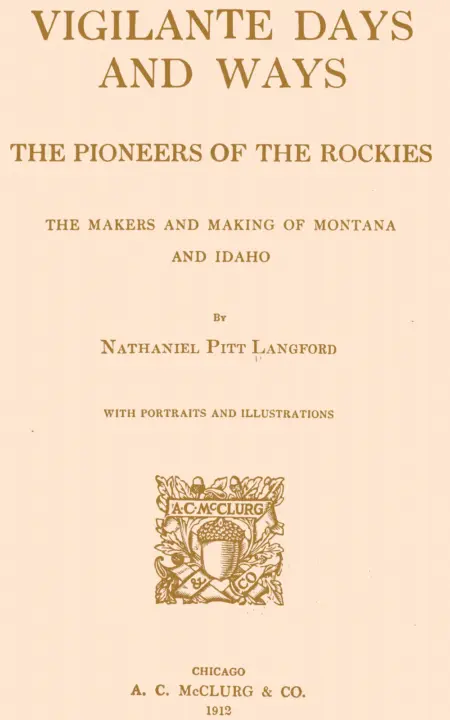
"Vigilante Days and Ways" by Nathaniel Pitt Langford is a historical account written in the late 19th century that explores lawlessness and the rise of vigilante justice during the early settlement of Montana and Idaho. The narrative delves into the tumultuous lives in mining camps fraught with crime, as individuals band together to establish order in a society plagued by violence and corruption. The opening chapters introduce key characters such as the notorious gambler Henry Plummer, leading the criminal underworld, and Patrick Ford, a figure who advocates for law and order amidst the chaos. At the start of the narrative, Langford provides a vivid picture of the mining town of Lewiston, highlighting its rapid growth and the moral degradation that followed the gold rush. The community is depicted as being in constant threat from bandits, with Plummer forming a gang that ravages the area. As crime escalates, the citizens, desperate for safety, consider taking justice into their own hands, culminating in the formation of a Vigilance Committee after a series of violent robberies. This establishes the groundwork for a dramatic conflict between the lawless elements and those striving for justice, setting the stage for the tensions and moral ambiguities that will unfold throughout the rest of the book.
Introduction adapted from the source catalogue; source summaries may be automatically generated.
Free to read · English · 164,131 words · No account needed
MAKE TIME FOR A GOOD BOOK
On by default. Untick to stop anonymous reading totals. Each page counts after 10 seconds in view. How this works.
Anonymous counting is on unless you have switched it off.
Long John was taken in charge by the company, and as soon as it was light enough to enable them to see distinctly, the leader, with four men, escorted him to the spot where Tiebalt was found. The remainder of the company kept guard over the men found sleeping near the wakiup. When they arrived upon the ground, the leader said to him,
“Long John, we have arrested you for the murder of Nicholas Tiebalt. We believe you to be guilty, and have brought you up here to the spot where his body was found to hear what you have to say.”
Palmer, who was one of the company, then proceeded to explain all the circumstances connected with the discovery, the position of the body, and the conversation he held with Long John when he applied to him for assistance.
“Boys,” said John, in a serious tone, “I did not do it. As God shall judge me, I did not.”
One man, more excited than the rest, now began handling his pistol,
saying to John, meanwhile,
“Long John, you had better prepare for another world.” What more he might have said, or what done, it is easy to conceive, had he not been interrupted by the leader, who, stepping forward, remarked,
“This won’t do. If there is anything to be done, let us all be
together.”
Long John was then taken aside by three of the company, who sat down in the faint morning light to examine him. Just as they were seated, they saw through the haze at no great distance, “Black Bess,” the mule which Tiebalt rode from Nevada when he started for Dempsey’s. She seemed to be there at this opportune moment as a dumb witness to the assassination of her master. Pointing to the animal, one of the men inquired,
“John, whose mule is that?”
“That’s the mule that Tiebalt rode down here,” he answered.
“John,” was the reply, “you know whose mule that is. Things look dark for you. You had better be thinking of your condition now.”
“I am innocent,” murmured John.
The mule was caught and led up to him. “Where are the other two mules?” was the next inquiry.
“I do not know,” he replied.
“John,” said his interrogator, “you had better be looking forward to another world. You are ‘played out’ in this one, sure.”
“I did not commit that crime,” was his reply, “and if you’ll give me a chance, I’ll clear myself.”
Your reading position is saved on this browser. Take it to another device with a library code. Reading pages adapt to text, rather than matching a printed edition.
BEHIND THE BOOK
This eBook is for the use of anyone anywhere in the United States and most other parts of the world at no cost and with almost no restrictions whatsoever. You may copy it, give it away or re-use it under the terms of the Project Gutenberg License included with this eBook or online at www.gutenberg.org. If you are not located in the United States, you will have to check the laws of the country where you are located before using this eBook. Read the source licence.
The original source file, including credits and licence, is retained by this library. Request an original-format copy at no charge. Please include the book title and Project Gutenberg identifier #64135.
KEEP YOUR CURIOSITY GOING
Cécile Tormay

Moritz Busch
John L. Ransom
Frances Wright
Cécile Tormay

Mabel Potter Daggett