THE CLASSIC COLLECTION✦An outlaw’s diary: the CommuneCLASSIC FREE BOOKS
An outlaw’s diary: the Commune
Cécile Tormay
THE CLASSIC COLLECTION · 1890
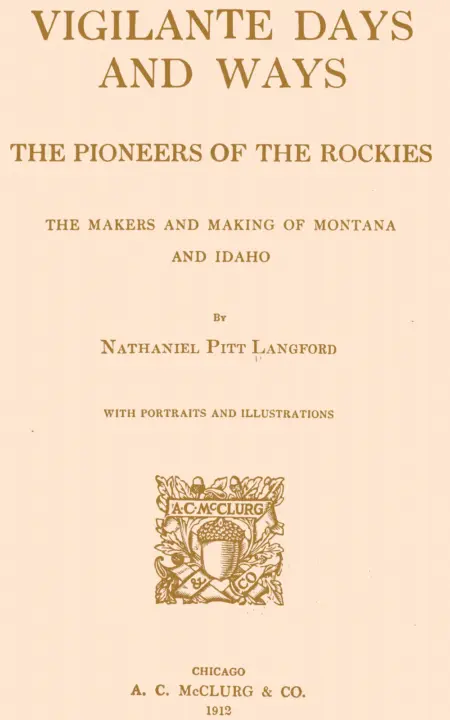
"Vigilante Days and Ways" by Nathaniel Pitt Langford is a historical account written in the late 19th century that explores lawlessness and the rise of vigilante justice during the early settlement of Montana and Idaho. The narrative delves into the tumultuous lives in mining camps fraught with crime, as individuals band together to establish order in a society plagued by violence and corruption. The opening chapters introduce key characters such as the notorious gambler Henry Plummer, leading the criminal underworld, and Patrick Ford, a figure who advocates for law and order amidst the chaos. At the start of the narrative, Langford provides a vivid picture of the mining town of Lewiston, highlighting its rapid growth and the moral degradation that followed the gold rush. The community is depicted as being in constant threat from bandits, with Plummer forming a gang that ravages the area. As crime escalates, the citizens, desperate for safety, consider taking justice into their own hands, culminating in the formation of a Vigilance Committee after a series of violent robberies. This establishes the groundwork for a dramatic conflict between the lawless elements and those striving for justice, setting the stage for the tensions and moral ambiguities that will unfold throughout the rest of the book.
Introduction adapted from the source catalogue; source summaries may be automatically generated.
Free to read · English · 164,131 words · No account needed
MAKE TIME FOR A GOOD BOOK
On by default. Untick to stop anonymous reading totals. Each page counts after 10 seconds in view. How this works.
Anonymous counting is on unless you have switched it off.
Southmayd still continued looking at the robbers as the coach departed, which Ives observing, the villain raised his gun, and yelled,
“If you don’t turn around and mind your business, I’ll shoot the top of
your head off.”
The three robbers then stood together, watching the coach until it was
lost to their view.
“By George!” said Leroy, laughing, “I looked down into those gun-barrels so long that I thought I fairly saw the buckshot leap from their imprisonment. It would have afforded me pleasure to squander the bullets in my pistol on the scoundrel.”
Southmayd lost four hundred dollars in gold, and Captain Moore one hundred dollars in treasury notes. As was usual, quite a large number of people were awaiting the arrival of the coach, when it drove up to the express-office at Bannack. Inquiries were immediately made as to the cause of its detention so much later than common.
“Was the coach robbed to-day?” inquired Plummer of Southmayd, as he
jumped from the box.
“It was,” replied Leroy, taking him by the arm, and by his confidential manner signifying that he was about to impart to him, as sheriff, all he knew about it. Just at this moment, Dr. Bissell, the miners’ judge at Virginia City, gave Southmayd a slight nudge, and catching his eye, winked significantly for him to step aside.
“Be careful, Leroy,—very careful what you say to that man.”
Leroy gave an appreciative nod, and rejoined Plummer.
“So you have been robbed,” said the latter. “I’m not surprised,—and I think I can tell you who were the robbers.”
“Who were they?” eagerly asked Southmayd.
“George Ives was one of them,” said Plummer.
“Yes,” responded Southmayd, “and the others were ‘Whiskey Bill’ and Bob Zachary; and I’ll live to see them hanged before three weeks.”
Southmayd did not know that Plummer’s accusation was made for the purpose of detecting his knowledge of the robbers. Bissell, who had overheard Southmayd’s revelation to Plummer, said to him soon after,
“Leroy, your life isn’t worth a cent.”
George Crisman, who was standing by, added,
“They’ll kill you sure.”
Business detained Southmayd in Bannack the succeeding three days. During that time he never met Plummer, who left him immediately after they held the conversation above narrated.
Two days afterwards, while on his way to Virginia City, Caldwell, the driver, met with “Whiskey Bill” at the Cold Spring ranche.
“Did you hear of the robbery, Bill, on my trip out?” he inquired.
“Sure, I did, Tom,” replied Bill. “Do you know any of the fellows who
committed it?”
Your reading position is saved on this browser. Take it to another device with a library code. Reading pages adapt to text, rather than matching a printed edition.
BEHIND THE BOOK
This eBook is for the use of anyone anywhere in the United States and most other parts of the world at no cost and with almost no restrictions whatsoever. You may copy it, give it away or re-use it under the terms of the Project Gutenberg License included with this eBook or online at www.gutenberg.org. If you are not located in the United States, you will have to check the laws of the country where you are located before using this eBook. Read the source licence.
The original source file, including credits and licence, is retained by this library. Request an original-format copy at no charge. Please include the book title and Project Gutenberg identifier #64135.
KEEP YOUR CURIOSITY GOING
Cécile Tormay

Moritz Busch
John L. Ransom
Frances Wright
Cécile Tormay

Mabel Potter Daggett