THE CLASSIC COLLECTION✦An outlaw’s diary: the CommuneCLASSIC FREE BOOKS
An outlaw’s diary: the Commune
Cécile Tormay
THE CLASSIC COLLECTION · 1890
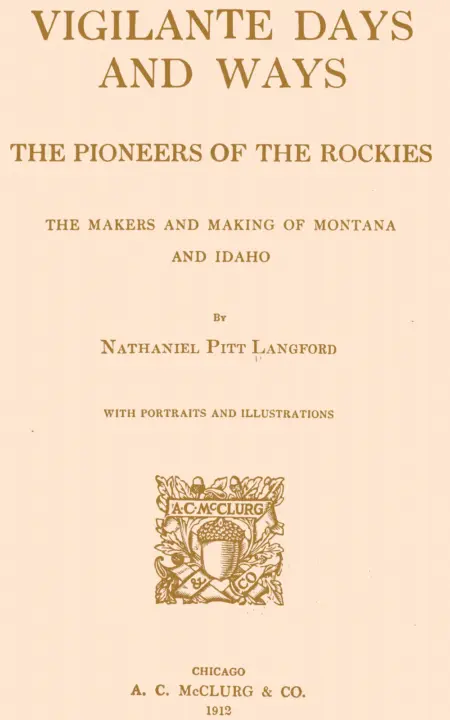
"Vigilante Days and Ways" by Nathaniel Pitt Langford is a historical account written in the late 19th century that explores lawlessness and the rise of vigilante justice during the early settlement of Montana and Idaho. The narrative delves into the tumultuous lives in mining camps fraught with crime, as individuals band together to establish order in a society plagued by violence and corruption. The opening chapters introduce key characters such as the notorious gambler Henry Plummer, leading the criminal underworld, and Patrick Ford, a figure who advocates for law and order amidst the chaos. At the start of the narrative, Langford provides a vivid picture of the mining town of Lewiston, highlighting its rapid growth and the moral degradation that followed the gold rush. The community is depicted as being in constant threat from bandits, with Plummer forming a gang that ravages the area. As crime escalates, the citizens, desperate for safety, consider taking justice into their own hands, culminating in the formation of a Vigilance Committee after a series of violent robberies. This establishes the groundwork for a dramatic conflict between the lawless elements and those striving for justice, setting the stage for the tensions and moral ambiguities that will unfold throughout the rest of the book.
Introduction adapted from the source catalogue; source summaries may be automatically generated.
Free to read · English · 164,131 words · No account needed
MAKE TIME FOR A GOOD BOOK
On by default. Untick to stop anonymous reading totals. Each page counts after 10 seconds in view. How this works.
Anonymous counting is on unless you have switched it off.
Southmayd withstood it no longer, but while making a deliberate descent threw open his coat, thinking that an opportunity might offer for him to use his revolver. Ives, perceiving his object, levelled his gun, and hissed out, in words terribly distinct,
“If you do that again, I’ll kill you!”
The passengers stood with upraised hands by the roadside, under cover of the guns of the robbers. Addressing Zachary, Ives said,
“Get down and look after those fellows.”
This was an unwelcome task for Zachary. Villain as he was, Southmayd says that while he was engaged in searching his person, he quivered like an aspen. Throwing Southmayd’s pistol and money on the ground, he was about to renew the search, when Billy, tired of the position, dropped his hands.
“Up with your hands again,” roared Ives with an oath, at the same time bringing the terrible muzzles to bear upon the person of the frightened driver. Billy, who felt that it was no time to bandy proprieties, threw them up with more speed than pleasure, realizing that the buckshot were safer in the barrels than in his luckless carcass.
Zachary now commenced searching Moore, and, taking from his pocket a
sack, inquired,
“Is this all you have?”
“All I have in the world,” replied Moore.
Zachary threw it on the heap and came to Billy.
“Give me your pistol,” said he. Billy placed the weapon in his hands.
“Is it loaded?” inquired Ives.
“No,” replied Billy.
“Give it to him again,” said Ives to Zachary. “We don’t want any empty
weapons.”
“My God!” exclaimed Caldwell, as Zachary next approached him. “What do you want of me? I have nothing.”
“Let him alone,” said Ives; and addressing Caldwell, he inquired, “Is there anything in the mail we want?”
“I don’t think there is,” answered Tom.
Zachary mounted the box, and commenced an examination, but found nothing. Caldwell scanned the villain narrowly, for the purpose, if possible, of recognizing him.
“Don’t you do that, if you want to live,” said Ives, rattling his gun into dangerous range.
“Well then,” said Tom impudently, “may I look at you?”
The robber nodded a ready assent, as much as to say, “Find me out, if
you can.”
The search over, Zachary picked up his gun, and stepped back.
“Get up and skedaddle,” said Ives to the plundered group. The horses had grown restive while the robbery was progressing, but Tom had restrained them.
“Drive slowly, Tom,” said Southmayd to Caldwell in an undertone, as he ascended the box. “I want to reconnoitre a little,” and turned his face to the robbers.
“Drive on,” shouted Ives.
Your reading position is saved on this browser. Take it to another device with a library code. Reading pages adapt to text, rather than matching a printed edition.
BEHIND THE BOOK
This eBook is for the use of anyone anywhere in the United States and most other parts of the world at no cost and with almost no restrictions whatsoever. You may copy it, give it away or re-use it under the terms of the Project Gutenberg License included with this eBook or online at www.gutenberg.org. If you are not located in the United States, you will have to check the laws of the country where you are located before using this eBook. Read the source licence.
The original source file, including credits and licence, is retained by this library. Request an original-format copy at no charge. Please include the book title and Project Gutenberg identifier #64135.
KEEP YOUR CURIOSITY GOING
Cécile Tormay

Moritz Busch
John L. Ransom
Frances Wright
Cécile Tormay

Mabel Potter Daggett