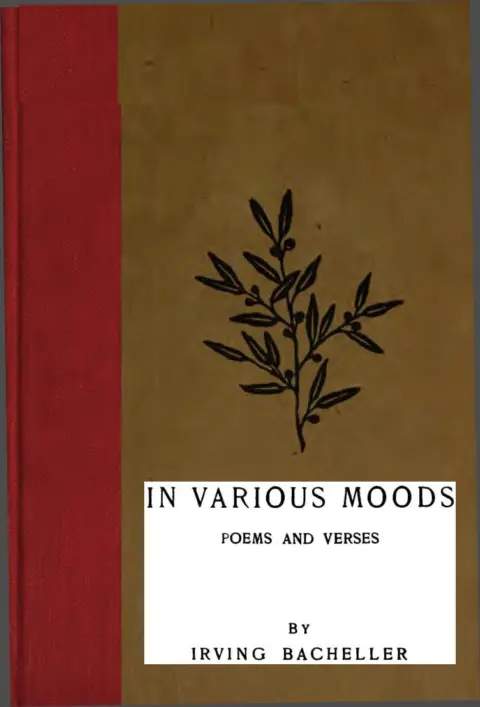
In Various Moods: Poems and Verses
Irving Bacheller
THE CLASSIC COLLECTION · 1904
"Vergilius: A Tale of the Coming of Christ" by Irving Bacheller is a historical novel written in the early 20th century. The narrative is set in ancient Rome, exploring themes of love, faith, and the transition from a world of paganism to one of emerging Christianity. The story primarily follows Vergilius, a young Roman knight, as he navigates the complexities of love and duty amid a backdrop of moral decay in the empire. The opening of "Vergilius" introduces readers to a richly depicted Rome, presenting a stark contrast between its opulent surface and the spiritual discontent of its people. As Rome grapples with excess and corruption, Vergilius is portrayed as a sincere and noble youth who is enamored with Arria, the daughter of a noble. Their budding romance unfolds with challenges, societal expectations, and hints of political intrigue, particularly as Vergilius is drawn into the machinations of powerful figures, including the emperor Augustus. The early chapters set the stage for a grand journey, reflecting on themes of love, virtue, and the search for truth as the empire stands on the brink of significant change.
Introduction adapted from the source catalogue; source summaries may be automatically generated.
Free to read · English · 41,356 words · No account needed
MAKE TIME FOR A GOOD BOOK
On by default. Untick to stop anonymous reading totals. Each page counts after 10 seconds in view. How this works.
Anonymous counting is on unless you have switched it off.
"A man of sincerity, upon my soul!" said the old philosopher. "I have put my hope in him, and so shall Rome. A lucky girl is she, for has he not riches, talent, honor, temperance, courage, and the beauty of a god? And was I not his teacher?"
"My brave Vergilius," the matron answered, "you are like the knights of old I have heard my father tell of. They had such a way with them--never a smile and a melancholy look in their faces when they spoke of love. I give you the crown of gallantry, and, if she be willing, you shall walk with her in the garden. That is your reward."
Vergilius, advancing, took the girl's hand and kissed it.
"Will you go with me?" said he.
"On one condition," she answered, looking down at the folds of her
tunic.
"And it is?"
"That you will entertain me with philosophy and the poets," she
answered, with a smile.
"And with no talk of love," the matron added, as Arria took his arm.
They walked through the long hall of the palace, over soft rugs and great mosaics, and between walls aglow with tints of sky and garden. These two bore with them a tender feeling as they passed the figures of embattled horse and host in carven wood, and mural painting and colored mosaic and wrought metal--symbols of the martial spirit of the empire now oddly in contrast with their own. They came out upon a peristyle overlooking an ample garden wherein were vines, flowers, and fruit trees.
"You have a way of words," said she. "It is almost possible to believe
you."
He stopped and for a long moment looked into her eyes. "I love you,
sweet girl," he said, softly; "I love you. As I live, I speak the
truth."
"And you a man!" she exclaimed, incredulously.
"Ay, strange as it may be, a Roman."
"My mother has told me," said she, looking down at her sandal, "that when a man speaks, it is well to listen but never to believe."
"They are not easy to understand--these men and women," said he, thoughtfully. "Sometimes I think they would be nobler if they were dumb as dogs. Albeit I suppose they would find a new way of lying. But, O sweet sister of Appius, try to believe me, though you believe no other, and I--I shall believe you always."
"You had better not," said she, with a merry glance.
"I must."
"But you will doubt me soon, for I shall say that I do not love you."
Your reading position is saved on this browser. Take it to another device with a library code. Reading pages adapt to text, rather than matching a printed edition.
Irving Bacheller
Irving Bacheller
Irving Bacheller
Irving Bacheller
BEHIND THE BOOK
This eBook is for the use of anyone anywhere in the United States and most other parts of the world at no cost and with almost no restrictions whatsoever. You may copy it, give it away or re-use it under the terms of the Project Gutenberg License included with this eBook or online at www.gutenberg.org. If you are not located in the United States, you will have to check the laws of the country where you are located before using this eBook. Read the source licence.
The original source file, including credits and licence, is retained by this library. Request an original-format copy at no charge. Please include the book title and Project Gutenberg identifier #16491.
KEEP YOUR CURIOSITY GOING
Cécile Tormay

Moritz Busch
Coulson Kernahan
John L. Ransom

Maurice Baring
Frances Wright