THE CLASSIC COLLECTION✦Vanished Halls and Cathedrals of FranceCLASSIC FREE BOOKS
Vanished Halls and Cathedrals of France
George Wharton Edwards
THE CLASSIC COLLECTION · 1916
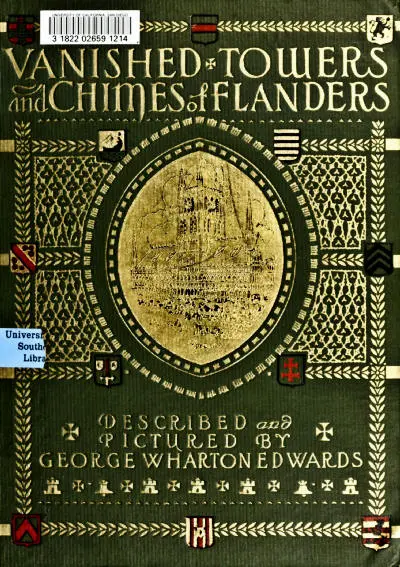
"Vanished Towers and Chimes of Flanders" by George Wharton Edwards is a historical account written in the early 20th century. The focus of the text is on the once-vibrant region of Flanders, particularly its architectural marvels, the social landscape of its towns, and the melodious chimes from the bells that marked the lives of its people. The author reflects on the cultural significance of these towers and bells, especially in the light of the destruction they faced during the war. At the start of the work, Edwards provides a foreword that illustrates the plight of the Flemish people, their little-known heritage, and the beauty of their towns, especially the architectural grandeur of the belfries and cathedrals. He recounts his observations on the nature of the Flemish culture, characterized by their artistic achievements and deep-seated Catholic faith. The opening chapters not only highlight the historical richness of towns like Malines and Ypres but also introduce us to their iconic structures and the unique sounds of their bells, which poignantly resonate with the reader as symbols of a past now marred by war. The narrative sets a tone of nostalgia and loss, as the author laments the destruction of this exquisite heritage.
Introduction adapted from the source catalogue; source summaries may be automatically generated.
Free to read · English · 35,428 words · No account needed
MAKE TIME FOR A GOOD BOOK
On by default. Untick to stop anonymous reading totals. Each page counts after 10 seconds in view. How this works.
Anonymous counting is on unless you have switched it off.
His son Jacques, born 1657, was admitted to the Gild in 1688, and died
in 1732.
Egide Joseph, natural son of Jacques, born 1694, was an historical painter, as well as a poet. He lived at Dusseldorf for three years. Obliged to support his sick parents, he did a great deal of work. Smeyers had a profound knowledge of the Latin tongue, which he wrote with great fluency and ease, in both poetry and prose. He possessed, too, a working knowledge of French, German, and Italian. His historical works are many. At length, sick and helpless, he was admitted to the hospital of Notre Dame, where he died in 1771. He painted the large portrait of Cardinal Thomas Philippe d'Alsace, Archbishop of Malines.
Daniel Janssens, born in 1636, was a painter-decorator of the first order. He adopted the manner of Jacques de Hornes of whom he was the favorite pupil. After having resided in Antwerp for some years he returned to Malines, where he died in 1682. He it was who designed and constructed the immense triumphal arch for the Jubilee of 1680. This arch is preserved in the Town Hall, and serves to decorate the facade of the "Halles" on the occasion of the Grandes Fetes.
Sebastian Van Aken, born 1648, was pupil of Luc Franchoys the Younger. Later he entered the studio of Charles Maratti in Rome. After painting in Spain and Portugal he returned to Malines, where he died in 1722.
August Casimir Redel, born 1640. This painter of merit became insane from excesses and died in 1687. He was also the author of a life of St. Rombaut (Rombold) and wrote much in verse. He composed an ode on the occasion of the Jubilee of Malines in 1680.
Jacques la Pla, pupil of Jean le Saive, a master painter of Malines in
1673, died in 1678.
Jean Barthelemy Joffroy, born 1669, was historian, painter, and
engraver. He died 1740.
Jean Joseph Van Campenhout, designer and engraver. He was designer of the great book of the "Cavalcade of Malines" in 1775.
Antoine Opdebeek, born 1709, author of many paintings of merit, was an untaught genius. Employed in the hospital of St. Hedwige in Malines, he taught himself the art, with success, but never reached the height which would have been his had he had instruction in his youth. He died 1759.
Pierre Antoine Verhulst, born 1751, painter of marines and landscape, which he executed with great delicacy and charm, died 1809.
Matthieu Joseph Charles Hunin, born 1770, was a master engraver, producing many plates after Rubens and other masters. To his talent is also due a great number of original engravings of the Tower of St. Rombold; the interior and exterior of the Cathedral of Antwerp; the Hotels de Villes of Oudenaarde, Brussels and Louvain, etc., etc. He died in 1851.
Your reading position is saved on this browser. Take it to another device with a library code. Reading pages adapt to text, rather than matching a printed edition.
BEHIND THE BOOK
This eBook is for the use of anyone anywhere in the United States and most other parts of the world at no cost and with almost no restrictions whatsoever. You may copy it, give it away or re-use it under the terms of the Project Gutenberg License included with this eBook or online at www.gutenberg.org. If you are not located in the United States, you will have to check the laws of the country where you are located before using this eBook. Read the source licence.
The original source file, including credits and licence, is retained by this library. Request an original-format copy at no charge. Please include the book title and Project Gutenberg identifier #28288.
KEEP YOUR CURIOSITY GOING
Wilfrid Scawen Blunt
Wilfrid Scawen Blunt

E. W. (Edgar Watson) Howe

David Patterson (Spirit) Hatch

David Patterson (Spirit) Hatch

David Patterson (Spirit) Hatch