
Tropical nature, and other essays
Alfred Russel Wallace
THE CLASSIC COLLECTION · 1898
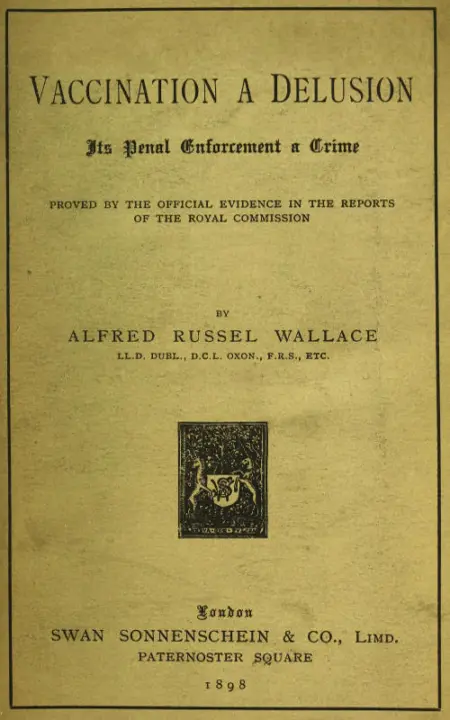
"Vaccination a Delusion: Its Penal Enforcement a Crime" by Alfred Russel Wallace is a critical examination of vaccination practices written in the late 19th century. This publication challenges the legitimacy of compulsory vaccination laws by presenting evidence that allegedly proves vaccination to be ineffective and harmful. The author argues for the abolition of these laws, framing the enforcement of vaccination as a violation of personal liberty and a threat to public health. The opening of the work sets a confrontational tone, with Wallace declaring his intention to influence Parliament and urging legislators to scrutinize the "ignorance and incompetence" surrounding the Royal Commission's findings on vaccination. He critiques historical and contemporary statistics related to vaccinations and smallpox infections, asserting that data have been manipulated to support the vaccination agenda. Through a detailed analysis of early medical practices and outcomes, Wallace aims to highlight how the public has been misled regarding the effectiveness of vaccination, suggesting that improved sanitary conditions, not vaccination, should be credited with decreasing disease prevalence.
Introduction adapted from the source catalogue; source summaries may be automatically generated.
Free to read · English · 31,632 words · No account needed
MAKE TIME FOR A GOOD BOOK
On by default. Untick to stop anonymous reading totals. Each page counts after 10 seconds in view. How this works.
Anonymous counting is on unless you have switched it off.
Vaccinated and unvaccinated, how determined by doctors, 25.
persons wrongly registered, 26.
and unvaccinated death-rates of, as given by doctors, 27.
and unvaccinated death-rates of, as given by doctors in last
century, 28.
and unvaccinated, how they differ, 70.
Vaccination, early history of, 6.
injury and death from, 10.
and the medical profession, 12.
doctors not best judges, 13.
deaths caused by, 17.
illness and death from, 19.
estimated deaths from, 19.
official evidence of, not trustworthy, 21.
a dreadful case of death from, 21.
how it affects the poor, 22.
evidence for, often worthless, 23.
can only be proved useful by statistics, 23.
marks not permanent, 26.
marks hidden by eruption, 26.
proved useless by modern hospital statistics, 30.
in England 1872-95, 40.
on the Continent, 44.
in Stockholm from 1810, 46.
in Stockholm not especially deficient, 47.
false assertions as to value of, 50.
uselessness of, proved, 51.
and small-pox in Leicester, 55.
and infant mortality in Leicester, 56.
injuries from increase death-rate, 57.
disasters at Shorncliffe camp concealed, 73.
increases liability to small-pox, 78.
Vacher, Dr., on registration of vaccinated and unvaccinated, 25.
Variolous test, fallacy of, 7, 9.
Vogt, Prof. A., on vaccination increasing small-pox, 51. no immunity from a previous attack of small-pox, 76.
Warrington and Leicester small-pox, 59.
Whooping-cough in London, 37.
Zymotic diseases in London, 36.
in Leicester, 55.
Zymotics in bills of mortality, 33.
Butler & Tanner, The Selwood Printing Works, Frome, and London.
To be Published in April, 1898
In One Volume, Crown 8vo
The Wonderful Century
Its Successes and Failures
LL.D., Dubl.; D.C.L., Oxon.; F.R.S., etc.
The object of this volume is to give a short descriptive sketch of the more important mechanical inventions and scientific discoveries which are distinctive of the nineteenth century; and especially to enable those who have lived only in the latter half of it to realise its full significance in the history of human progress.
The author maintains that our century is altogether unique; that it differs from the eighteenth or the seventeenth centuries, not merely as those differed from the centuries which immediately preceded them, but that it has initiated a new era, and that it may be more properly compared with the whole preceding historical period.
His estimate of the advances made during the present century is, therefore, higher than that of previous writers; but he points out that it is almost wholly a material and intellectual progress, and that, even intellectually, it is very imperfect. The second part of the work discusses the intellectual and moral failures of the century, which are shown to be as conspicuous and deplorable as its successes are admirable and unprecedented.
End of Project Gutenberg's Vaccination a Delusion, by Alfred Russel Wallace
Your reading position is saved on this browser. Take it to another device with a library code. Reading pages adapt to text, rather than matching a printed edition.
Alfred Russel Wallace
Alfred Russel Wallace

Alfred Russel Wallace
Alfred Russel Wallace
BEHIND THE BOOK
This eBook is for the use of anyone anywhere in the United States and most other parts of the world at no cost and with almost no restrictions whatsoever. You may copy it, give it away or re-use it under the terms of the Project Gutenberg License included with this eBook or online at www.gutenberg.org. If you are not located in the United States, you will have to check the laws of the country where you are located before using this eBook. Read the source licence.
The original source file, including credits and licence, is retained by this library. Request an original-format copy at no charge. Please include the book title and Project Gutenberg identifier #58918.
KEEP YOUR CURIOSITY GOING

Charles G. (Charles Griffith) Ross
Hannah Webster Foster

Emily Lawless
Edwin Hamlin Carr

Charles De Lano Hine
Andrew Ure