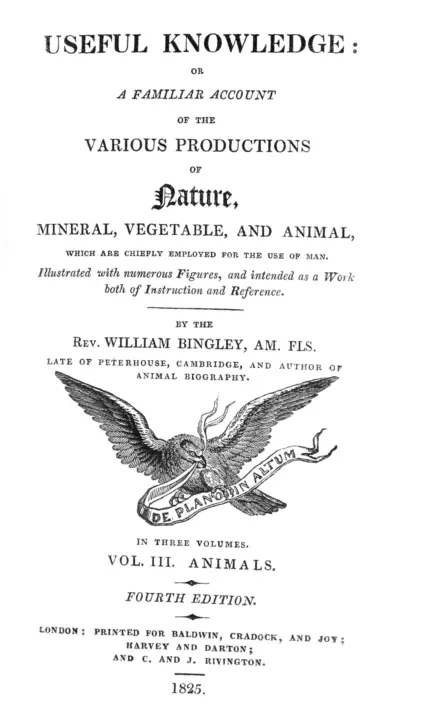
Useful Knowledge: Volume 3. Animals Or, a familiar account of the various productions of nature
William Bingley
THE CLASSIC COLLECTION · 1816
"Useful Knowledge: Volume 2. Vegetables" by William Bingley is a scientific publication written in the early 19th century. This volume serves as a detailed account of the various vegetable productions of nature, focusing on their structures, classifications, and uses for human benefit. It covers a wide range of plants, providing insights into their agricultural practices, medicinal applications, and culinary relevance. At the start of the work, the author introduces the concept of vegetables or plants, defining their characteristics and explaining the field of botany as it relates to plant study. He describes the main parts of plants, discusses the Linnæan classification system, and outlines the various classes based on reproductive structures. The opening sets the foundation for exploring specific plants, beginning with ginger, cardamoms, turmeric, and arrow root, detailing their cultivation, uses, and significance in both historical and contemporary contexts. This informative introduction establishes a clear thematic focus for the text, catering to readers interested in botany, agriculture, and the practical applications of plants.
Introduction adapted from the source catalogue; source summaries may be automatically generated.
Free to read · English · 94,509 words · No account needed
MAKE TIME FOR A GOOD BOOK
On by default. Untick to stop anonymous reading totals. Each page counts after 10 seconds in view. How this works.
Anonymous counting is on unless you have switched it off.
Q.
Quassia, description, history, and uses of, 134, 135
Quince, description and uses of, 149, 150
Quincy berries. See Currants, black.
R.
Rack or arrack, from what prepared, 218
Raisins, how prepared, and uses of, 70
Rape, culture and uses of, 70
Raspberry, uses of, 152
----, brandy, how made, 152
Rattan, description and uses of, 100
Receptacle, 3
Reed, common, uses of, 36
Resin, common and yellow, how prepared, and uses of, 233
Rhenish wine, 67
Rhubarb, officinal or Turkey, how obtained, and uses of, 123
----, how cultivated in England, 124
Rhubarb, common, description and uses of, 125
Rice, description, culture, and preparation of, 104-106
----, uses of, 105
Rush, common, description, preparation, and uses of, 102
Root of Scarcity. See Mangel Wurzel.
Rose, common garden, uses of, 150
----, hep or wild briar, flowers, fruit, and leaves, 151
----, red officinal, uses of, 152
Roses, ottar or oil of, how made, 150
----, conserve and syrup of, 150
----, honey of, 152
Rose wood, description and uses of, 110
Rosin. See Resin.
Rotang. See Dragon's Blood-tree.
Rota wine, 66
Rum, how prepared, 23
Rye, uses of, 28
S.
Saffron, description, culture, preparation, and uses of, 16, 17
Sago, description, preparation, and uses of, 255
Saint-foin, description, cultivation, and uses of, 187
Salad oil. See Olive oil.
Salep, what it is, how prepared, and uses of, 202
Sallow, common, 244
Saloop, what it is, 121
Samphire, rock, how obtained and uses of, 76
----, marsh, 76
Sandal wood, description and use of, 40
Sap-green, of what made, 57
Sassafras, description and uses of, 121
Saunders, yellow, description and use of, 40
Saxon, blue and green, what made from, 189
Scammony, what, how obtained, and uses of, 44
Sea Kale, description, mode of culture, and uses of, 171
Seed vessel, 2
Semolina, of what made, and use of, 26
Senna, description and uses of, 125
Shaddock, description and uses of, 195
Shalot, description and uses of, 90
Sherry wine, 66
Shoe-maker's wax, of what made, 235
Sloe, fruit, flowers, bark, leaves, and wood, uses of, 145
Smouch, what it is, 164
Snuff, how made, 52
Soda. See Barilla.
Sour-crout, of what made, 176
Sour-gourd, description and uses of, 178
Sowins, 24
Soy, description, preparation, and use of, 133
Spanish black, of what made, 226
Spart. See Broom.
Spruce, essence of, from what prepared, and uses of, 236
Spunk or Touchwood, description and use of, 277
Squinancy berries. See Currants, black.
Stamens, 2
Starch, prepared from different vegetable productions, 25, 55, 107, 219,
221
Stone blue, what made from, 189
Storax, description, mode of obtaining, and use of, 131
Stramonium, description, properties, and uses of, 50
Strawberries, uses of, 153
Sugar, how manufactured, 19, 20
----, muscovado or raw, and clayed, 21
----, how refined, 21
----, loaf or lump, 22
----, candy, how made, 22
----, uses of, 22
----, cane, description and cultivation of, 19
----, mode of obtaining sugar from, 20
Sunflowers, description and uses of, 201
Sycamore tree, description and uses of, 111, 112
Your reading position is saved on this browser. Take it to another device with a library code. Reading pages adapt to text, rather than matching a printed edition.
William Bingley
William Bingley
William Bingley
BEHIND THE BOOK
This eBook is for the use of anyone anywhere in the United States and most other parts of the world at no cost and with almost no restrictions whatsoever. You may copy it, give it away or re-use it under the terms of the Project Gutenberg License included with this eBook or online at www.gutenberg.org. If you are not located in the United States, you will have to check the laws of the country where you are located before using this eBook. Read the source licence.
The original source file, including credits and licence, is retained by this library. Request an original-format copy at no charge. Please include the book title and Project Gutenberg identifier #57954.
KEEP YOUR CURIOSITY GOING
Cécile Tormay

Moritz Busch
John L. Ransom
Frances Wright
Cécile Tormay

Mabel Potter Daggett