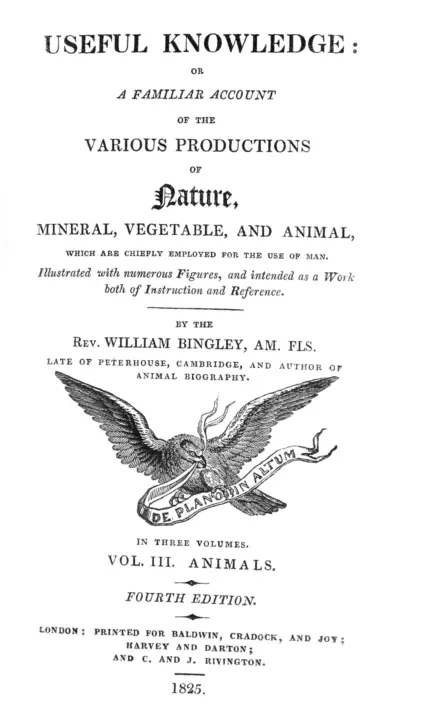
Useful Knowledge: Volume 3. Animals Or, a familiar account of the various productions of nature
William Bingley
THE CLASSIC COLLECTION · 1816
"Useful Knowledge: Volume 2. Vegetables" by William Bingley is a scientific publication written in the early 19th century. This volume serves as a detailed account of the various vegetable productions of nature, focusing on their structures, classifications, and uses for human benefit. It covers a wide range of plants, providing insights into their agricultural practices, medicinal applications, and culinary relevance. At the start of the work, the author introduces the concept of vegetables or plants, defining their characteristics and explaining the field of botany as it relates to plant study. He describes the main parts of plants, discusses the Linnæan classification system, and outlines the various classes based on reproductive structures. The opening sets the foundation for exploring specific plants, beginning with ginger, cardamoms, turmeric, and arrow root, detailing their cultivation, uses, and significance in both historical and contemporary contexts. This informative introduction establishes a clear thematic focus for the text, catering to readers interested in botany, agriculture, and the practical applications of plants.
Introduction adapted from the source catalogue; source summaries may be automatically generated.
Free to read · English · 94,509 words · No account needed
MAKE TIME FOR A GOOD BOOK
On by default. Untick to stop anonymous reading totals. Each page counts after 10 seconds in view. How this works.
Anonymous counting is on unless you have switched it off.
N.
Nankeen dye (Scot's), of what made, 157
Nectarine, 140
Nettle, common, leaves, tops, stalks, roots, flowers, and seed, uses of,
213, 214
Nettle stings, description of, 214
Nightshade, deadly, description, injurious effects, and uses of, 53, 54
Nutmeg tree, description of, 244
Nutmegs, how gathered and prepared for use, and uses of, 245
Nut-oil, from what prepared, 228
Nux vomica, description and uses of, 58
O.
Oak tree, wood, bark, saw-dust, and acorns, uses of, 222-225
Oatmeal, uses of, 24
Oats, mode of cultivation and uses of, 24
Oil-cake, of what made, and uses of, 87, 174
Olive tree, description and uses of, 11, 12
---- oil, how prepared and uses of, 11
Olives, how prepared for use, and uses of, 11
Onion, Canadian or tree, description and uses of, 90
----, common, description and uses of, 91
----, Portugal and Spanish, 91
Opium, how obtained, properties and uses of, 154, 155
----, how cultivated in England, 155
----, how adulterated, 154
Orange, flowers, juice and peel, uses of, 194, 195
----, Seville or bitter, 195
Orchall, description, preparation, and use of, 270
Orders of plants, 4
Orenberg gum, of what made, 237
Orris root, description and uses of, 17
Osier, wood and bark, uses of, 243
Ottar of roses, from what made and how adulterated, 150
Owler. See Alder.
P.
Paddy. See Rice.
Paper made from vegetable productions of different kinds, 18, 28, 101,
185, 215, 243
Papyrus, description, preparation, and uses of, 18, 19
Parsley, leaves, roots, and seed, uses of, 82
Parsnips, how cultivated, and uses of, 79
Pawpaw, description and uses of, fruit, bark, leaves, and stem, 266
Peach, fruit, kernels, flowers, and leaves, uses of, 139
Pear, fruit, wood, and leaves, uses of, 146
Pearl barley, how made, and uses of, 28
Peas, cultivation and uses of, 185, 186
----, everlasting, use of, 186
Pepper, black, how cultivated and prepared for use, 13
----, white, what it is, and how prepared, 13
----, uses of, and how adulterated, 14
----, long, description and uses of, 14, 15
----, Guinea, description and uses of, 57
Perry, of what made, 147
Peruvian bark, whence obtained, how prepared for, use, and uses of, 45
Petals, 2
Pimento, description and cultivation of, 138, 139
----, how collected and prepared for use, and uses of, 138
Pine, Weymouth, description and uses of, 235
Pines, fruit, description, history, cultivation, and uses of, 87
Pistil, 2
Pitch, how prepared, and uses of, 234, 235
Plane tree, description and uses of, 230
Plantain tree, description and uses of, 259
Plum, common, description and uses of, 143
----, French, 44
----, bullace, fruit, flowers, and wood, uses of, 144
Pomegranate, description and uses of, 141, 142
Pontac wine, 66
Pontefract cakes, how made, and uses of, 187
Poplar, great white, description and uses of, 253, 254
----, trembling, 254
----, black, 254
----, Lombardy or Italian, 255
Poppy, white, description, cultivation, and uses of, 154, 155
Port-wine, 65
Potatoe, roots, stalks, and apples, uses of, 54-56
Pounce, from what prepared, 257
Prunes, 144
Puff-ball, description and use of, 275
Pumpkin or pompion, description and uses of, 208
Your reading position is saved on this browser. Take it to another device with a library code. Reading pages adapt to text, rather than matching a printed edition.
William Bingley
William Bingley
William Bingley
BEHIND THE BOOK
This eBook is for the use of anyone anywhere in the United States and most other parts of the world at no cost and with almost no restrictions whatsoever. You may copy it, give it away or re-use it under the terms of the Project Gutenberg License included with this eBook or online at www.gutenberg.org. If you are not located in the United States, you will have to check the laws of the country where you are located before using this eBook. Read the source licence.
The original source file, including credits and licence, is retained by this library. Request an original-format copy at no charge. Please include the book title and Project Gutenberg identifier #57954.
KEEP YOUR CURIOSITY GOING
Cécile Tormay

Moritz Busch
John L. Ransom
Frances Wright
Cécile Tormay

Mabel Potter Daggett