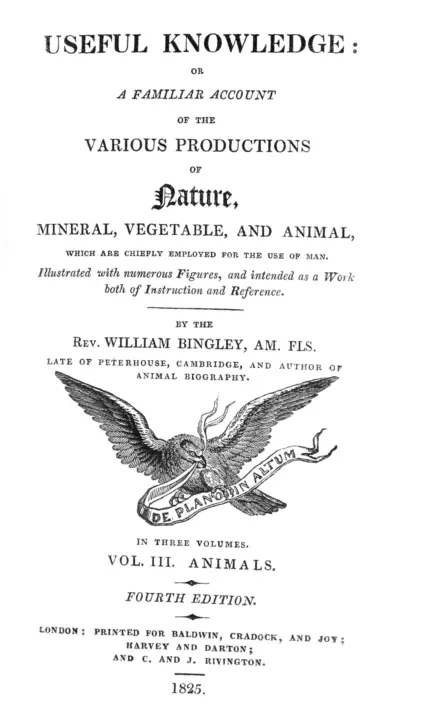
Useful Knowledge: Volume 3. Animals Or, a familiar account of the various productions of nature
William Bingley
THE CLASSIC COLLECTION · 1816
"Useful Knowledge: Volume 1. Minerals" by William Bingley is a scientific publication written in the early 19th century. This volume serves as an accessible introduction to the field of mineralogy, detailing natural minerals and their significance to human life and industry. The author aims to provide a comprehensive overview of various minerals, their properties, and their uses, making it approachable for general readers. The opening of the work establishes its educational intent, emphasizing the importance of understanding minerals in light of their numerous applications in everyday life. Bingley critiques previous methods of instruction, such as the use of catechisms for children's learning, and aims to provide a more thorough and engaging account suitable for all readers. He outlines the organization of the book, explaining how each mineral will be introduced with a definition, characteristics, and practical applications, highlighting its relevance to natural history and human progress. This systematic approach encourages readers to explore the foundational elements and classification of minerals, setting the stage for a detailed examination of specific minerals in the chapters to follow.
Introduction adapted from the source catalogue; source summaries may be automatically generated.
Free to read · English · 89,653 words · No account needed
MAKE TIME FOR A GOOD BOOK
On by default. Untick to stop anonymous reading totals. Each page counts after 10 seconds in view. How this works.
Anonymous counting is on unless you have switched it off.
146. CARRARA MARBLE, the purest of all the kinds with which we are acquainted, is to this day obtained from quarries near the town of Carrara. It is of brilliant white colour, has a granular texture; and, when broken, sparkles like sugar. This marble, which is almost the only one in use by modern sculptors, was also quarried and wrought by the ancients.
It is susceptible of a high polish, and is applicable to every species of sculpture, except when, as is too often the case, dark veins intrude, and spoil the beauty of the work. In the centre of the blocks a beautiful kind of rock crystals, called Carrara diamonds, are sometimes found.
During the late war with France, the exportation of statuary marble from the countries under the dominion of Buonaparte was prohibited; and, at one time, it became so scarce in England as to be sold at the rate of more than seven guineas per cubic foot. The block of marble for the statue of his late Majesty in the great Council Chamber at Guildhall, London, was stated by the public prints to have cost twelve hundred guineas.
147. LUNI MARBLE is a snow─white, compact, and finely granular variety, which was obtained by the ancients from quarries on the coast of Tuscany. It was preferred by the Grecian sculptors, both to the Parian and Pentelic marbles; and it is usually supposed that the Belvidere Apollo, as well as the Antinous of the Capitol, was wrought out of this marble. There is now found at Luni a white marble, variegated with red spots and dots.
148. GREEN ANTIQUE MARBLE, or VERDE ANTIQUE of the Italians, is a mixture of white marble and green serpentine (132). This is believed to have been obtained from some part of Italy, but the quarries are not now known.
149. SIENNA MARBLE is of close texture, and yellowish colour, disposed in large irregular spots, surrounded with veins of bluish red, passing sometimes into purple. It is not uncommon in the vicinity of Sienna, and is in great request, throughout Europe, for chimney─pieces and ornamental furniture.
150. BROCATELLO MARBLE is somewhat like the last; but is also
irregularly marked with various shades of red, and, in some parts, with
white.
151. MANDELATO MARBLE is of light red colour, with yellowish white spots. It is found at Lugezzana, in the Veronese. Another variety, bearing the same name, occurs at Preosa.
152. VERDE DI PRATO MARBLE is a green marble, marked with darker green spots, which is found near the town of Prato in Tuscany.
153. LAGO MAGGIORE MARBLE is a beautiful kind, white, with black spots and dots. It has been employed for decorating the interior of many churches in the Milanese.
Your reading position is saved on this browser. Take it to another device with a library code. Reading pages adapt to text, rather than matching a printed edition.
William Bingley
William Bingley
William Bingley
BEHIND THE BOOK
This eBook is for the use of anyone anywhere in the United States and most other parts of the world at no cost and with almost no restrictions whatsoever. You may copy it, give it away or re-use it under the terms of the Project Gutenberg License included with this eBook or online at www.gutenberg.org. If you are not located in the United States, you will have to check the laws of the country where you are located before using this eBook. Read the source licence.
The original source file, including credits and licence, is retained by this library. Request an original-format copy at no charge. Please include the book title and Project Gutenberg identifier #57898.
KEEP YOUR CURIOSITY GOING
Cécile Tormay

Moritz Busch
John L. Ransom
Frances Wright
Cécile Tormay

Mabel Potter Daggett