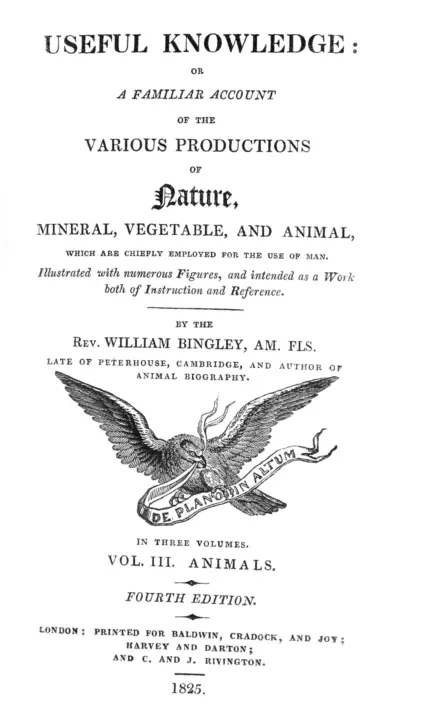
Useful Knowledge: Volume 3. Animals Or, a familiar account of the various productions of nature
William Bingley
THE CLASSIC COLLECTION · 1816
"Useful Knowledge: Volume 1. Minerals" by William Bingley is a scientific publication written in the early 19th century. This volume serves as an accessible introduction to the field of mineralogy, detailing natural minerals and their significance to human life and industry. The author aims to provide a comprehensive overview of various minerals, their properties, and their uses, making it approachable for general readers. The opening of the work establishes its educational intent, emphasizing the importance of understanding minerals in light of their numerous applications in everyday life. Bingley critiques previous methods of instruction, such as the use of catechisms for children's learning, and aims to provide a more thorough and engaging account suitable for all readers. He outlines the organization of the book, explaining how each mineral will be introduced with a definition, characteristics, and practical applications, highlighting its relevance to natural history and human progress. This systematic approach encourages readers to explore the foundational elements and classification of minerals, setting the stage for a detailed examination of specific minerals in the chapters to follow.
Introduction adapted from the source catalogue; source summaries may be automatically generated.
Free to read · English · 89,653 words · No account needed
MAKE TIME FOR A GOOD BOOK
On by default. Untick to stop anonymous reading totals. Each page counts after 10 seconds in view. How this works.
Anonymous counting is on unless you have switched it off.
Pinchbeck, of what made, and use of, 187
Pipe─clay, description and use of, 72
Plaster of Paris, of what made, and use of, 118
Plate glass, how made, 56
Plating of copper, &c. how performed, 180
Platina, description, properties, and uses of, 166, 167
Pompey’s pillar, of what formed, 230
Ponderous earth. See Barytes.
Porcelain─clay, description and use of, 74 ——, Chinese, French, and English porcelain, account of, 74 ——, how manufactured, glazed, and painted, 74, 75 ——, biscuit, how made, 47, 75
Porphyry, description and uses of, 229
Portland stone, description and use of, 114
Potash, description of, how obtained, and use of, 135
Potstone, description and use of, 90
Pottery, how made, 73
Powder blue, of what made, and use of, 222
Prince’s metal, what it is, and for what used, 187
Printer’s types, of what made, 205, 218
Pumice, description and use of, 67
Pyrites, description, properties, and uses of, 198, 199
Quartz, description, properties, and uses of, 44
——, rock, 231
Queen’s ware pottery, of what made, 73
Quick lime, how made, 98
Quicksilver. See Mercury.
Red chalk and Reddle, description and uses of, 199
Realgar, description and uses of, 214
Rocks, systematic arrangement of, 7, 224
——, primitive, description of, 224
——, secondary, 231
——, transition, 232
——, floetz or flat, 233
——, volcanic, 235
Rock oil. See Naphtha.
Roe stone. See Ketton stone.
Roofing slate, description of, 76
—— ——, how to choose, 77
—— ——, Welsh and Westmoreland, 78
—— ——, French, 76
—— ——, various uses of, 77─80
Rolling stones, of what made, 234
Rotten stone, description and use of, 76
Rouge, of what made, 84, 91
Rubellite, valuable specimen of, 41
Ruby, Oriental, description of, 31
——, whence imported, value, properties, and uses of, 31, 32
——, spinel, description, value, and uses of, 32
——, Balais, 32
——, false, 49
Ruin marble. See Florence marble.
Sal ammoniac, description of, how made, and uses of, 138, 139
Salt, common, description and uses of, 129
——, mines in Poland, description of, 129
——, mines in Chester, 130
——, mountains of, in Spain, 130
—— springs, 131
Salt, how manufactured, 131
——, bay, 132
——, spirit of, how made, and uses of, 132
Saltpetre. See Nitre.
Sand, common, description and uses of, 52
Sandstone, 234
Sapphire, Oriental, description of, how cut and set, 30
——, properties, value, and use of, 30, 31
——, false, or water, 49
Sardonyx, 57
Scots pebbles, description and use of, 62
Scythe─stones, how made, 234
Sea froth. See Meerschaum.
Sea water, description and properties of, 244
—— ——, cause of its bitterness, and saltiness, 244
—— ——, uses of, 245
Serpentine, description and uses of, 89, 90
Shell silver, how prepared, 181
Shot, how made, 205
Sienite, description and uses of, 230
Silex, 15
Siliceous earth, 15
Silicium, 15
Silver, description of, 177
—— mines of Potosi and Norway, account of, 177, 178
——, found in Scotland, 178
——, extracted from lead, 178
——, how extracted from its ores, 178
——, value and uses of, and how alloyed, 179
——, marks or stamps on silver plate explained, 179
——, nitrat of, uses of, 181
——, fulminating, extraordinary properties of, 182
——, experiments with preparations of, 182
——, how to gild, 172
Silver plate, how cleaned, 179
——, ductility of, 179
Silver wire, 179
Silvering of looking─glasses, process of, 176
—— of metals, how performed, 186
—— of paper and wood, 181
Slate. See Roofing slate, and Writing slate.
Slate pencils, how made, 78
Slickenside, extraordinary properties of, 218
Your reading position is saved on this browser. Take it to another device with a library code. Reading pages adapt to text, rather than matching a printed edition.
William Bingley
William Bingley
William Bingley
BEHIND THE BOOK
This eBook is for the use of anyone anywhere in the United States and most other parts of the world at no cost and with almost no restrictions whatsoever. You may copy it, give it away or re-use it under the terms of the Project Gutenberg License included with this eBook or online at www.gutenberg.org. If you are not located in the United States, you will have to check the laws of the country where you are located before using this eBook. Read the source licence.
The original source file, including credits and licence, is retained by this library. Request an original-format copy at no charge. Please include the book title and Project Gutenberg identifier #57898.
KEEP YOUR CURIOSITY GOING
Cécile Tormay

Moritz Busch
John L. Ransom
Frances Wright
Cécile Tormay

Mabel Potter Daggett