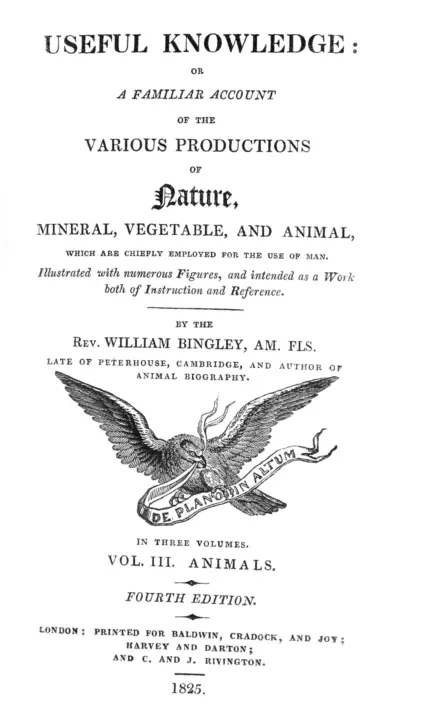
Useful Knowledge: Volume 3. Animals Or, a familiar account of the various productions of nature
William Bingley
THE CLASSIC COLLECTION · 1816
"Useful Knowledge: Volume 1. Minerals" by William Bingley is a scientific publication written in the early 19th century. This volume serves as an accessible introduction to the field of mineralogy, detailing natural minerals and their significance to human life and industry. The author aims to provide a comprehensive overview of various minerals, their properties, and their uses, making it approachable for general readers. The opening of the work establishes its educational intent, emphasizing the importance of understanding minerals in light of their numerous applications in everyday life. Bingley critiques previous methods of instruction, such as the use of catechisms for children's learning, and aims to provide a more thorough and engaging account suitable for all readers. He outlines the organization of the book, explaining how each mineral will be introduced with a definition, characteristics, and practical applications, highlighting its relevance to natural history and human progress. This systematic approach encourages readers to explore the foundational elements and classification of minerals, setting the stage for a detailed examination of specific minerals in the chapters to follow.
Introduction adapted from the source catalogue; source summaries may be automatically generated.
Free to read · English · 89,653 words · No account needed
MAKE TIME FOR A GOOD BOOK
On by default. Untick to stop anonymous reading totals. Each page counts after 10 seconds in view. How this works.
Anonymous counting is on unless you have switched it off.
Harrowgate has long been celebrated for its sulphureous waters. It has also two very valuable chalybeate springs, called the Old Spa, and the Tewit Well, the water of which was formerly used internally, whilst the other water was confined to external use. But, at present, the latter is employed to very great extent as an internal medicine.
The two villages of High and Low Harrowgate are situated in a pleasant open country, in the centre of the county of York, near the town of Knaresborough, and about 212 miles north of London.
300. MOFFAT WATER is a cold sulphureous water, the smell of which is precisely similar to that of Harrowgate water, and the taste simply saline, and without any bitterness.
Its foreign contents are common salt, together with carbonic acid gas, azotic gas, and sulphureted hydrogen gas. It is consequently very simple in its composition.
Moffat is a village situated, at the head of a valley, on the banks of the river Annan, and about fifty─six miles south─west of Edinburgh. It is surrounded by hills, some of which are very lofty. This village has obtained so much celebrity, on account of its waters, as to be considered the Harrowgate of North Britain. These issue from a rock which is at a little distance below a bog, whence, probably, they derive their sulphureous ingredients. The principal spring is contained within a stone building, and affords a sufficient quantity of water to supply every demand. It is drawn by a pump.
When the water is first taken from the well it appears somewhat milky and bluish. It sparkles a little; but, on being exposed to the air, it becomes turbid, and throws up a thin film, which, on examination, will be found pure sulphur. This change takes place even in close vessels, so that it cannot be sent to any distance with advantage.
The common people so much esteem this water that many of them drink at the rate of from six to ten quarts of it in a morning, and one instance has been stated of a person drinking thirty─two quarts of it in eight hours.
Acid, sulphuric, 12; how made, properties and uses of, 145
Acid, phosphoric, 12
Acid, carbonic, 12
Acid, fluoric, 13; how made, properties and uses of, 120
Acid, boracic, 13
Acid, muriatic, 13; How made and uses of, 132
Acid, nitric, 14; How made, and uses of, 138
Adamant. See Diamond.
Adamantine spar. See Corundum.
Adularia, description and uses of, 70
Agate, description, uses, &c. of, 61, 62
——, different kinds of, 63
Alabaster, description and uses of, 117
——, calcareous, account and uses of, 111, 112
Alkalies, 18
Alumine, 15, 123
Alluvial depositions, 235
Alum, description and uses of, 123, 124
——, Roman and Roche, 123
——, how procured and made, 123
Amalgams, what they are, 176
Your reading position is saved on this browser. Take it to another device with a library code. Reading pages adapt to text, rather than matching a printed edition.
William Bingley
William Bingley
William Bingley
BEHIND THE BOOK
This eBook is for the use of anyone anywhere in the United States and most other parts of the world at no cost and with almost no restrictions whatsoever. You may copy it, give it away or re-use it under the terms of the Project Gutenberg License included with this eBook or online at www.gutenberg.org. If you are not located in the United States, you will have to check the laws of the country where you are located before using this eBook. Read the source licence.
The original source file, including credits and licence, is retained by this library. Request an original-format copy at no charge. Please include the book title and Project Gutenberg identifier #57898.
KEEP YOUR CURIOSITY GOING
Cécile Tormay

Moritz Busch
John L. Ransom
Frances Wright
Cécile Tormay

Mabel Potter Daggett