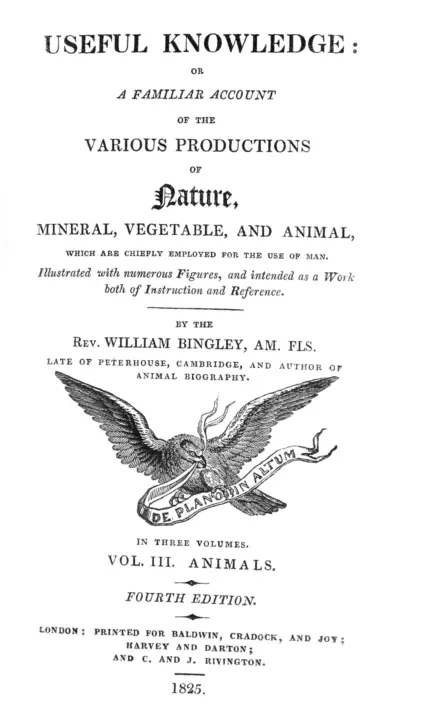
Useful Knowledge: Volume 3. Animals Or, a familiar account of the various productions of nature
William Bingley
THE CLASSIC COLLECTION · 1816
"Useful Knowledge: Volume 1. Minerals" by William Bingley is a scientific publication written in the early 19th century. This volume serves as an accessible introduction to the field of mineralogy, detailing natural minerals and their significance to human life and industry. The author aims to provide a comprehensive overview of various minerals, their properties, and their uses, making it approachable for general readers. The opening of the work establishes its educational intent, emphasizing the importance of understanding minerals in light of their numerous applications in everyday life. Bingley critiques previous methods of instruction, such as the use of catechisms for children's learning, and aims to provide a more thorough and engaging account suitable for all readers. He outlines the organization of the book, explaining how each mineral will be introduced with a definition, characteristics, and practical applications, highlighting its relevance to natural history and human progress. This systematic approach encourages readers to explore the foundational elements and classification of minerals, setting the stage for a detailed examination of specific minerals in the chapters to follow.
Introduction adapted from the source catalogue; source summaries may be automatically generated.
Free to read · English · 89,653 words · No account needed
MAKE TIME FOR A GOOD BOOK
On by default. Untick to stop anonymous reading totals. Each page counts after 10 seconds in view. How this works.
Anonymous counting is on unless you have switched it off.
Scotland Ben Nevis, Inverness─shire 1 4380 Ben Lawers, Perthshire 2 4051 England Skiddaw, Cumberland 3 3530 Cross Fell, Cumberland 4 3390 Helvellyn, Cumberland 5 3324 Wharnside, Yorkshire 6 2480 Ingleborough, Yorkshire 7 2380 Wales Snowdon, Caernarvonshire 8 3568 Cader Idris, Merionethshire 9 3550 Ireland Macgillicuddy’s Reeks, Kerry 10 3404 Sleibh─Dorin, Londonderry 11 3150
=Continent of Europe.=
France Mont d’Or, Auvergne 12 6707
Puy de Sausi, Auvergne 13 6700
Pyrenees Mont Perdu, the highest of the 14 11,283
Pyrenees
Le Pic Blanc, Spain 15 10,205
Alps Loucira 16 14,451
Loupilon 17 14,144
Switzerland Mont Blanc, highest mountain 18 15,680
in Europe
Mont Rosa 19 15,555
Mont St. Gothard 20 10,014
Italy Mont Cimone 21 6401
Vesuvius 22 3900
Germany Ortler─Spitze, Tyrol 23 15,430
Ostelle, Saltzburg 24 12,800
Carpathian Mountains, highest 25 8640
summit
Lomnitz Peak 26 8640
Sweden Areskutan, Jempland 27 6180
=Islands.=
Teneriffe Peak of Teneriffe 28 12,236 Sicily Ætna 29 10,963 Jamaica Blue Mountains 30 7431 Iceland Snæfiel 31 6860 Hecla 32 4900
=Asia.=
India Dhawalgeri in Nepaul 46 27,667 Mountains of Thibet 47 23,262 Turkey Mount Lebanon, estimated at 33 9520 in Asia Mount Ararat, estimated at 34 9500 Mount Ida 35 4960
=America.=
Andes, South Chimborazo, Quito 36 20,900 America. Cotopaxi, Quito 37 18,880
=Height of Remarkable Lakes, Cities, &c.=
Alps Lake of Lausanne 38 8640
Lake of Lanzon, on the 39 6797
mountain of Olan
Switzerland Lake of Lucerne 40 1408
South America City of Riobamba, Quito 41 18,800
City of Quito 42 9356
North America City of Mexico 43 7424
Austria Town of Eisenerz 44 2056
Egypt The great Pyramid 45 477
273. WATER, generally speaking, is a transparent and nearly incompressible fluid, the component parts of which are two kinds of gas, called hydrogen (45) and oxygen (21).
It is liquid in the common temperature of our atmosphere, assumes a solid state under the denomination of ice, in a cold temperature (32° of Fahrenheit’s thermometer); and, by heat at 212°, is converted into an elastic vapour of almost incredible force, called steam. At any temperature betwixt these two points, it returns, unaltered, to its liquid state. The weight of water is about 816 times greater than that of atmospheric air.
Water abounds in, and may be considered as, a kind of general cement to all solid bodies. It performs the most important functions both in the animal and vegetable kingdoms, and even enters largely into their composition.
A chief part of the nutrition of vegetables is the water which they absorb from the earth through the pores of their roots. The great quantity so absorbed may readily be imagined, when it is stated that the driest and most compact kinds of wood, such as even heart of oak, when converted into charcoal, lose, during the process, full three─fourths of their weight; and that the fluid which escapes is nearly pure water. This fluid is found in the driest of solid bodies, whatever be their description. A piece of hartshorn kept for forty years, and thereby become as hard and dry as metal (so that if struck against a flint it would give sparks of fire), upon being distilled, was found to yield an eighth part of its weight of water.
Your reading position is saved on this browser. Take it to another device with a library code. Reading pages adapt to text, rather than matching a printed edition.
William Bingley
William Bingley
William Bingley
BEHIND THE BOOK
This eBook is for the use of anyone anywhere in the United States and most other parts of the world at no cost and with almost no restrictions whatsoever. You may copy it, give it away or re-use it under the terms of the Project Gutenberg License included with this eBook or online at www.gutenberg.org. If you are not located in the United States, you will have to check the laws of the country where you are located before using this eBook. Read the source licence.
The original source file, including credits and licence, is retained by this library. Request an original-format copy at no charge. Please include the book title and Project Gutenberg identifier #57898.
KEEP YOUR CURIOSITY GOING
Cécile Tormay

Moritz Busch
John L. Ransom
Frances Wright
Cécile Tormay

Mabel Potter Daggett