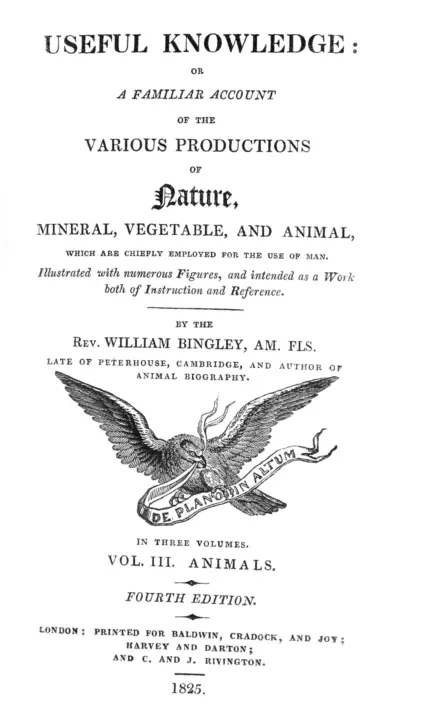
Useful Knowledge: Volume 3. Animals Or, a familiar account of the various productions of nature
William Bingley
THE CLASSIC COLLECTION · 1816
"Useful Knowledge: Volume 1. Minerals" by William Bingley is a scientific publication written in the early 19th century. This volume serves as an accessible introduction to the field of mineralogy, detailing natural minerals and their significance to human life and industry. The author aims to provide a comprehensive overview of various minerals, their properties, and their uses, making it approachable for general readers. The opening of the work establishes its educational intent, emphasizing the importance of understanding minerals in light of their numerous applications in everyday life. Bingley critiques previous methods of instruction, such as the use of catechisms for children's learning, and aims to provide a more thorough and engaging account suitable for all readers. He outlines the organization of the book, explaining how each mineral will be introduced with a definition, characteristics, and practical applications, highlighting its relevance to natural history and human progress. This systematic approach encourages readers to explore the foundational elements and classification of minerals, setting the stage for a detailed examination of specific minerals in the chapters to follow.
Introduction adapted from the source catalogue; source summaries may be automatically generated.
Free to read · English · 89,653 words · No account needed
MAKE TIME FOR A GOOD BOOK
On by default. Untick to stop anonymous reading totals. Each page counts after 10 seconds in view. How this works.
Anonymous counting is on unless you have switched it off.
214. MINERAL TAR, or BARBADOES TAR, is a fluid kind of bitumen, somewhat thicker than petroleum, and nearly of the consistence of common tar. It is viscid, of a black, brownish black, or reddish colour.
In burning its smell is disagreeable, but less pungent than that of most other kinds of bitumen. Its weight is somewhat greater than that of water.
In the West Indies, where this substance is principally found, it is applied to many of the purposes for which the preceding species is used; but its principal repute has been obtained from its being thought useful in disorders of the breast and lungs, though this application of it is considered very improper. It is likewise used as an external remedy in paralytic disorders.
215. ELASTIC BITUMEN, or MINERAL CAOUT─CHOUC, has a strong resemblance to Indian rubber. In some instances it is elastic, and so soft as to adhere to the fingers, and in others brittle, and so hard as nearly to resemble asphalt (216).
Its colour is yellowish, reddish brown, or blackish. One kind of this mineral, when fresh cut, nearly resembles fine cork, both in texture and colour.
This extraordinary substance, which will expunge the marks of black lead in the same manner as Indian rubber, was first discovered, about the year 1786, in cavities of the lead mine of Odin, near Castleton, in Derbyshire, and it has not hitherto been found elsewhere. Elastic bitumen appears to be a peculiar modification of petroleum, in its passage to asphalt: and probably owes its elasticity to its cellular texture, and to the moisture with which it is combined.
216. ASPHALT, or SOLID BITUMEN, is a brittle substance, of black or brownish black colour, and of consistence somewhat harder than pitch.
It has nearly the same weight as water, is smooth to the touch, does not stain the fingers, and has little or no smell unless it be rubbed or heated. When heated, it melts, swells and inflames; and, if pure, burns without leaving any ashes.
The ancients were well acquainted with this substance, which is nothing more than mineral tar (214) in an indurated or hardened state. It is found on the surface of volcanic productions, and floats, in solid pieces, and in considerable abundance, on the Asphaltic Lake, in Syria, which has thence received its name. This lake is also called the Dead Sea, from a notion that the odour arising from the asphalt destroys even birds which fly over it: Maundrell, however, states that this is not true, as he saw several birds fly about and over it, without experiencing the slightest injury.
Your reading position is saved on this browser. Take it to another device with a library code. Reading pages adapt to text, rather than matching a printed edition.
William Bingley
William Bingley
William Bingley
BEHIND THE BOOK
This eBook is for the use of anyone anywhere in the United States and most other parts of the world at no cost and with almost no restrictions whatsoever. You may copy it, give it away or re-use it under the terms of the Project Gutenberg License included with this eBook or online at www.gutenberg.org. If you are not located in the United States, you will have to check the laws of the country where you are located before using this eBook. Read the source licence.
The original source file, including credits and licence, is retained by this library. Request an original-format copy at no charge. Please include the book title and Project Gutenberg identifier #57898.
KEEP YOUR CURIOSITY GOING
Cécile Tormay

Moritz Busch
John L. Ransom
Frances Wright
Cécile Tormay

Mabel Potter Daggett