THE CLASSIC COLLECTION✦An outlaw’s diary: the CommuneCLASSIC FREE BOOKS
An outlaw’s diary: the Commune
Cécile Tormay
THE CLASSIC COLLECTION · 1921
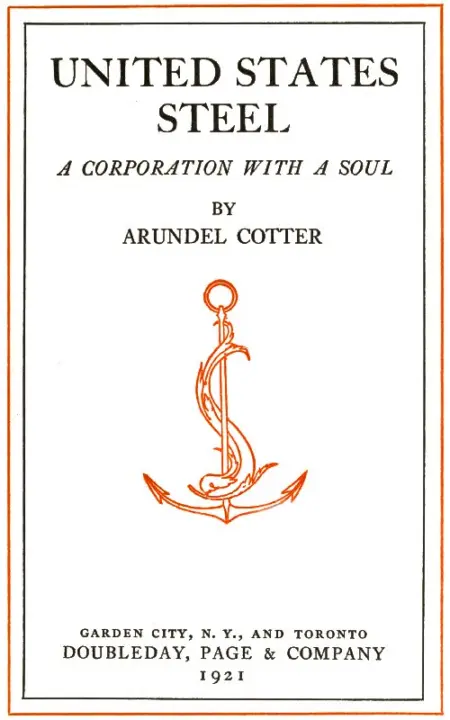
"United States Steel: A Corporation with a Soul" by Arundel Cotter is a historical account written in the early 20th century, specifically 1921. The work explores the foundational story of the United States Steel Corporation, emphasizing the interplay between corporate development and the broader context of the steel industry in America. Through the narrative, Cotter suggests that behind the formidable corporate structure lies a sense of ethics and responsibility, advocating for a perception of the corporation not merely as a business entity but as an institution with moral obligations towards its employees and society. The opening of the book establishes a clear framework for understanding the significance of the United States Steel Corporation within the larger narrative of American industrialization. It introduces Elbert H. Gary, the chairman and chief executive officer, whose vision and leadership are depicted as instrumental in shaping the corporation’s ethos. The prologue suggests that the corporation, which dwarfed its competitors in size and influence, also sought to redefine corporate responsibility by promoting fair competition and transparency in business practices. This veritable blend of corporate ambition and social consciousness lays the groundwork for the detailed history that follows, tracing the evolution of the steel industry's practices and its prominent figures, foreshadowing the in-depth examination of events leading to the establishment of this industrial giant.
Introduction adapted from the source catalogue; source summaries may be automatically generated.
Free to read · English · 96,408 words · No account needed
MAKE TIME FOR A GOOD BOOK
On by default. Untick to stop anonymous reading totals. Each page counts after 10 seconds in view. How this works.
Anonymous counting is on unless you have switched it off.
Total earnings in 1909 were $131,491,413.94, and after all fixed charges had been met, dividends paid, and a special appropriation of $18,200,000 set aside for new construction, etc., a surplus of $15,321,918.04 was carried to profit and loss. The bonded debt of the Corporation in 1909 was increased by $12,718,639.43 to a total of $607,584,173.72, there having been issued by the subsidiary companies bonds to a total of $21,976,500, and bonds totalling $9,257,860.57 having been redeemed.
The year’s operations resulted in a production of 13,355,189 tons of steel ingots and 9,859,660 tons of finished steel products. The total volume of business was reported at $646,382,251.29.
On the steel plant and city of Gary $11,081,367.80 was spent, making the total expended on the project to December 31, 1909, $53,878,597.37. Gary was now a steel-producing centre. Early in the year steel rails were turned out there and shortly after the close of 1908 and later in 1909 several of the steel furnaces and other finishing mills had been placed in operation. About this time it was decided that two of the other constituent companies of the corporation, the Sheet Tin Plate and Bridge companies, should erect plants at Gary, which plants are now in operation and have been for some time.
About the middle of 1910 the wave of improvement that had brought better business and profits to the steel companies began to slacken. The effect was not very immediate and the year, as a whole, was one of the best experienced by the Corporation prior to the war boom. Earnings reached a total of $141,054,754.51, but a fall in quarterly profits from $40,170,960.83 in the quarter ending June 30th, to $25,901,729.87 was sufficient to show the downward tendency in conditions affecting the trade.
Gross business aggregated $703,961,424.41, and production reached its high-water mark, 14,179,369 tons of ingots and 10,733,995 tons of finished steel being turned out by the plants controlled by the Steel Corporation.
Bonds to a total of $17,392,752.14 were redeemed and $6,945,237.50 issued making the outstanding bonded debt of the Corporation and its subsidiary companies on December 31, 1910, $597,136,659.08. Some $16,000,000 was expended in further work at Gary bringing the total outlay on the plant, city, and terminals there to $69,978,695.15, of which $60,203,189.22 was financed from the funds of the parent corporation and the balance by various subsidiary companies, including the Bridge and Wire companies, which began the construction of their new plants during the year.
Your reading position is saved on this browser. Take it to another device with a library code. Reading pages adapt to text, rather than matching a printed edition.
BEHIND THE BOOK
This eBook is for the use of anyone anywhere in the United States and most other parts of the world at no cost and with almost no restrictions whatsoever. You may copy it, give it away or re-use it under the terms of the Project Gutenberg License included with this eBook or online at www.gutenberg.org. If you are not located in the United States, you will have to check the laws of the country where you are located before using this eBook. Read the source licence.
The original source file, including credits and licence, is retained by this library. Request an original-format copy at no charge. Please include the book title and Project Gutenberg identifier #48465.
KEEP YOUR CURIOSITY GOING
Cécile Tormay

Moritz Busch
John L. Ransom
Frances Wright
Cécile Tormay

Mabel Potter Daggett