THE CLASSIC COLLECTION✦An outlaw’s diary: the CommuneCLASSIC FREE BOOKS
An outlaw’s diary: the Commune
Cécile Tormay
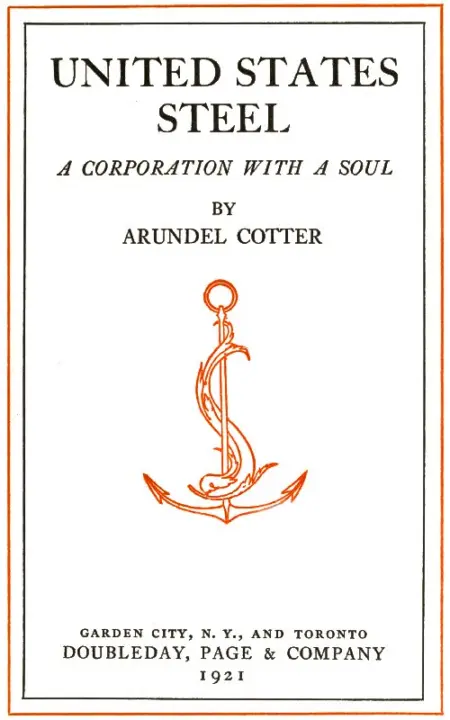
THE CLASSIC COLLECTION · 1921
"United States Steel: A Corporation with a Soul" by Arundel Cotter is a historical account written in the early 20th century, specifically 1921. The work explores the foundational story of the United States Steel Corporation, emphasizing the interplay between corporate development and the broader context of the steel industry in America. Through the narrative, Cotter suggests that behind the formidable corporate structure lies a sense of ethics and responsibility, advocating for a perception of the corporation not merely as a business entity but as an institution with moral obligations towards its employees and society. The opening of the book establishes a clear framework for understanding the significance of the United States Steel Corporation within the larger narrative of American industrialization. It introduces Elbert H. Gary, the chairman and chief executive officer, whose vision and leadership are depicted as instrumental in shaping the corporation’s ethos. The prologue suggests that the corporation, which dwarfed its competitors in size and influence, also sought to redefine corporate responsibility by promoting fair competition and transparency in business practices. This veritable blend of corporate ambition and social consciousness lays the groundwork for the detailed history that follows, tracing the evolution of the steel industry's practices and its prominent figures, foreshadowing the in-depth examination of events leading to the establishment of this industrial giant.
Introduction adapted from the source catalogue; source summaries may be automatically generated.
Free to read · English · 96,408 words · No account needed
MAKE TIME FOR A GOOD BOOK
On by default. Untick to stop anonymous reading totals. Each page counts after 10 seconds in view. How this works.
Anonymous counting is on unless you have switched it off.
Among the important items of expenditure for 1908 is found a sum of $3,460,993 which was employed in modernizing the plants of the Tennessee company acquired the previous year. This was the beginning of a series of large expenditures extending over many years, and all for this purpose. Up to the end of 1914 approximately $20,180,092 had been spent on this work, most of it coming from the general funds of the Corporation and not from the earnings of the southern subsidiary itself.
To what extent the acquisition of the Tennessee company affected the Steel Corporation’s capacity is shown in a table submitted in the report to stockholders for 1908, the figures given being as of the end of the year:
BLAST FURNACE STEEL FINISHED PRODUCTS INGOTS STEEL Tons Tons Tons
Capacity April 1, 1901 7,440,000 9,425,000 7,719,000 Purchase of Union and Sharon Cos. 1,228,000 1,258,000 1,103,000 Tennessee purchase 1,000,000 500,000 400,000 Additions made by different Cos. after acquisition 5,322,000 5,887,000 3,678,000 Capacity January 1, 1909 14,990,000 17,070,000 12,900,000
This report also states that although the total steel capacity of the Corporation had been increased by 2,306,000 tons during 1908 its capacity for the making of Bessemer steel had decreased 746,000 tons, open-hearth capacity increasing 3,052,000 tons. These figures illustrate sufficiently the change then occurring in the steel trade from the old Bessemer to the new open-hearth process.
An even more striking illustration of the manner in which open-hearth steel has been displacing the older Bessemer process in recent years is afforded by the figures of the American Iron & Steel Institute. In 1880 open-hearth production was only 100,851 tons against 1,064,262 tons of Bessemer. A decade after Bessemer production was 3,688,871 tons compared with 513,232 tons of open-hearth, and in 1900, 6,684,770 tons of Bessemer were turned out by the steel mills of this country for 3,398,135 tons of open-hearth. By 1907 the two processes of steel making were running a close race for popularity with consumers, open-hearth production being 11,549,736 tons in that year, and Bessemer 11,667,549 tons. In every subsequent year open-hearth production has been the larger, as shown by the following figures of the country’s production:
1908 6,166,755 7,836,729 1909 9,330,783 14,493,936 1910 9,412,772 16,504,509 1911 7,947,854 15,598,650 1912 10,327,901 20,780,723 1913 9,545,706 21,599,931 1914 6,220,846 17,174,684 1915 23,679,102 8,287,213 1916 31,415,427 11,059,039 1917 34,148,893 10,479,960 1918 34,459,391 9,376,236 1919 26,948,694 7,271,562
Business conditions gradually bettered throughout 1909, although the so-called open market that existed in the steel trade resulted in an average of prices during the year somewhat lower than in 1908. Nevertheless, increased production caused a marked and gradual gain in the earnings of the big Corporation, which from $22,921,268.75 in the first quarter grew to $29,340,491.62 in the second quarter, $38,246,907.43 in the third, and $40,982,746.14 in the closing three months.
Your reading position is saved on this browser. Take it to another device with a library code. Reading pages adapt to text, rather than matching a printed edition.
BEHIND THE BOOK
This eBook is for the use of anyone anywhere in the United States and most other parts of the world at no cost and with almost no restrictions whatsoever. You may copy it, give it away or re-use it under the terms of the Project Gutenberg License included with this eBook or online at www.gutenberg.org. If you are not located in the United States, you will have to check the laws of the country where you are located before using this eBook. Read the source licence.
The original source file, including credits and licence, is retained by this library. Request an original-format copy at no charge. Please include the book title and Project Gutenberg identifier #48465.
KEEP YOUR CURIOSITY GOING
Cécile Tormay

Moritz Busch
John L. Ransom
Frances Wright
Cécile Tormay

Mabel Potter Daggett