
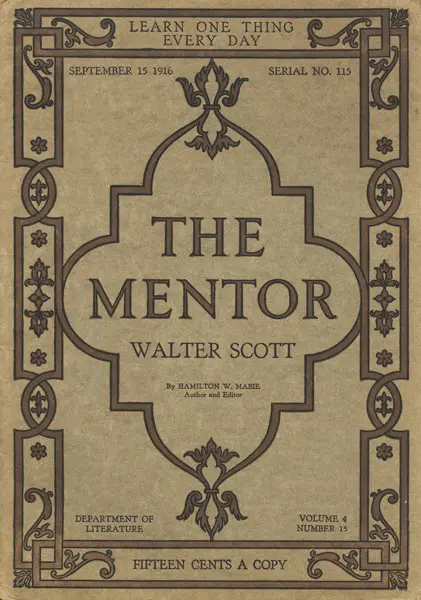
The Mentor: American Pioneer Prose Writers, Vol. 4, Num. 6, Serial No. 106, May 1, 1916
Hamilton Wright Mabie
THE CLASSIC COLLECTION · 1891
"Under the Trees and Elsewhere" by Hamilton Wright Mabie is a collection of nature essays likely written in the late 19th century. The work explores the beauty and significance of nature through the lens of human experience, focusing on the emotional and philosophical reflections prompted by seasonal changes and natural landscapes. It emphasizes a deep emotional connection between humanity and the natural world, celebrating the quiet moments of appreciation and insight found in solitude. The opening of the collection introduces the author's personal retreat from the busyness of life into the tranquility of nature. He reflects on the dullness that had taken over his study, prompting him to seek solace outdoors. As he experiences the awakening of spring, with blossoming apple trees and the subtle transformations of the landscape, he conveys a profound appreciation for the gentler aspects of nature that often go unnoticed amidst the vibrant summer sights. The first chapter sets the stage for a series of contemplative essays that invite readers to find beauty and meaning in the quiet and often overlooked moments of the natural world.
Introduction adapted from the source catalogue; source summaries may be automatically generated.
Free to read · English · 47,303 words · No account needed
MAKE TIME FOR A GOOD BOOK
On by default. Untick to stop anonymous reading totals. Each page counts after 10 seconds in view. How this works.
Anonymous counting is on unless you have switched it off.
And this our life, exempt from public haunt,
Finds tongues in trees, books in the running brooks,
Sermons in stones, and good in everything.
It was one of those entrancing mornings when the earth seems to have been made over under cover of night, and one drinks the first draught of a new experience when he sees it by the light of a new day. Such mornings are not uncommon in Arden, where the nightly dews work a perpetual miracle of freshness. On this particular morning we had strayed long and far, the silence and solitude of the woods luring us hour after hour with unspoken promises to the imagination. We had come at length to a place so secluded, so remote from stir and sound, that one might dream there of the sacredness of ancient oracles and the revels of ancient gods.
Rosalind had gathered wild flowers along the way, and sat at the base of a great tree intently disentangling her treasures. With that figure before me, I thought of nearer and more sacred things than the old woodland gods that might have strayed that way centuries ago; I had no need to recall the vanished times and faiths to interpret the spirit of an hour so far from the commonplaces of human speech, so free from the passing moods of human life. The sweet unconsciousness of that face, bent over the mass of wild flowers, and akin to them in its unspoiled loveliness, was to that hour and place like the illuminated capital in the old missal; a ray of colour which unlocked the dark mystery of the text. When one can see the loveliness of a wild flower, and feel the absorbing charm of its sentiment, one is not far from the kingdom of Nature.
As these fancies chased one another across my mind, lying there at full length on the moss, I, too, seemed to lose all consciousness that I had ever touched life at any point than this, or that any other hour had ever pressed its cup of experience to my lips. The great world of which I was once part disappeared out of memory like a mist that recedes into a faint cloud and lies faint and far on the boundaries of the day; my own personal life, to which I had been bound by such a multitude of gossamer threads that when I tried to unloose one I seemed to weave a hundred in its place, seemed to sink below the surface of consciousness. I ceased to think, to feel; I was conscious only of the vast and glorious world of tree and sky which surrounded me. I felt a thrill of wonder that I should be so placed. I had often lain thus under other trees, but never in such a mood as this. It was as if I had detached myself from the hitherto unbroken current of my personal life, and by some miracle of that marvellous place become part of the inarticulate life of Nature. Clouds and trees, dim vistas of shadow and flower-starred space of sunlight, were no longer alien to me; I was akin with the vast and silent movement of things which encompassed me. No new sound came to me, no new sight broke on my vision; but I heard with ears, and I saw with eyes, to which all other sounds and sights had ceased to be. I cannot translate into words the mystery and the thrill of that hour when, for the first time, I gave myself wholly into the keeping of Nature, and she received me as her child. What I felt, what I saw and heard, belong only to that place; outside the Forest of Arden they are incomprehensible. It is enough to say that I had parted with all my limitations, and freed myself from all my bonds of habit and ignorance and prejudice; I was no longer worn and spent with work and emotion and impression; I was no longer prisoned within the iron bars of my own personality. I was as free as the bird; I was as little bound to the past as the cloud that an hour ago was breathed out of the heart of the sea; I was as joyous, as unconscious, as wholly given to the rapture of the hour as if I had come into a world where freedom and joy were an inalienable and universal possession. I did not speculate about the great fleecy clouds that moved like galleons in the ethereal sea above me; I simply felt their celestial beauty, the radiancy of their unchecked movement, the freedom and splendour of the inexhaustible play of life of which they were part. I asked no questions of myself about the great trees that wove the garments of the magical forest about me; I felt the stir of their ancient life, rooted in the centuries that had left no record in that place save the added girth and the discarded leaf; I had no thought about the bird whose note thrilled the forest save the rapture of pouring out without measure or thought the joy that was in me; I felt the vast irresistible movement of life rolling, wave after wave, out of the unseen seas beyond, obliterating the faint divisions by which, in this working world, we count the days of our toil, and making all the ages one unbroken growth; I felt the measureless calm, the sublime repose, of that uninterrupted expansion of form and beauty, from flower to star and from bird to cloud; I felt the mighty impulse of that force which lights the sun in its track and sets the stars to mark the boundaries of its way. Unbroken repose, unlimited growth, inexhaustible life, measureless force, unsearchable beauty--who shall feel these things and not know that there are no words for them! And yet in Arden they are part of every man's life!
Your reading position is saved on this browser. Take it to another device with a library code. Reading pages adapt to text, rather than matching a printed edition.
Hamilton Wright Mabie
Hamilton Wright Mabie
Hamilton Wright Mabie
Hamilton Wright Mabie
BEHIND THE BOOK
This eBook is for the use of anyone anywhere in the United States and most other parts of the world at no cost and with almost no restrictions whatsoever. You may copy it, give it away or re-use it under the terms of the Project Gutenberg License included with this eBook or online at www.gutenberg.org. If you are not located in the United States, you will have to check the laws of the country where you are located before using this eBook. Read the source licence.
The original source file, including credits and licence, is retained by this library. Request an original-format copy at no charge. Please include the book title and Project Gutenberg identifier #19645.
KEEP YOUR CURIOSITY GOING

David Patterson (Spirit) Hatch

David Patterson (Spirit) Hatch

David Patterson (Spirit) Hatch
Cécile Tormay

Moritz Busch
John L. Ransom