THE CLASSIC COLLECTION✦An outlaw’s diary: the CommuneCLASSIC FREE BOOKS
An outlaw’s diary: the Commune
Cécile Tormay
THE CLASSIC COLLECTION · 1908
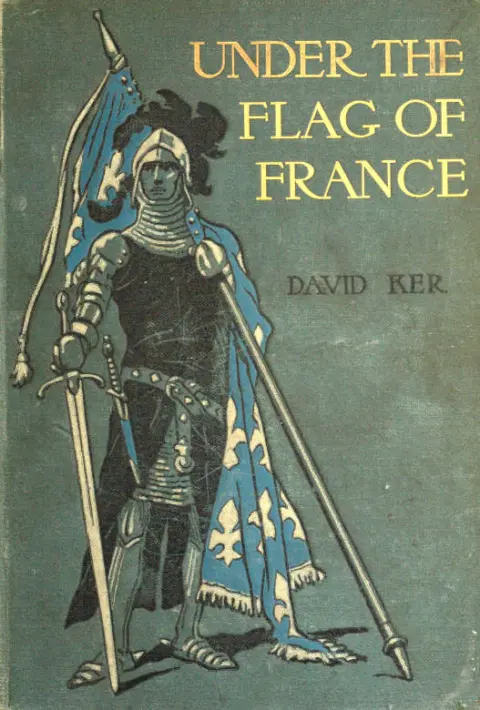
"Under the Flag of France: A Tale of Bertrand du Guesclin" by David Ker is a historical novel written in the early 20th century. The book centers around Bertrand du Guesclin, a young boy from Brittany in the 14th century, who faces ridicule due to his physical appearance but is destined for greatness. The narrative explores themes of heroism, destiny, and the struggles of the underdog as it unfolds during a tumultuous period marked by conflict between France and England. The opening of the tale introduces readers to a fourteen-year-old Bertrand, who is grappling with feelings of despair over his perceived ugliness and his longing for acceptance. Set against a serene backdrop of the Breton countryside, Bertrand's emotional turmoil leads to an inner confrontation as he expresses a wish for death due to his family's disdain. However, his fortunes begin to shift when he encounters a beautiful song that resonates deeply with him, followed by a fateful encounter where he demonstrates great valor by saving a simpleton from a wolf attack. This moment establishes Bertrand's character and foreshadows the greater legacy that awaits him as a defender of the weak. Additionally, the presence of Brother Michael, a holy monk who assures Bertrand of his destined greatness, paints a vivid picture of Bertrand's journey from a tormented youth to a future champion of France.
Introduction adapted from the source catalogue; source summaries may be automatically generated.
Free to read · English · 85,354 words · No account needed
MAKE TIME FOR A GOOD BOOK
On by default. Untick to stop anonymous reading totals. Each page counts after 10 seconds in view. How this works.
Anonymous counting is on unless you have switched it off.
“Then,” faltered the stout bowman, “in a moment both swords were out, and the fray began. We all ran like madmen to part them; but——”
Here the brave man’s overtasked firmness fairly gave way, and the fatal words that he tried to utter were lost in a convulsive gasp.
“Enough, good friend. I understand thee,” said Prince Edward, kindly. “It was Sir Hugo, then, who fell. But what of the unhappy Sir Alured, whom God pity and forgive?”
“He dashed away as if pursued by the Evil One himself; and just then back came Sir Simon, who had seen from afar, belike, what had befallen.”
“Ha!” cried the prince again, in the same peculiar tone as before.
“Then shouted Sir Simon to us, ‘What do ye, knaves, letting yon felon knight escape?’ And he pointed after the traitor Flanderkin, who, seeing none left to guard him, was making his escape like a false rogue as he was, in spite of his plighted word. ‘After him speedily, and see he escape ye not. I will follow my nephew.’
“As he spake thus, he turned and rode off after Sir Alured, while we chased the Fleming and caught him; for we must needs obey Sir Simon’s command, though certain of us had our own thoughts of the matter.”
“And what were thy thoughts of it?” asked Prince Edward, turning suddenly on him, and looking him full in the face.
The rough soldier replied only by shuffling uneasily with his feet, and twisting his fingers nervously into each other, while his eyes shrank away from the piercing glance fixed on him.
“I ask thee, friend,” repeated the prince, in a tone which there was no gainsaying, “what were thy thoughts on this matter? And I charge thee, as thou art loyal subject and true Englishman, to answer me truly.”
“Well, if your highness will have it,” blurted out the yeoman, in sheer desperation, “I thought, as did others beside me (may God forgive us if we were wrong!), that Sir Simon, being next heir to the broad lands of Claremont, had bred a quarrel ’twixt his nephews, hoping that if they slew each other, lands and goods should be his without more ado.”
A gloomy silence followed the utterance of this ghastly suspicion, broken at last by the Black Prince himself.
“Be not troubled, good fellow,” said he, laying his hand kindly on the other’s shoulder. “Thou hast spoken what thou holdest to be the truth, as every man is bound to do; and if thou art mistaken, why, so might any man be in like case. But what befell next?”
Your reading position is saved on this browser. Take it to another device with a library code. Reading pages adapt to text, rather than matching a printed edition.
BEHIND THE BOOK
This eBook is for the use of anyone anywhere in the United States and most other parts of the world at no cost and with almost no restrictions whatsoever. You may copy it, give it away or re-use it under the terms of the Project Gutenberg License included with this eBook or online at www.gutenberg.org. If you are not located in the United States, you will have to check the laws of the country where you are located before using this eBook. Read the source licence.
The original source file, including credits and licence, is retained by this library. Request an original-format copy at no charge. Please include the book title and Project Gutenberg identifier #46855.
KEEP YOUR CURIOSITY GOING
Cécile Tormay

Moritz Busch
Coulson Kernahan
John L. Ransom

Maurice Baring
Frances Wright