THE CLASSIC COLLECTION✦Found in the Philippines: The Story of a Woman’s LettersCLASSIC FREE BOOKS
Found in the Philippines: The Story of a Woman’s Letters
Charles King
THE CLASSIC COLLECTION · 1894
"Under Fire" by Charles King is a novel written in the late 19th century. The narrative centers around Captain Wilbur Cranston, a soldier who is preparing to return to the frontier after a leave of absence at home, where he was reunited with his family and old friends. The story explores themes of military duty, family ties, and the contrast between civilized life and the harsh realities of army life on the American frontier. The opening of the book sets the scene with Captain Cranston's bittersweet departure from a bustling Western city, filled with fond memories of his time spent with his charming wife and their two energetic boys. As the narrative unfolds, Cranston's internal conflicts about his duty and his family's reactions to his departure become evident. The introduction of characters such as Mrs. Barnard, who seeks Cranston's assistance regarding her troubled son, hints at the wider social dynamics and personal struggles that will intersect with military life. The initial chapters vividly depict the disconnection between the glamorous life left behind and the challenging world awaiting him on the frontier, setting the stage for the unfolding drama as they grapple with personal and societal challenges amidst the backdrop of impending military conflict.
Introduction adapted from the source catalogue; source summaries may be automatically generated.
Free to read · English · 142,767 words · No account needed
MAKE TIME FOR A GOOD BOOK
On by default. Untick to stop anonymous reading totals. Each page counts after 10 seconds in view. How this works.
Anonymous counting is on unless you have switched it off.
"Yes?" said Davies, smiling. "Then perhaps I'll see him some day. I expect to be out there before long."
"And you are a soldier, too! Ach Gott! ein offizier?" she exclaimed, in consternation, born of German associations.
"Not yet, though I suppose I shall be very soon. What is your boy's
regiment?"
And, jabbering excitedly now, both at once, the two old people began pouring their tale into his ears; told their boy's name,--"He was a gorboral alretty,"--and they were justly proud, and Davies made them happy by noting the name and company in his book and giving his own, though he explained that he was not yet a lieutenant, only a just-graduated cadet, but that if ever he found the corporal, he said, he should tell him of his pleasant meeting with the old folks, and then, after a cup of coffee at the restaurant counter, he returned to his own thoughts and the car.
Soon they were spinning up along the shining Mohawk, and still his eyelids would not close. In his waistcoat-pocket lay a bulky letter, the last of many in the same superscription--a prim, unformed, school-girlish hand--that had come to him during the last two years of his cadet life. Its predecessors, carefully wrapped and tied, were in the old trunk somewhere ahead among the baggage. In his hand again was the telegram that, reaching him at the moment when he was bidding adieu to the academic shades he had grown so deeply to love, had determined him in the already half-formed resolution to cut loose from his comrades and the class festivities in New York and take the first train for the far West.
"URBANA, June 12.
"Doctor says come quick. Almira worse.
"B" was Almira's elder sister. Urbana, the home of his boy- and her girlhood, the home where his father lived and died, pastor of the village flock, a man whose devotion and patriotism during the great war had won for himself the friendship of the leaders of the armies of the West and for his only son, years afterwards, the prize of a cadetship at West Point. Deeply religious in every fibre of his soul, the chaplain had labored among the hospitals in the field from first to last, and died not long after the close of the historic struggle, a martyr to the cause. He died poor, too, as such men ever die, laying up no treasures upon earth, where moth and rust and thieves are said to lessen treasure there accumulated, yet where its accumulation seems the chief end of man not spiritually constituted as was Davies, who was imposed upon by every beat and beggar, tramp and drab, within reachable distance of Urbana. Far and wide had spread abroad the words of his personal creed,--that he would rather it were recorded against him that he had been duped a million times than that one human being had left his door hungering. His widow was not only merely penniless, she was helpless but for the strong arms of her son, who slaved for her as the father had slaved for the Union. Those were the days when pensions were few. It was too soon after the war, and facts were fresher in men's minds. Percy did all the farm-work by day and taught school by night until, in his twenty-first year, he was sent to the Military Academy by the President himself, who had known his father from the days of Donelson. It was told of the tall, taciturn young man that he seriously contemplated resigning during his fourth class year when he found that he could not send home the little savings from his cadet pay. If the rule of the sacred commandment could but be made to work both ways, and days would be indeed long in the land the Lord our God had given to him who most honored his father and mother, no life insurance company in all America would have hesitated in Percy Davies's case, had the policy been millions and the premium unity. A gentle woman was Mrs. Davies, but a distressingly helpless and dependent one, and it was an old saying in Urbana that Davies had married poor Salome Percy because if he didn't nobody would; not because he stood in need of her, but because she was much in need of him. And when, not long after his father's death, Percy appealed to a well-to-do citizen on the widow's behalf, he was refused, and the brawny son and heir of the well-to-do citizen told of the incident, and was idiot enough in Percy's presence to repeat this old village saw as the reason of the refusal, it nearly led to tragedy. Seizing the first available weapon, a flail, which he wielded with uncommon skill, in one mad moment the indignant youth smote the other hip and thigh,--the first, and for years the only, time he was ever known to lose control of himself. In ten seconds the battered gossip was sprawled full length, and they who would have rushed to tear his assailant away stood amazed to see him tearfully imploring the pardon of the vanquished.
Your reading position is saved on this browser. Take it to another device with a library code. Reading pages adapt to text, rather than matching a printed edition.
Charles King

Charles King
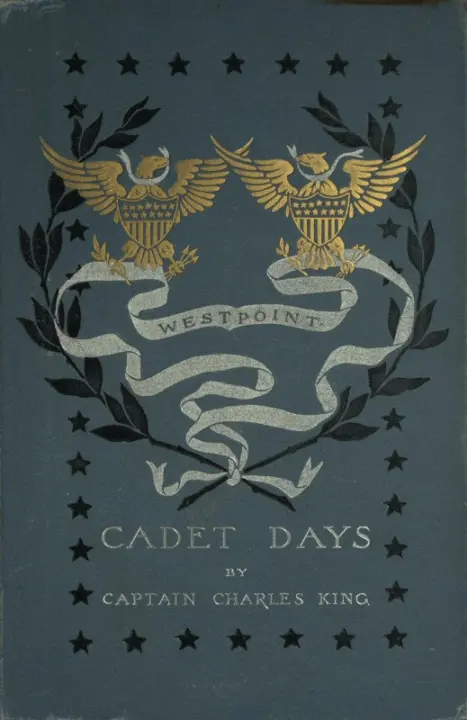
Charles King

Charles King
BEHIND THE BOOK
This eBook is for the use of anyone anywhere in the United States and most other parts of the world at no cost and with almost no restrictions whatsoever. You may copy it, give it away or re-use it under the terms of the Project Gutenberg License included with this eBook or online at www.gutenberg.org. If you are not located in the United States, you will have to check the laws of the country where you are located before using this eBook. Read the source licence.
The original source file, including credits and licence, is retained by this library. Request an original-format copy at no charge. Please include the book title and Project Gutenberg identifier #20101.
KEEP YOUR CURIOSITY GOING
Cécile Tormay

Moritz Busch
Coulson Kernahan
John L. Ransom

Maurice Baring
Frances Wright