
Uncle Sam’s Boys on Field Duty; or, Winning Corporal’s Chevrons
H. Irving (Harrie Irving) Hancock
THE CLASSIC COLLECTION · 1910
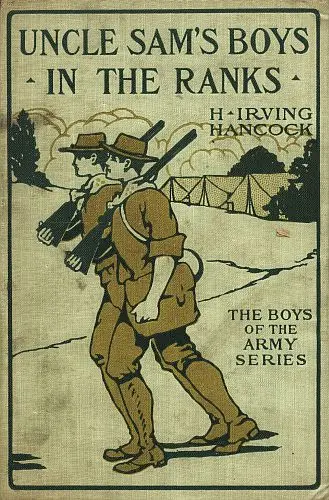
"Uncle Sam's Boys in the Ranks; or, Two Recruits in the United States Army" by H. Irving Hancock is a novel written in the early 20th century. The story focuses on two young boys, Hal Overton and Noll Terry, who are eager to enlist in the United States Army, driven by a sense of patriotism and adventure. As they navigate the challenges of military life, they encounter a mix of camaraderie and the harsh realities of the discipline that comes with serving in the army. At the start of the book, we are introduced to the boys and their friends in a small New Jersey town, highlighting their differing opinions about soldiers and patriotism. After a heated debate, Hal and Noll resolve to enlist, despite the criticisms from others. The opening scenes depict their journey to the recruiting office, interactions with various characters, including a bully named Tip Branders, and their first experiences as recruits. Through humor and friendship, the narrative sets the stage for their transformation from inexperienced boys into disciplined soldiers, leading to adventures that await them in the army.
Introduction adapted from the source catalogue; source summaries may be automatically generated.
Free to read · English · 47,181 words · No account needed
MAKE TIME FOR A GOOD BOOK
On by default. Untick to stop anonymous reading totals. Each page counts after 10 seconds in view. How this works.
Anonymous counting is on unless you have switched it off.
So Hal was silent, though he could hardly escape the feeling that he was being treated a good deal like a suspected criminal. Though he knew that he was innocent of any wrong-doing in connection with the excitement of the night before he could not help feeling undefined dread.
Lieutenant Wright speedily returned to his office, taking his seat at his desk. Hal was summoned and made to stand at attention before the adjutant.
"Now, Private Overton," began the adjutant, fixing a frigid gaze on the rookie, "you may as well tell me all you know about last night's business."
Hal quickly told the little that he knew.
"Come, come, my man," retorted Lieutenant Wright, "that much won't do.
Out with the rest of it."
"There isn't any 'rest of it' that I know of, sir," Private Hal answered
respectfully.
"Now, my man----"
With that preliminary Lieutenant Wright proceeded to put the young recruit through a severe, grilling cross-examination. But Hal kept his head through it all, insisting that he had told all he knew.
"Overton," rapped in the adjutant, at last, "you are very new to the Army, and you don't appear to realize all the facilities we have for compelling men to speak. If you remain obtuse any longer, it may be necessary for me to order you to the guard-house under confinement."
"I am very sorry, Lieutenant," Hal replied, flushing, "that you will not believe me. On my word of honor as a soldier I have told you all that I know of the matter."
The adjutant bent forward, looking keenly into the rookie's eyes. Hal did not flinch, returning the gaze steadily, respectfully.
Then, in a somewhat less gruff tone, Lieutenant Wright continued:
"That is all for the present, Private Overton. Report to your company
commander, at once."
The adjutant and sergeant-major left headquarters a moment later, going by a different path. As Hal glanced down the parade ground he saw the men out of ranks, though every man was still close to his place.
"Major," reported the adjutant, after the exchange of salutes between the officers, "Private Overton denies having left the squad room in the early hours this morning. For that matter, sir, if he had not been honest, he need not have reported that he was out of his bed, or that he heard the sentries' shots."
"It was well he did admit that much," replied the major, "for he let it out at company mess this morning."
"I went at the young recruit, sir, so severely that I was almost ashamed of myself," continued the adjutant. "I am under the impression, sir, that Private Overton told me the truth."
Your reading position is saved on this browser. Take it to another device with a library code. Reading pages adapt to text, rather than matching a printed edition.
H. Irving (Harrie Irving) Hancock

H. Irving (Harrie Irving) Hancock

H. Irving (Harrie Irving) Hancock

H. Irving (Harrie Irving) Hancock
BEHIND THE BOOK
This eBook is for the use of anyone anywhere in the United States and most other parts of the world at no cost and with almost no restrictions whatsoever. You may copy it, give it away or re-use it under the terms of the Project Gutenberg License included with this eBook or online at www.gutenberg.org. If you are not located in the United States, you will have to check the laws of the country where you are located before using this eBook. Read the source licence.
The original source file, including credits and licence, is retained by this library. Request an original-format copy at no charge. Please include the book title and Project Gutenberg identifier #27680.
KEEP YOUR CURIOSITY GOING
Coulson Kernahan

Maurice Baring
Frances Wright
Cécile Tormay

Frederic Jesup Stimson

W. H. P. (William Henry Pope) Jarvis