
Uncle Sam’s Boys on Field Duty; or, Winning Corporal’s Chevrons
H. Irving (Harrie Irving) Hancock
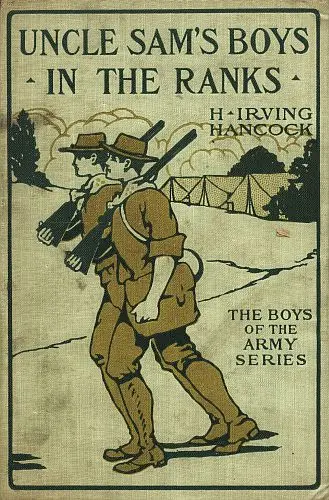
THE CLASSIC COLLECTION · 1910
"Uncle Sam's Boys in the Ranks; or, Two Recruits in the United States Army" by H. Irving Hancock is a novel written in the early 20th century. The story focuses on two young boys, Hal Overton and Noll Terry, who are eager to enlist in the United States Army, driven by a sense of patriotism and adventure. As they navigate the challenges of military life, they encounter a mix of camaraderie and the harsh realities of the discipline that comes with serving in the army. At the start of the book, we are introduced to the boys and their friends in a small New Jersey town, highlighting their differing opinions about soldiers and patriotism. After a heated debate, Hal and Noll resolve to enlist, despite the criticisms from others. The opening scenes depict their journey to the recruiting office, interactions with various characters, including a bully named Tip Branders, and their first experiences as recruits. Through humor and friendship, the narrative sets the stage for their transformation from inexperienced boys into disciplined soldiers, leading to adventures that await them in the army.
Introduction adapted from the source catalogue; source summaries may be automatically generated.
Free to read · English · 47,181 words · No account needed
MAKE TIME FOR A GOOD BOOK
On by default. Untick to stop anonymous reading totals. Each page counts after 10 seconds in view. How this works.
Anonymous counting is on unless you have switched it off.
"Perhaps we can," assented Noll.
A soldier came along, driving a pair of mules to which a quarter master's wagon was hitched. As he drew near, with a heavy load aboard, he halted to rest the mules.
"Rooks, ain't ye?" questioned the soldier.
"Yes," admitted Hal.
"Taking a survey of the post?"
"Rather. We don't have to report for duty until to-morrow."
After a few moments the soldier climbed down from the seat of the wagon. He was wholly willing to tell the boys whatever they wanted to know about Fort Clowdry and to point out the features of interest in the surrounding lines of mountains.
"Ever go hunting?" asked the soldier, at last.
"Yes; after squirrels and partridges," laughed Hal.
"No real hunting, though?"
"None."
"Then, if you can keep out of discipline troubles, ye'll have some fun
around here by and by."
"Soldiers don't have much time for hunting, do they?" Hal asked.
"Those that know how to hunt do," replied the older soldier. "That's
part of the life here. Didn't ye ever hear about soldier hunting
parties?"
"I certainly haven't," Hal admitted.
"Why, men of good conduct are often allowed to go off on hunting parties when the game's running right. Generally there's six or eight men to a party, and all have to be fair shots, for the K. O. doesn't aim to have too much ammunition wasted," explained the old soldier. "One of the party is a non-com and he has charge of the party."
"What do the hunters get?" queried Hal.
"Well, for bigger game, bear and mountain antelope mostly. Then some parties go after birds; there's plenty of them, too, in the mountains, at the right seasons."
"Say!" exploded Noll, his eyes shining.
"Think ye'd like to go on a hunting party, do ye?" asked the soldier. "Get up yer record for marksmanship, then."
"What's done with the game?" asked Noll innocently.
"What----" the soldier started to repeat. Then he added, dryly:
"Oh, we send the game to the hospitals in Denver and Pueblo, of course!"
"Don't we get any of it to eat?" asked Noll, looking up.
"Say, don't ever go off with a party that doesn't bring back a big haul of game," advised the older soldier. "If ye do, the company cooks will lynch ye. Why, that's what we go hunting for--to vary the bill of fare here at the post. Sometimes, when we're all just aching for bear steaks, an officer and twenty or thirty men all hike off at once into the mountain trails. There are plenty of game dinners at Clowdry, at different times in the year."
Your reading position is saved on this browser. Take it to another device with a library code. Reading pages adapt to text, rather than matching a printed edition.
H. Irving (Harrie Irving) Hancock

H. Irving (Harrie Irving) Hancock

H. Irving (Harrie Irving) Hancock

H. Irving (Harrie Irving) Hancock
BEHIND THE BOOK
This eBook is for the use of anyone anywhere in the United States and most other parts of the world at no cost and with almost no restrictions whatsoever. You may copy it, give it away or re-use it under the terms of the Project Gutenberg License included with this eBook or online at www.gutenberg.org. If you are not located in the United States, you will have to check the laws of the country where you are located before using this eBook. Read the source licence.
The original source file, including credits and licence, is retained by this library. Request an original-format copy at no charge. Please include the book title and Project Gutenberg identifier #27680.
KEEP YOUR CURIOSITY GOING
Coulson Kernahan

Maurice Baring
Frances Wright
Cécile Tormay

Frederic Jesup Stimson

W. H. P. (William Henry Pope) Jarvis