
Uncle Sam’s Boys on Field Duty; or, Winning Corporal’s Chevrons
H. Irving (Harrie Irving) Hancock
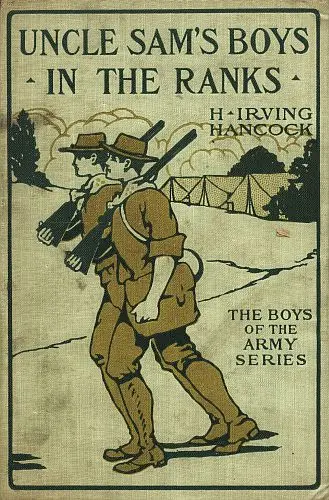
THE CLASSIC COLLECTION · 1910
"Uncle Sam's Boys in the Ranks; or, Two Recruits in the United States Army" by H. Irving Hancock is a novel written in the early 20th century. The story focuses on two young boys, Hal Overton and Noll Terry, who are eager to enlist in the United States Army, driven by a sense of patriotism and adventure. As they navigate the challenges of military life, they encounter a mix of camaraderie and the harsh realities of the discipline that comes with serving in the army. At the start of the book, we are introduced to the boys and their friends in a small New Jersey town, highlighting their differing opinions about soldiers and patriotism. After a heated debate, Hal and Noll resolve to enlist, despite the criticisms from others. The opening scenes depict their journey to the recruiting office, interactions with various characters, including a bully named Tip Branders, and their first experiences as recruits. Through humor and friendship, the narrative sets the stage for their transformation from inexperienced boys into disciplined soldiers, leading to adventures that await them in the army.
Introduction adapted from the source catalogue; source summaries may be automatically generated.
Free to read · English · 47,181 words · No account needed
MAKE TIME FOR A GOOD BOOK
On by default. Untick to stop anonymous reading totals. Each page counts after 10 seconds in view. How this works.
Anonymous counting is on unless you have switched it off.
"I'll wager you hit him first, though, or else gave young Overton good cause for hitting you," smiled the chief. "I know Overton, and he's the kind of boy his neighbors can vouch for. I don't know as much good of you. But I'll tell you, Tip, how you can best win my good opinion. Take a walk--a good, brisk walk--straight down the street. And start now!"
Something in the police chief's voice told Tip that it would be well to
obey. He did so.
"Too many young fellows like him on the street," observed Chief Blake, with a quiet smile. "Good morning, boys."
At the next corner Hal and Noll turned.
"Oh, you're going to see Sergeant Wright?" asked Jud.
"Yes," nodded Hal. "Our last visit to him."
"Then you won't want us along," said Jud sensibly. "But say, we wish you barrels of luck--honest--in the new life you're going into."
"Thank you," laughed Hal good-humoredly, holding out his hand.
"Send me a brass button soon, one that you've worn on your uniform blouse, will you?" begged Jud.
"Yes," agreed Hal, "if there's nothing in the regulations against it."
"And you, Noll? Will you do as much for me?" begged Tom.
"Surely, on the same conditions," promised Noll Terry.
"But we haven't succeeded in getting into the service yet, you must
remember," Hal warned them.
"Oh, shucks!" retorted Jud. "I wish I were as sure of anything that I want. The recruiting officer'll be tickled to death when he sees you two walking in on him."
"I hope you're a real, true prophet, Jud," replied Hal, with a wistful
smile.
Neither of these two younger boys had any idea how utterly Hal Overton had set his heart on entering the service, nor why. The reader will presently discover more about the surging "why."
On one of the side streets the boys paused before the door of a cozy, little cottage in which lived Sergeant Wright and the wife who had been with him nearly the whole of his time in the service.
Ere they could ring the bell the door opened, and Sergeant Wright, U. S. Army, retired, stood before them, holding out his hand.
"Well, boys," was the kindly greeting of this fine-looking, middle-aged man, "have you settled the whole matter at home?"
"Yes," nodded Hal happily. "We go to New York, to-morrow, to try our luck with the recruiting officer."
"Come right in, boys, and we'll have our final talk about the good old Army," cried the retired sergeant heartily.
Your reading position is saved on this browser. Take it to another device with a library code. Reading pages adapt to text, rather than matching a printed edition.
H. Irving (Harrie Irving) Hancock

H. Irving (Harrie Irving) Hancock

H. Irving (Harrie Irving) Hancock

H. Irving (Harrie Irving) Hancock
BEHIND THE BOOK
This eBook is for the use of anyone anywhere in the United States and most other parts of the world at no cost and with almost no restrictions whatsoever. You may copy it, give it away or re-use it under the terms of the Project Gutenberg License included with this eBook or online at www.gutenberg.org. If you are not located in the United States, you will have to check the laws of the country where you are located before using this eBook. Read the source licence.
The original source file, including credits and licence, is retained by this library. Request an original-format copy at no charge. Please include the book title and Project Gutenberg identifier #27680.
KEEP YOUR CURIOSITY GOING
Coulson Kernahan

Maurice Baring
Frances Wright
Cécile Tormay

Frederic Jesup Stimson

W. H. P. (William Henry Pope) Jarvis