
Uncle Sam’s Boys on Field Duty; or, Winning Corporal’s Chevrons
H. Irving (Harrie Irving) Hancock
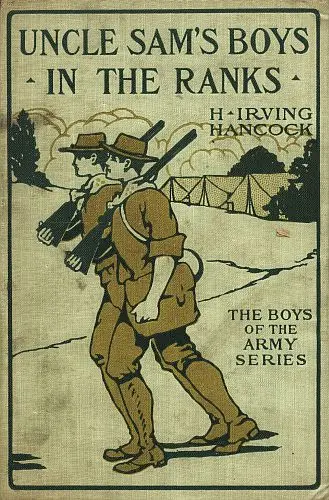
THE CLASSIC COLLECTION · 1910
"Uncle Sam's Boys in the Ranks; or, Two Recruits in the United States Army" by H. Irving Hancock is a novel written in the early 20th century. The story focuses on two young boys, Hal Overton and Noll Terry, who are eager to enlist in the United States Army, driven by a sense of patriotism and adventure. As they navigate the challenges of military life, they encounter a mix of camaraderie and the harsh realities of the discipline that comes with serving in the army. At the start of the book, we are introduced to the boys and their friends in a small New Jersey town, highlighting their differing opinions about soldiers and patriotism. After a heated debate, Hal and Noll resolve to enlist, despite the criticisms from others. The opening scenes depict their journey to the recruiting office, interactions with various characters, including a bully named Tip Branders, and their first experiences as recruits. Through humor and friendship, the narrative sets the stage for their transformation from inexperienced boys into disciplined soldiers, leading to adventures that await them in the army.
Introduction adapted from the source catalogue; source summaries may be automatically generated.
Free to read · English · 47,181 words · No account needed
MAKE TIME FOR A GOOD BOOK
On by default. Untick to stop anonymous reading totals. Each page counts after 10 seconds in view. How this works.
Anonymous counting is on unless you have switched it off.
"I'll wait a few moments," Hal decided. "Then, if I don't hear from the scoundrels, I'll cross over to see what has happened to Major Davis."
Crack! crack! crack! The vanished pair of train robbers were opening fire again, from behind a boulder that sheltered them admirably. Hal and Noll had no protection other than they could get from lying close to the ground. But they answered the fire briskly.
Crack! crack! crack! As fast as revolvers were emptied the marksmen reloaded and again began firing. In daylight the execution would have been swifter, but all hits made in black darkness are made by the grace of luck.
In the first place the only target anyone in the combat had was the flash of an opponent's pistol.
The train robbers behind the ledge changed their positions after nearly every shot. And Hal and Noll, after the warm, uncomfortable experience of having bullets fan their faces persistently, found it advisable to crouch low and dart here and there, firing from new positions.
All this time the scores of people on the train were sitting in terrified silence. Passengers or train crews rarely interfere in a case of this kind.
Not even the train's lights aided either side, for the two young recruits had taken pains to close in on the ledge sufficiently to escape illumination by the train's lights.
Crack! crack! crack! This was a new note, coming from past the forward
end of the ledge.
Almost in the same instant a howl sounded from behind the barrier of
rock.
Then another voice was heard, shouting.
"Hold on! We surrender! Stop the shooting!"
Instantly this hail was answered by another. It sounded good to the young recruits as Major Davis roared from behind the forward end of the ledge:
"Then throw up your hands, keep them up, and walk into the train light
where we can see you."
"You won't shoot?" demanded the voice of the surrendering one.
"Not unless you attempt tricks," replied the voice of Major Davis.
"All right. Here I come."
A lone figure rose over the edge of the ledge, and a tall, masked man, holding his hands very high, strode toward the train, passing between Hal and Noll, who instantly turned and covered him with their weapons.
"Where's the other man?" demanded Major Davis, still invisible in the
blackness beyond.
"You'll find him behind the ledge," returned the surrendered one. "He's
hurt too bad to move."
"Overton," called the major, "keep your weapon trained right on that prisoner. Terry, join me behind the ledge."
"Yes, sir," answered both recruits.
Your reading position is saved on this browser. Take it to another device with a library code. Reading pages adapt to text, rather than matching a printed edition.
H. Irving (Harrie Irving) Hancock

H. Irving (Harrie Irving) Hancock

H. Irving (Harrie Irving) Hancock

H. Irving (Harrie Irving) Hancock
BEHIND THE BOOK
This eBook is for the use of anyone anywhere in the United States and most other parts of the world at no cost and with almost no restrictions whatsoever. You may copy it, give it away or re-use it under the terms of the Project Gutenberg License included with this eBook or online at www.gutenberg.org. If you are not located in the United States, you will have to check the laws of the country where you are located before using this eBook. Read the source licence.
The original source file, including credits and licence, is retained by this library. Request an original-format copy at no charge. Please include the book title and Project Gutenberg identifier #27680.
KEEP YOUR CURIOSITY GOING
Coulson Kernahan

Maurice Baring
Frances Wright
Cécile Tormay

Frederic Jesup Stimson

W. H. P. (William Henry Pope) Jarvis