
Uncle Sam’s Boys on Field Duty; or, Winning Corporal’s Chevrons
H. Irving (Harrie Irving) Hancock
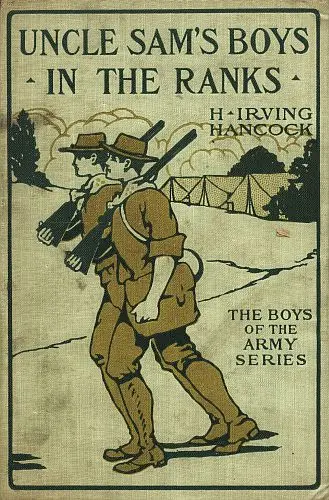
THE CLASSIC COLLECTION · 1910
"Uncle Sam's Boys in the Ranks; or, Two Recruits in the United States Army" by H. Irving Hancock is a novel written in the early 20th century. The story focuses on two young boys, Hal Overton and Noll Terry, who are eager to enlist in the United States Army, driven by a sense of patriotism and adventure. As they navigate the challenges of military life, they encounter a mix of camaraderie and the harsh realities of the discipline that comes with serving in the army. At the start of the book, we are introduced to the boys and their friends in a small New Jersey town, highlighting their differing opinions about soldiers and patriotism. After a heated debate, Hal and Noll resolve to enlist, despite the criticisms from others. The opening scenes depict their journey to the recruiting office, interactions with various characters, including a bully named Tip Branders, and their first experiences as recruits. Through humor and friendship, the narrative sets the stage for their transformation from inexperienced boys into disciplined soldiers, leading to adventures that await them in the army.
Introduction adapted from the source catalogue; source summaries may be automatically generated.
Free to read · English · 47,181 words · No account needed
MAKE TIME FOR A GOOD BOOK
On by default. Untick to stop anonymous reading totals. Each page counts after 10 seconds in view. How this works.
Anonymous counting is on unless you have switched it off.
"Follow me, then. Here you are. Eight and nine will be your beds until further orders. Later, when you have your clothing issued, Corporal Shrimp or I will show you how and where to take care of it. Now, men, you'll likely find it a bit dull here for a day or two. Recruits generally do. Then that will all wear off, and you'll be glad you're in the Army. If there's anything you need to know, ask Corporal Shrimp"--Hal winced inwardly--"or me. The mess call will soon go for dinner. When it does, follow me outside, but take your places in the rear of A Company, which is the recruit company that you now belong to. I'll show you where to stand. New recruits don't march with the battalion--not until they've been drilled enough to know how to march."
"Is there a battalion here, Sergeant?"
"Two recruit companies, at present. The non-commissioned officers, of course, are trained soldiers. Then there are a few old-time privates in each company--just enough to give the recruits some steadiness. The trained privates also act as instructors sometimes."
With this remark Sergeant Brimmer moved away.
"He's all right," murmured Noll Terry. "If all were like Sergeant Brimmer we wouldn't feel so lonely and blue."
Noll had let that last word escape him without thinking. But Hal, who felt just as blue, pretended not to have heard.
"It'll all look different to us, just as soon as we get into uniform, and get past the first breaking-in," predicted young Overton.
Ta-ra-ra-ra-ta! sounded a bugle, out in the corridor.
"That must be the call to dinner," muttered Hal.
But a uniformed recruit, passing them, stopped to say, pleasantly:
"No; that's first call to mess. Every call by the bugler has a 'first call,' sounded just a little while before. That 'first call' is always just the same strain. But the real call differs, according to what is meant. The mess call itself, which is the one you'll hear next, sounds like this."
The recruit hummed mess call for them.
"Thank you," acknowledged Hal gratefully.
"Feeling lonesome?" asked the uniformed rookie.
"J-j-just a bit," assented Hal.
"I'm getting almost over it," smiled the uniformed one, "The older men, those who have seen service with a regiment, tell me that a man soon gets to find delight in being in the Army. But that's after he has gotten away from the recruit rendezvous."
"Oh, we'll get over it before then," promised Hal. "We'll be all over it
by to-morrow."
"Look out for that Shrimp," whispered the uniformed rookie.
Your reading position is saved on this browser. Take it to another device with a library code. Reading pages adapt to text, rather than matching a printed edition.
H. Irving (Harrie Irving) Hancock

H. Irving (Harrie Irving) Hancock

H. Irving (Harrie Irving) Hancock

H. Irving (Harrie Irving) Hancock
BEHIND THE BOOK
This eBook is for the use of anyone anywhere in the United States and most other parts of the world at no cost and with almost no restrictions whatsoever. You may copy it, give it away or re-use it under the terms of the Project Gutenberg License included with this eBook or online at www.gutenberg.org. If you are not located in the United States, you will have to check the laws of the country where you are located before using this eBook. Read the source licence.
The original source file, including credits and licence, is retained by this library. Request an original-format copy at no charge. Please include the book title and Project Gutenberg identifier #27680.
KEEP YOUR CURIOSITY GOING
Coulson Kernahan

Maurice Baring
Frances Wright
Cécile Tormay

Frederic Jesup Stimson

W. H. P. (William Henry Pope) Jarvis