
Uncle Sam’s Boys on Field Duty; or, Winning Corporal’s Chevrons
H. Irving (Harrie Irving) Hancock
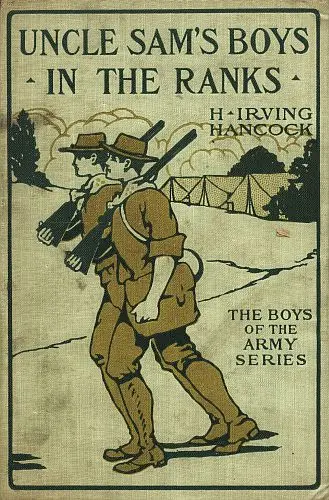
THE CLASSIC COLLECTION · 1910
"Uncle Sam's Boys in the Ranks; or, Two Recruits in the United States Army" by H. Irving Hancock is a novel written in the early 20th century. The story focuses on two young boys, Hal Overton and Noll Terry, who are eager to enlist in the United States Army, driven by a sense of patriotism and adventure. As they navigate the challenges of military life, they encounter a mix of camaraderie and the harsh realities of the discipline that comes with serving in the army. At the start of the book, we are introduced to the boys and their friends in a small New Jersey town, highlighting their differing opinions about soldiers and patriotism. After a heated debate, Hal and Noll resolve to enlist, despite the criticisms from others. The opening scenes depict their journey to the recruiting office, interactions with various characters, including a bully named Tip Branders, and their first experiences as recruits. Through humor and friendship, the narrative sets the stage for their transformation from inexperienced boys into disciplined soldiers, leading to adventures that await them in the army.
Introduction adapted from the source catalogue; source summaries may be automatically generated.
Free to read · English · 47,181 words · No account needed
MAKE TIME FOR A GOOD BOOK
On by default. Untick to stop anonymous reading totals. Each page counts after 10 seconds in view. How this works.
Anonymous counting is on unless you have switched it off.
"Well, those two kids----" began Tip. But the sergeant, though a middle-aged man, showed himself agile enough to reach Tip Branders' side in three swift, long bounds.
"Young man, either conduct yourself properly, or get out of here," ordered the sergeant point-blank.
Muttering something under his breath, Tip turned back to his writing, at which he was making poor headway, while the orderly led Hal and Noll down the corridor, halting and knocking at another door.
"Come in!" called a voice.
"Lieutenant Shackleton's compliments, sir, and two applicants to be
examined, sir."
"Very good, Orderly," replied Captain Wayburn, assistant surgeon, Army Medical Corps, as he received the papers from the orderly. The latter then left the room, closing the door behind him.
"You are Overton and Terry?" questioned Captain Wayburn, eyeing the papers, then turning to the chums, who answered in the affirmative.
Captain Wayburn, being a medical officer of the Army, wore shoulder straps with a green ground. At the ends of each strap rested the two bars that proclaimed his rank of captain. Being a staff officer, Captain Wayburn wore black trousers, instead of blue, beneath his blue fatigue blouse. Moreover, the black trousers of the staff carried no broad side stripe along the leg. The side stripe is always in evidence along the outer leg side of the blue trousers of the line officer, and the color of the stripe denotes to which arm of the service the officer belongs--a white stripe denotes the infantry officer, while a yellow stripe distinguishes the cavalry and a red stripe the artillery officer.
Captain Wayburn now laid out two other sets of papers on his desk. These were the blanks for the surgeon's report on an applicant for enlistment.
At first this examination didn't seem to amount to much. The surgeon began by looking Hal Overton's scalp over, next examining his face, neck and back of head. Then he took a look at Hal's teeth, which he found to be perfect.
"Stand where you are. Read this line of letters to me," ordered the surgeon, stepping across the room to a card on which were ranged several rows of printed letters of different sizes.
Hal read the line off perfectly.
"Read the line above."
Hal did so. He read all of the lines, to the smallest, in fact, without
an error.
"There's nothing the matter with your vision," remarked Captain Wayburn, in a pleased tone. "Now tell me--promptly--what color is this?"
The surgeon held up a skein of yarn.
"Red," announced Hal, without an instant's hesitation.
"This one?"
"Green."
"And this?"
"Blue."
And so on. Hal missed with none of the colors.
Your reading position is saved on this browser. Take it to another device with a library code. Reading pages adapt to text, rather than matching a printed edition.
H. Irving (Harrie Irving) Hancock

H. Irving (Harrie Irving) Hancock

H. Irving (Harrie Irving) Hancock

H. Irving (Harrie Irving) Hancock
BEHIND THE BOOK
This eBook is for the use of anyone anywhere in the United States and most other parts of the world at no cost and with almost no restrictions whatsoever. You may copy it, give it away or re-use it under the terms of the Project Gutenberg License included with this eBook or online at www.gutenberg.org. If you are not located in the United States, you will have to check the laws of the country where you are located before using this eBook. Read the source licence.
The original source file, including credits and licence, is retained by this library. Request an original-format copy at no charge. Please include the book title and Project Gutenberg identifier #27680.
KEEP YOUR CURIOSITY GOING
Coulson Kernahan

Maurice Baring
Frances Wright
Cécile Tormay

Frederic Jesup Stimson

W. H. P. (William Henry Pope) Jarvis