
Uncle Sam’s Boys on Field Duty; or, Winning Corporal’s Chevrons
H. Irving (Harrie Irving) Hancock
THE CLASSIC COLLECTION · 1910
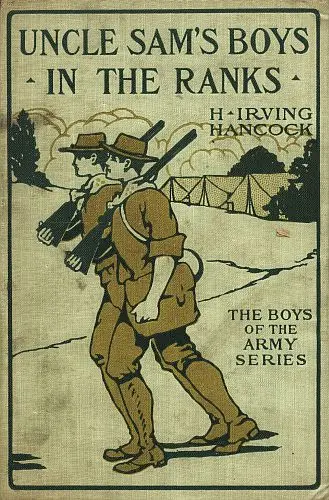
"Uncle Sam's Boys in the Ranks; or, Two Recruits in the United States Army" by H. Irving Hancock is a novel written in the early 20th century. The story focuses on two young boys, Hal Overton and Noll Terry, who are eager to enlist in the United States Army, driven by a sense of patriotism and adventure. As they navigate the challenges of military life, they encounter a mix of camaraderie and the harsh realities of the discipline that comes with serving in the army. At the start of the book, we are introduced to the boys and their friends in a small New Jersey town, highlighting their differing opinions about soldiers and patriotism. After a heated debate, Hal and Noll resolve to enlist, despite the criticisms from others. The opening scenes depict their journey to the recruiting office, interactions with various characters, including a bully named Tip Branders, and their first experiences as recruits. Through humor and friendship, the narrative sets the stage for their transformation from inexperienced boys into disciplined soldiers, leading to adventures that await them in the army.
Introduction adapted from the source catalogue; source summaries may be automatically generated.
Free to read · English · 47,181 words · No account needed
MAKE TIME FOR A GOOD BOOK
On by default. Untick to stop anonymous reading totals. Each page counts after 10 seconds in view. How this works.
Anonymous counting is on unless you have switched it off.
"That you, Tip?" called the voice of an invisible man. "Good for you, lad. We thought you was a goner."
Hal did not answer further, for Captain Cortland broke in:
"Rush 'em, men! We've got 'em."
"Ho! The blazes you have!" sounded a rough voice ahead. "Come on, boys--it's the sojers! Give it to 'em!"
Almost in an instant the crevices between the rocks ahead were full of
red flashes.
Bullets sped, struck rocks with spiteful thuds and flattened out before bounding into the air again.
"Lie down, men!" shouted Captain Cortland. "Give it to the rascals as
long as they shoot at us."
All in a moment this rock-strewn spot had become a bedlam of discharging
firearms.
Two regulars were hit before they could find cover from which to fire. These men, however, made no outcry, but, finding themselves unable to handle their rifles, lay quietly where they had fallen until the time came for them to have attention.
Though he had sharply ordered his men to lie down, Captain Cortland did nothing of the sort himself. Instead, with his revolver drawn, he stood up, peering ahead and trying to get sight of the scoundrels beyond.
Bullets flew all about the captain, many of them passing his head. But he stood there calmly until he caught just the opportunity for which he had waited.
Then his pistol spoke, and a groan beyond showed that he had been a
successful marksman.
"Squad, rise!" shot out the commander's order. "Charge!"
Crouching low, the soldiers sprang suddenly forward.
"Halt! Lie down," continued Cortland. He had gained sixty feet by his rush without loss of a man. "Fire only when you see something to shoot at. Commence firing at will."
Now the firing slackened, though it was not less deadly. Even the scoundrels ahead slowed down their fire, as though they found their weapons becoming hot.
Captain Cortland was in no hurry. He meant to have the scoundrels, dead or alive, but he did not intend to risk his own men needlessly. The army officer knew it was now only a question of time. Nor did he fear running out of ammunition, for the greater part of his small command was not yet in action, but posted beyond.
The daylight grew stronger; then the upper rim of the sun peeped over the horizon, sending its rays into the sky.
"Cease firing," commanded Cortland at last. Then he called over the
rocks.
"Are you fellows ready to surrender to United States forces?"
"Not until we're all dead," came the taunting reply.
Your reading position is saved on this browser. Take it to another device with a library code. Reading pages adapt to text, rather than matching a printed edition.
H. Irving (Harrie Irving) Hancock

H. Irving (Harrie Irving) Hancock

H. Irving (Harrie Irving) Hancock

H. Irving (Harrie Irving) Hancock
BEHIND THE BOOK
This eBook is for the use of anyone anywhere in the United States and most other parts of the world at no cost and with almost no restrictions whatsoever. You may copy it, give it away or re-use it under the terms of the Project Gutenberg License included with this eBook or online at www.gutenberg.org. If you are not located in the United States, you will have to check the laws of the country where you are located before using this eBook. Read the source licence.
The original source file, including credits and licence, is retained by this library. Request an original-format copy at no charge. Please include the book title and Project Gutenberg identifier #27680.
KEEP YOUR CURIOSITY GOING
Coulson Kernahan

Maurice Baring
Frances Wright
Cécile Tormay

Frederic Jesup Stimson

W. H. P. (William Henry Pope) Jarvis