
Uncle Sam’s Boys on Field Duty; or, Winning Corporal’s Chevrons
H. Irving (Harrie Irving) Hancock
THE CLASSIC COLLECTION · 1910
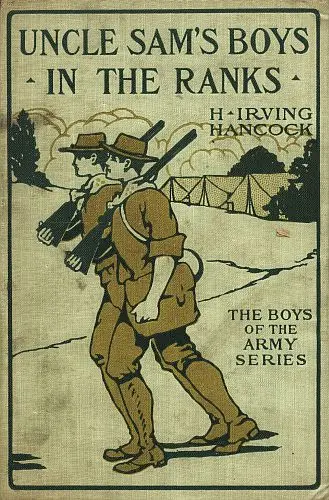
"Uncle Sam's Boys in the Ranks; or, Two Recruits in the United States Army" by H. Irving Hancock is a novel written in the early 20th century. The story focuses on two young boys, Hal Overton and Noll Terry, who are eager to enlist in the United States Army, driven by a sense of patriotism and adventure. As they navigate the challenges of military life, they encounter a mix of camaraderie and the harsh realities of the discipline that comes with serving in the army. At the start of the book, we are introduced to the boys and their friends in a small New Jersey town, highlighting their differing opinions about soldiers and patriotism. After a heated debate, Hal and Noll resolve to enlist, despite the criticisms from others. The opening scenes depict their journey to the recruiting office, interactions with various characters, including a bully named Tip Branders, and their first experiences as recruits. Through humor and friendship, the narrative sets the stage for their transformation from inexperienced boys into disciplined soldiers, leading to adventures that await them in the army.
Introduction adapted from the source catalogue; source summaries may be automatically generated.
Free to read · English · 47,181 words · No account needed
MAKE TIME FOR A GOOD BOOK
On by default. Untick to stop anonymous reading totals. Each page counts after 10 seconds in view. How this works.
Anonymous counting is on unless you have switched it off.
Then came the sounds of running feet. Corporal Sanders was coming with
the guard.
That incident showed the young soldier, more clearly than anything else could have done, how brief the duel between Tip and himself had been.
For Hal knew that, when the alarm is sounded, accompanied by the sound of a shot, the corporal and the guard come on the dead run.
"Right here, Corporal of the guard!" shouted Captain Ruggles, standing up. "Send one man back immediately for hospital men and a stretcher."
"Hospital men and a stretcher, Davidson," called the corporal, and one soldier detached himself from the running squad, wheeling and racing back.
Then the corporal of the guard dashed up at the head of his men, giving Captain Ruggles the rifle salute by bringing his left hand smartly against the barrel of his piece.
Barely behind the guard came Lieutenant Hayes, of A Company, who was
officer of the day.
"The sentry has caught one of the burglars, Hayes," called Captain Ruggles, as the lieutenant came up on the run.
"Glad of it, sir. It's about time."
Then, turning to Hal, Lieutenant Hayes continued:
"You're sentry on number three, Private Overton?"
"Yes, sir."
"Make your report in as few words as you can."
This Hal did, telling about the two men whom he saw sneaking away with bundles, and also about the third man who had joined in firing at him.
"Which way did the other two retreat, Private Overton?"
"I couldn't see, sir," the young soldier answered. "I was in the corn at
that moment."
The corporal of the guard, in the meantime, had sent another man to relieve Noll Terry on post number four, directing Terry to report to the officer of the day.
Still another member of the guard had been placed on post number three.
All the other commissioned officers on post, including Colonel North, now appeared, and the investigating party was adjourned to the roadway.
Noll reported that he had seen two fugitives at a distance, and had
fired three times.
Under military discipline matters move rapidly. Soldiers with lanterns were now searching for the trail of those who had escaped. Keen eyes were also seeking either bundle of loot from Captain Ruggles's quarters. It was thought that the thieves, in their haste to get away, might have dropped their plunder.
Tip Branders, still unconscious, and badly hurt, according to the surgeon, was taken to the post hospital, and the civil authorities in Clowdry were notified.
"That fellow you shot called you by name, didn't he, Overton?" inquired
Captain Ruggles.
"Yes, sir," Hal admitted.
Your reading position is saved on this browser. Take it to another device with a library code. Reading pages adapt to text, rather than matching a printed edition.
H. Irving (Harrie Irving) Hancock

H. Irving (Harrie Irving) Hancock

H. Irving (Harrie Irving) Hancock

H. Irving (Harrie Irving) Hancock
BEHIND THE BOOK
This eBook is for the use of anyone anywhere in the United States and most other parts of the world at no cost and with almost no restrictions whatsoever. You may copy it, give it away or re-use it under the terms of the Project Gutenberg License included with this eBook or online at www.gutenberg.org. If you are not located in the United States, you will have to check the laws of the country where you are located before using this eBook. Read the source licence.
The original source file, including credits and licence, is retained by this library. Request an original-format copy at no charge. Please include the book title and Project Gutenberg identifier #27680.
KEEP YOUR CURIOSITY GOING
Coulson Kernahan

Maurice Baring
Frances Wright
Cécile Tormay

Frederic Jesup Stimson

W. H. P. (William Henry Pope) Jarvis