
Uncle Sam’s Boys on Field Duty; or, Winning Corporal’s Chevrons
H. Irving (Harrie Irving) Hancock
THE CLASSIC COLLECTION · 1912
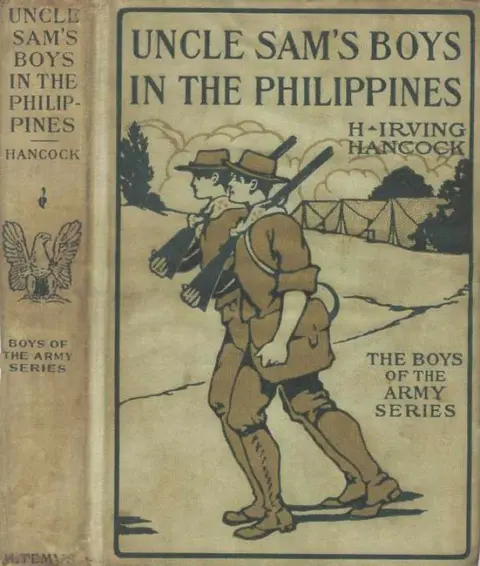
"Uncle Sam's Boys in the Philippines; or, Following the Flag against the Moros" by H. Irving Hancock is a military adventure novel written in the early 20th century. The story follows the experiences of two young sergeants, Hal Overton and Noll Terry, as they navigate both the exotic landscapes and political tensions of the Philippines during a time of conflict with the Moro people. A blend of action and camaraderie, the narrative encapsulates the spirit of young soldiers eager to serve their country. The beginning of the book introduces Sergeants Overton and Terry as they explore Manila, the bustling heart of the Philippines, discovering the new culture and its nuances. Feeling the allure of the East, they encounter a Filipino dandy, Vicente Tomba, who seems overly interested in befriending them. As the plot unfolds, Tomba's intentions become suspect, hinting at danger lurking beneath the surface of their charming surroundings. The chapter ends with a dramatic storm, setting the stage for an intriguing conflict between the soldiers and local forces, suggesting a looming adventure filled with peril and intrigue.
Introduction adapted from the source catalogue; source summaries may be automatically generated.
Free to read · English · 50,475 words · No account needed
MAKE TIME FOR A GOOD BOOK
On by default. Untick to stop anonymous reading totals. Each page counts after 10 seconds in view. How this works.
Anonymous counting is on unless you have switched it off.
"Steady, there!" Hal called, in an easy but business-like tone. "If we strike the rascals an unbroken line is the one hope for us all."
They had now reached the woods, but no halt was made. The boyish sergeant, who knew his business, marched his little command about six hundred yards under the trees.
Still no Moros were encountered.
Then Hal turned his line to the left, marching on through the woods. In this manner, in less than an hour, he had thoroughly explored the territory near the Seaforth plantation, and had returned to the point where his command had first entered the forest.
"Halt!" ordered the young sergeant. "Fall out, but don't scatter."
Then Overton stepped to the edge of the woods, waving his hat. In the distance Lieutenant Prescott, with his own hat, returned the signal. Then Hal, using one arm in place of a signal flag, wig-wagged the information:
"We have thoroughly scouted all about your position, and find no sign of
an enemy."
From the lieutenant came the answer, wig-wagged by arm:
"Good! March your men in."
"I have allowed men to fall out and rest," Hal answered. "They are tired
after their hike."
"Rest your men five minutes, then march them in," replied Lieutenant
Prescott.
"Very good, sir," Hal signaled.
Exactly five minutes later, Overton commanded:
"Fall in! By twos right, march!"
Within the hour several of the former Moro laborers on the plantation returned. They reported that the Datto Hakkut and some three hundred men were on the march, miles away and evidently headed for the mountains.
"These men are honest and loyal, Lieutenant," explained Mr. Seaforth. "They are my regular laborers. Of course, when the attack came those who could not reach the house took to their heels. But these natives, like many Moros, are dependable. They are not to be classed with the idle, vicious cut-throats that follow the datto."
"Hm!" replied Lieutenant Prescott, politely, but he scanned all of these returned natives, keenly. None of them, however, showed any wounds, or bore any other signs of having seen recent military service with the datto.
"Mr. Seaforth," said the young officer, presently, "I am going to follow the course laid down by Captain Cortland, and return to Bantoc with the greater part of my command. I shall, however, leave Sergeant Dinsmore and a dozen men here. I urge that all the white people of the plantation return with me to town."
"You can take the women with you, Lieutenant, if you will," replied the planter, "but we men feel that we should stay here and make every effort to go on running the plantation."
Your reading position is saved on this browser. Take it to another device with a library code. Reading pages adapt to text, rather than matching a printed edition.
H. Irving (Harrie Irving) Hancock

H. Irving (Harrie Irving) Hancock

H. Irving (Harrie Irving) Hancock

H. Irving (Harrie Irving) Hancock
BEHIND THE BOOK
This eBook is for the use of anyone anywhere in the United States and most other parts of the world at no cost and with almost no restrictions whatsoever. You may copy it, give it away or re-use it under the terms of the Project Gutenberg License included with this eBook or online at www.gutenberg.org. If you are not located in the United States, you will have to check the laws of the country where you are located before using this eBook. Read the source licence.
The original source file, including credits and licence, is retained by this library. Request an original-format copy at no charge. Please include the book title and Project Gutenberg identifier #23447.
KEEP YOUR CURIOSITY GOING
Cécile Tormay

Moritz Busch
Coulson Kernahan
John L. Ransom

Maurice Baring
Frances Wright