
Uncle Sam’s Boys on Field Duty; or, Winning Corporal’s Chevrons
H. Irving (Harrie Irving) Hancock
THE CLASSIC COLLECTION · 1912
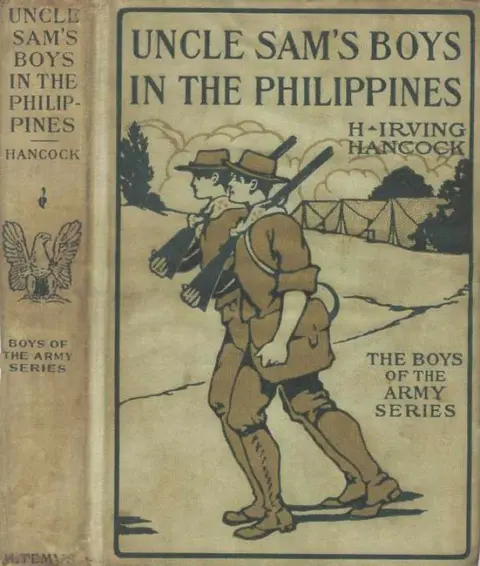
"Uncle Sam's Boys in the Philippines; or, Following the Flag against the Moros" by H. Irving Hancock is a military adventure novel written in the early 20th century. The story follows the experiences of two young sergeants, Hal Overton and Noll Terry, as they navigate both the exotic landscapes and political tensions of the Philippines during a time of conflict with the Moro people. A blend of action and camaraderie, the narrative encapsulates the spirit of young soldiers eager to serve their country. The beginning of the book introduces Sergeants Overton and Terry as they explore Manila, the bustling heart of the Philippines, discovering the new culture and its nuances. Feeling the allure of the East, they encounter a Filipino dandy, Vicente Tomba, who seems overly interested in befriending them. As the plot unfolds, Tomba's intentions become suspect, hinting at danger lurking beneath the surface of their charming surroundings. The chapter ends with a dramatic storm, setting the stage for an intriguing conflict between the soldiers and local forces, suggesting a looming adventure filled with peril and intrigue.
Introduction adapted from the source catalogue; source summaries may be automatically generated.
Free to read · English · 50,475 words · No account needed
MAKE TIME FOR A GOOD BOOK
On by default. Untick to stop anonymous reading totals. Each page counts after 10 seconds in view. How this works.
Anonymous counting is on unless you have switched it off.
Pop! pop! pop! Bullets struck all about the young sergeant, sprinkling
dirt over him.
"Keep your head below the top of the trench wall, Sergeant!" called Lieutenant Prescott sternly. "We can't afford to have you hit. Shield yourself. Don't be afraid of any one suspecting you of cold feet!"
So Hal, though he made a slight grimace, contented himself with crouching low and progressing slowly.
Barely had Sergeant Hal gained his own post, with Private Kelly on his right hand, when a furious fusillade broke out from the southward.
"Keep your heads down, all of you!" shouted the young sergeant. "Don't be too curious about what the Moros are doing. If you keep your heads down the rascals can't hit you, and it won't do us any harm to let them waste their ammunition. Don't any man fire without orders."
"They're doing some good shooting, Sarge, at last," remarked Private Kelly, as the showers of bullets peppered the top of the trench and sprinkled dirt over the crouching soldiers.
"The only good shooting, Kelly, is that which cuts up the enemy," rejoined Hal. "The goo-goos are not hitting any of us, and we're not losing anything by saving our ammunition."
"Goo-goos" is an old name applied to the Philippine raiders. Whenever a native grows tired of fighting, or wants to enter a town for the purpose of getting information, he hides his arms, then enters Uncle Sam's lines, pretending that he is a "good" man, and not a rebel against the authority of the United States Government. From this the soldiers have learned to allude to all fighting Filipinos as goo-goos.
"Lend me your trenching tool, Kelly?"
"Sure, Sarge."
With this implement Hal Overton burrowed a small hole through the top of the trench. Thus, without exposing himself too much, he was able to keep an eye on the distant grove in which the Moros had found cover.
"I'll let you spell me on this watch, from time to time, Kelly," said
Hal.
"I'll be glad to, Sarge, for I'll admit that I'm anxious to know what
the goo-goos are doing."
"At present they're not trying to advance," replied Sergeant Overton, "and that's about all we're interested in. As long as they stay where they are, and waste their ammunition, they'll not bother us much."
In the meantime Lieutenant Prescott was seated in a chair behind the high wall of dirt before the house door. The elder Seaforth occupied another chair.
"Have you any idea, sir, how you incurred the wrath of these Moro rascals?" asked the young lieutenant.
"By refusing to pay blackmail," replied the planter bluntly.
Your reading position is saved on this browser. Take it to another device with a library code. Reading pages adapt to text, rather than matching a printed edition.
H. Irving (Harrie Irving) Hancock

H. Irving (Harrie Irving) Hancock

H. Irving (Harrie Irving) Hancock

H. Irving (Harrie Irving) Hancock
BEHIND THE BOOK
This eBook is for the use of anyone anywhere in the United States and most other parts of the world at no cost and with almost no restrictions whatsoever. You may copy it, give it away or re-use it under the terms of the Project Gutenberg License included with this eBook or online at www.gutenberg.org. If you are not located in the United States, you will have to check the laws of the country where you are located before using this eBook. Read the source licence.
The original source file, including credits and licence, is retained by this library. Request an original-format copy at no charge. Please include the book title and Project Gutenberg identifier #23447.
KEEP YOUR CURIOSITY GOING
Cécile Tormay

Moritz Busch
Coulson Kernahan
John L. Ransom

Maurice Baring
Frances Wright