
Uncle Sam’s Boys on Field Duty; or, Winning Corporal’s Chevrons
H. Irving (Harrie Irving) Hancock
THE CLASSIC COLLECTION · 1912
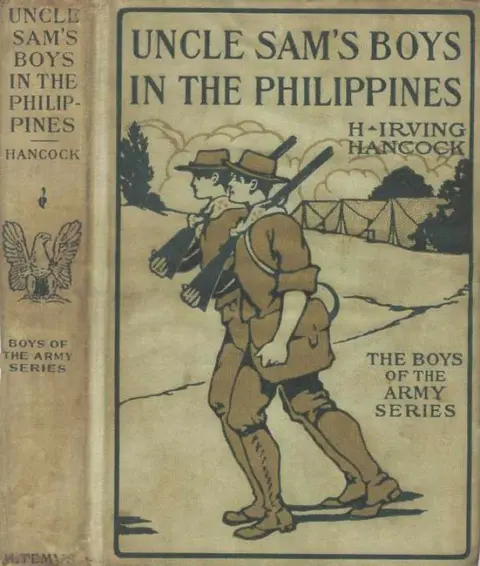
"Uncle Sam's Boys in the Philippines; or, Following the Flag against the Moros" by H. Irving Hancock is a military adventure novel written in the early 20th century. The story follows the experiences of two young sergeants, Hal Overton and Noll Terry, as they navigate both the exotic landscapes and political tensions of the Philippines during a time of conflict with the Moro people. A blend of action and camaraderie, the narrative encapsulates the spirit of young soldiers eager to serve their country. The beginning of the book introduces Sergeants Overton and Terry as they explore Manila, the bustling heart of the Philippines, discovering the new culture and its nuances. Feeling the allure of the East, they encounter a Filipino dandy, Vicente Tomba, who seems overly interested in befriending them. As the plot unfolds, Tomba's intentions become suspect, hinting at danger lurking beneath the surface of their charming surroundings. The chapter ends with a dramatic storm, setting the stage for an intriguing conflict between the soldiers and local forces, suggesting a looming adventure filled with peril and intrigue.
Introduction adapted from the source catalogue; source summaries may be automatically generated.
Free to read · English · 50,475 words · No account needed
MAKE TIME FOR A GOOD BOOK
On by default. Untick to stop anonymous reading totals. Each page counts after 10 seconds in view. How this works.
Anonymous counting is on unless you have switched it off.
"Then I beg your pardon for the mistake, sir," Hal replied quickly.
"No need to apologize, Sergeant, for you have done no harm," replied the
florid-faced man.
Here Captain Cortland's voice broke in, cool and steady:
"Yet I know, Mr. Draney, that Sergeant Overton feels embarrassed by the mere fact of his having made a mistake. Sergeant Overton is one of our best and most capable soldiers, and he rarely makes a mistake of any kind."
"I'm glad to hear that he's one of your best soldiers," replied Draney pleasantly. "It seems odd, doesn't it, Captain, to see so boyish a chap wearing sergeant's chevrons?"
"Sergeant Overton, Mr. Draney, is more than merely a sergeant. He is acting first sergeant of B Company, and is likely to continue as such for some months to come."
"He has risen so high?" cried Draney. "I certainly congratulate the
young man."
There appeared to be no further call for Hal to remain on the saloon deck. After flashing an inquiring look at his company commander, and saluting that officer, Hal next raised his uniform cap to Draney, then turned and made his way down to the spar deck.
"Your sergeant looks like a very upright young man, Captain," observed
Mr. Draney.
"Overton?" rejoined Captain Cortland. "I am certain that he is the soul
of honor."
"His loyalty has often been tested, I presume?" persisted the
florid-faced fellow.
"He's a very thoroughly trustworthy young man, if that's what you mean."
Captain Cortland was beginning to feel somewhat annoyed, for, truth to tell, he did not like Draney very well.
"Is your sergeant," asked Draney, "a young man much interested in the joys of life, or is he of the quiet, studious sort who seldom care for good times?"
"You seem to be uncommonly interested in Sergeant Overton, Mr. Draney," remarked the captain almost testily.
"Only as a type of American soldier," replied Draney blandly. "I was wondering if my estimate of the young man were borne out by your experience with him."
"Sergeant Overton is fond of the joys of life, if you mean the quiet and decent pleasures. He is a good deal of a student, and that type is never interested in drinking or gambling, or any of the vices and dissipations, if that is what you mean."
Then, noting that Colonel North had just stepped out on deck from his stateroom, Captain Cortland added hastily:
"Pardon me; I wish to speak with the commanding officer."
As colonel and captain met they exchanged salutes.
Your reading position is saved on this browser. Take it to another device with a library code. Reading pages adapt to text, rather than matching a printed edition.
H. Irving (Harrie Irving) Hancock

H. Irving (Harrie Irving) Hancock

H. Irving (Harrie Irving) Hancock

H. Irving (Harrie Irving) Hancock
BEHIND THE BOOK
This eBook is for the use of anyone anywhere in the United States and most other parts of the world at no cost and with almost no restrictions whatsoever. You may copy it, give it away or re-use it under the terms of the Project Gutenberg License included with this eBook or online at www.gutenberg.org. If you are not located in the United States, you will have to check the laws of the country where you are located before using this eBook. Read the source licence.
The original source file, including credits and licence, is retained by this library. Request an original-format copy at no charge. Please include the book title and Project Gutenberg identifier #23447.
KEEP YOUR CURIOSITY GOING
Cécile Tormay

Moritz Busch
Coulson Kernahan
John L. Ransom

Maurice Baring
Frances Wright