
Uncle Sam’s Boys on Field Duty; or, Winning Corporal’s Chevrons
H. Irving (Harrie Irving) Hancock
THE CLASSIC COLLECTION · 1912
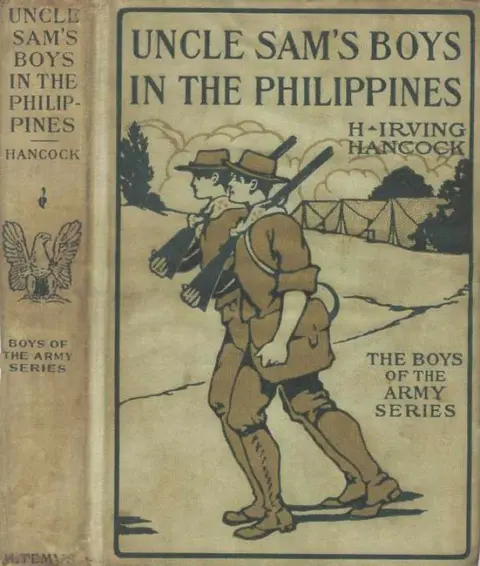
"Uncle Sam's Boys in the Philippines; or, Following the Flag against the Moros" by H. Irving Hancock is a military adventure novel written in the early 20th century. The story follows the experiences of two young sergeants, Hal Overton and Noll Terry, as they navigate both the exotic landscapes and political tensions of the Philippines during a time of conflict with the Moro people. A blend of action and camaraderie, the narrative encapsulates the spirit of young soldiers eager to serve their country. The beginning of the book introduces Sergeants Overton and Terry as they explore Manila, the bustling heart of the Philippines, discovering the new culture and its nuances. Feeling the allure of the East, they encounter a Filipino dandy, Vicente Tomba, who seems overly interested in befriending them. As the plot unfolds, Tomba's intentions become suspect, hinting at danger lurking beneath the surface of their charming surroundings. The chapter ends with a dramatic storm, setting the stage for an intriguing conflict between the soldiers and local forces, suggesting a looming adventure filled with peril and intrigue.
Introduction adapted from the source catalogue; source summaries may be automatically generated.
Free to read · English · 50,475 words · No account needed
MAKE TIME FOR A GOOD BOOK
On by default. Untick to stop anonymous reading totals. Each page counts after 10 seconds in view. How this works.
Anonymous counting is on unless you have switched it off.
"Some of Sergeant Terry's work, sir," whispered Hal. "When you're ready, sir, just keep on straight ahead until you come upon the advance. I'll remain here, sir, if you permit, to warn the men behind you that they're marching inside the Moros' lines."
"Do so, Sergeant," directed Lieutenant Prescott, at the same time making the motion for his men to move ahead. On came the rest of the command in single file.
"Softly," warned Hal, as the men passed by him. "You're inside the
enemy's lines."
Then, as the last man passed him, Hal whispered:
"Fall out, Gleason. Remain here to warn the rear guard when it arrives."
"All right, Sergeant. But this kind of work in the dark makes one creepy. I feel as though I were robbing a judge's chicken-roost."
Hal laughed softly and hurried after the vanishing troops. Within a few minutes more the rear guard had arrived.
By this time the rain had begun to come down again in torrents, but this favored the work of the American troops.
Led by the two young scouts, the entire command managed to advance, undetected, to a point from which Captain Freeman could dimly make out the mud walls of the datto's fort.
"Take the same twelve men of the advance guard, Sergeant Overton," whispered Captain Freeman, after he had given directions regarding the carrying of the wounded so that they would be as well protected as possible from slashing by Moro swords or creeses during the attack about to be made. "With your men, Sergeant, gain the gate of the fort. Remember, at no matter what cost, you must get your party inside and hold the gate. We'll be on the spot the moment we hear the first sound of your attack."
"Now, then, men," Hal instructed his own detachment, "we won't march forward, and we won't skulk, either. We'll simply stroll along. The instant that I hear any sound showing that we're discovered, I'll give the order to charge. When that order comes--remember that we simply must fight our way through the gate of the fort."
Then he gave the order for the forward movement. Hal placed himself at the head of his detachment, the post of greatest danger.
It was raining so heavily that even the guards at the datto's gate had
relaxed their vigilance.
So Sergeant Hal Overton was within thirty feet of the gate when one of the six sentries, peering outside, caught sight of him, yelled and held his rifle at aim.
"Detachment charge!" yelled Sergeant Hal Overton.
With a low-uttered yet enthusiastic yell the twelve regulars piled in
after their sergeant.
Your reading position is saved on this browser. Take it to another device with a library code. Reading pages adapt to text, rather than matching a printed edition.
H. Irving (Harrie Irving) Hancock

H. Irving (Harrie Irving) Hancock

H. Irving (Harrie Irving) Hancock

H. Irving (Harrie Irving) Hancock
BEHIND THE BOOK
This eBook is for the use of anyone anywhere in the United States and most other parts of the world at no cost and with almost no restrictions whatsoever. You may copy it, give it away or re-use it under the terms of the Project Gutenberg License included with this eBook or online at www.gutenberg.org. If you are not located in the United States, you will have to check the laws of the country where you are located before using this eBook. Read the source licence.
The original source file, including credits and licence, is retained by this library. Request an original-format copy at no charge. Please include the book title and Project Gutenberg identifier #23447.
KEEP YOUR CURIOSITY GOING
Cécile Tormay

Moritz Busch
Coulson Kernahan
John L. Ransom

Maurice Baring
Frances Wright