
Uncle Sam’s Boys on Field Duty; or, Winning Corporal’s Chevrons
H. Irving (Harrie Irving) Hancock
THE CLASSIC COLLECTION · 1912
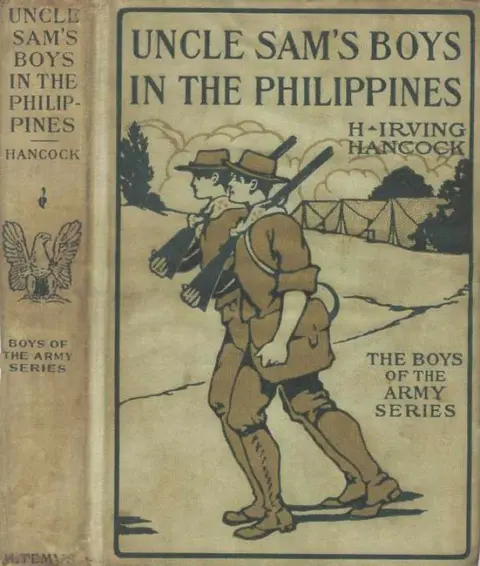
"Uncle Sam's Boys in the Philippines; or, Following the Flag against the Moros" by H. Irving Hancock is a military adventure novel written in the early 20th century. The story follows the experiences of two young sergeants, Hal Overton and Noll Terry, as they navigate both the exotic landscapes and political tensions of the Philippines during a time of conflict with the Moro people. A blend of action and camaraderie, the narrative encapsulates the spirit of young soldiers eager to serve their country. The beginning of the book introduces Sergeants Overton and Terry as they explore Manila, the bustling heart of the Philippines, discovering the new culture and its nuances. Feeling the allure of the East, they encounter a Filipino dandy, Vicente Tomba, who seems overly interested in befriending them. As the plot unfolds, Tomba's intentions become suspect, hinting at danger lurking beneath the surface of their charming surroundings. The chapter ends with a dramatic storm, setting the stage for an intriguing conflict between the soldiers and local forces, suggesting a looming adventure filled with peril and intrigue.
Introduction adapted from the source catalogue; source summaries may be automatically generated.
Free to read · English · 50,475 words · No account needed
MAKE TIME FOR A GOOD BOOK
On by default. Untick to stop anonymous reading totals. Each page counts after 10 seconds in view. How this works.
Anonymous counting is on unless you have switched it off.
"Cochero, para!" shouted Noll right after that, and a fareless quilez stopped near the door of the shed.
"Occupado (occupied)?" called Noll.
"No, senor."
Hal and Noll bolted through the rain, darted into the quilez through the door at the rear, and plumped themselves down on the seats.
"Sigue directio, Malate, cuartel nipa," ordered Hal, thus instructing the driver to go straight ahead to Malate and to take them to the nipa barracks.
The Filipino driver himself was drenched. In his thin cotton clothing the little brown man perched on the box outside, shivered until his teeth chattered. He did not propose, however, to let personal discomfort stop him from earning a fare.
Around the Walled City (Old Manila) the quilez carried the young soldiers. These massive walls, centuries old, enclose perhaps a square mile of city. Once past the Walled City the little vehicle glided on through pretty Ermita. Here, passing along Calle Real (Royal Street), the driver turned into the straight stretch for the next suburb, Malate.
For months before sailing for the Philippines both young sergeants had devoted a good deal of their spare time to the study of Spanish. They had, however, learned the best Spanish of old Castile. First Sergeant Gray, who had put in three terms of service in the Philippines, had taken pains to teach them much of the local Spanish dialect as it is spoken in this far-away colony of Uncle Sam's.
To-day the Filipino children speak English rather well and musically, for English is the language of the public schools of the islands. Many of the older natives, however, even those with English-speaking children, know only a few words at most of the tongue of the Americanos.
By the time that the little cab turned in at the barracks grounds much of the fury of the storm had passed. The rain, however, continued at a steady downpour, and seemed good for the night.
"We may have to be campaigning in this kind of weather in another
fortnight," remarked Hal.
"Fine business," commented Noll dryly.
"Well, it all goes in the life of a soldier. It can't hurt the soldier much, either, for somehow he's healthier than fellows who clerk or work in machine shops."
"Clerking? Shops?" repeated Noll, with a smile of mild disgust. "Did we ever stand that sort of life, Hal?"
"Once upon a time, Noll."
"Thank goodness that day has gone by."
"Here we are," announced Sergeant Hal, reaching for the rear door and opening it. "I'll pay the cochero this time, Noll; you paid for our last ride."
Your reading position is saved on this browser. Take it to another device with a library code. Reading pages adapt to text, rather than matching a printed edition.
H. Irving (Harrie Irving) Hancock

H. Irving (Harrie Irving) Hancock

H. Irving (Harrie Irving) Hancock

H. Irving (Harrie Irving) Hancock
BEHIND THE BOOK
This eBook is for the use of anyone anywhere in the United States and most other parts of the world at no cost and with almost no restrictions whatsoever. You may copy it, give it away or re-use it under the terms of the Project Gutenberg License included with this eBook or online at www.gutenberg.org. If you are not located in the United States, you will have to check the laws of the country where you are located before using this eBook. Read the source licence.
The original source file, including credits and licence, is retained by this library. Request an original-format copy at no charge. Please include the book title and Project Gutenberg identifier #23447.
KEEP YOUR CURIOSITY GOING
Cécile Tormay

Moritz Busch
Coulson Kernahan
John L. Ransom

Maurice Baring
Frances Wright