
The Writing of News A Handbook with Chapters on Newspaper Correspondence and Copy Reading
Charles G. (Charles Griffith) Ross
THE CLASSIC COLLECTION · 1911
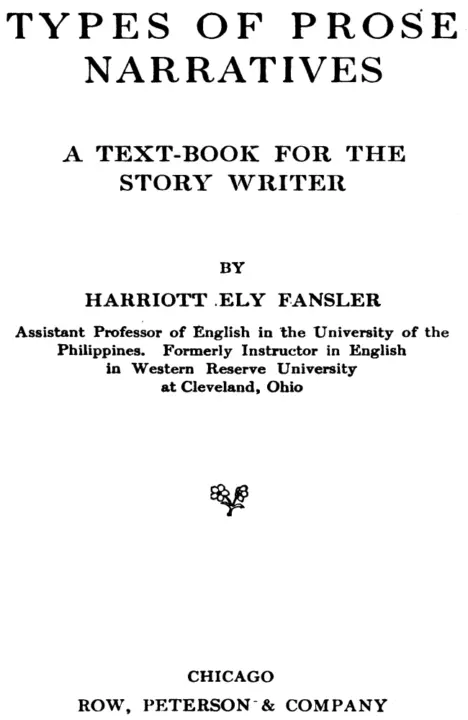
"Types of Prose Narratives: A Text-Book for the Story Writer" by Harriott Ely Fansler is a comprehensive guide intended for aspiring writers, likely written in the early 20th century. This work focuses on the different types of prose narratives, exploring their structures, characteristics, and functions. Fansler aims to educate writers about the historical context of storytelling, helping them understand the evolution of narrative forms and providing practical tools for crafting their own stories. At the start of the textbook, the author introduces the core premise: narratives are essential to both our understanding of literature and our capacity to create. Fansler emphasizes that storytelling is not a spontaneous act but rather a craft that draws upon the collective traditions of the past. The opening lays out the intention to guide readers through various narrative types, from myths and legends to modern fiction forms, encouraging a methodical approach to writing. Fansler connects the importance of historical context to contemporary storytelling, highlighting how understanding these foundational elements can inspire new authors and boost their confidence in creating original work.
Introduction adapted from the source catalogue; source summaries may be automatically generated.
Free to read · English · 190,507 words · No account needed
MAKE TIME FOR A GOOD BOOK
On by default. Untick to stop anonymous reading totals. Each page counts after 10 seconds in view. How this works.
Anonymous counting is on unless you have switched it off.
Mme. Loisel was a great success. She was prettier than them all, lovely, gracious, smiling, and wild with delight. All the men looked at her, inquired her name, tried to be introduced; all the officials of the Ministry wanted a waltz--even the minister himself noticed her. She danced with abandon, with ecstacy, intoxicated with joy, forgetting everything in the triumph of her beauty, in the radiance of her success, in a kind of mirage of bliss made up of all this worship, this adulation, of all these stirring impulses, and of that realization of perfect surrender, so sweet to the soul of woman.
She left about four in the morning.
Since midnight her husband had been sleeping in a little deserted anteroom with three other men whose wives were enjoying themselves. He threw over her shoulders the wraps he had brought, ordinary, everyday garments, contrasting sorrily with her elegant ball dress. She felt this, and wanted to get away so as not to be seen by the other women, who were putting on costly furs.
Loisel detained her: "Wait a little; you will catch cold outside; I
will go and call a cab."
But she would not listen to him, and hurried downstairs. When they reached the street they could not find a carriage, and they began to look for one, shouting to the cabmen who were passing by. They went down toward the river in desperation, shivering with cold. At last they found on the quays one of those antiquated, all-night broughams, which, in Paris, wait till after dark before venturing to display their dilapidation. It took them to their door in the Rue des Martyrs, and once more, wearily, they climbed the stairs.
Now all was over for her; as for him, he remembered that he must be at the office at ten o'clock. She threw off her cloak before the glass, that she might behold herself once more in all her magnificence. Suddenly she uttered a cry of dismay--the necklace was gone!
Her husband, already half-undressed, called out, "Anything wrong?"
She turned wildly toward him: "I have--I have--I've lost Mme.
Forestier's necklace!"
He stood aghast: "Where? When? You haven't!"
They looked in the folds of her dress, in the folds of her cloak, in her pocket, everywhere. They could not find it.
"Are you sure," he said, "that you had it on when you left the ball?"
"Yes; I felt it in the corridor of the palace."
"But if you had lost it in the street, we should have heard it fall. It
must be in the cab."
"No doubt. Did you take his number?"
"No. And didn't you notice it either?"
"No."
Your reading position is saved on this browser. Take it to another device with a library code. Reading pages adapt to text, rather than matching a printed edition.
BEHIND THE BOOK
This eBook is for the use of anyone anywhere in the United States and most other parts of the world at no cost and with almost no restrictions whatsoever. You may copy it, give it away or re-use it under the terms of the Project Gutenberg License included with this eBook or online at www.gutenberg.org. If you are not located in the United States, you will have to check the laws of the country where you are located before using this eBook. Read the source licence.
The original source file, including credits and licence, is retained by this library. Request an original-format copy at no charge. Please include the book title and Project Gutenberg identifier #64210.
KEEP YOUR CURIOSITY GOING
Charles G. (Charles Griffith) Ross
Hannah Webster Foster

Emily Lawless
Edwin Hamlin Carr

Charles De Lano Hine
Andrew Ure