
The Writing of News A Handbook with Chapters on Newspaper Correspondence and Copy Reading
Charles G. (Charles Griffith) Ross
THE CLASSIC COLLECTION · 1911
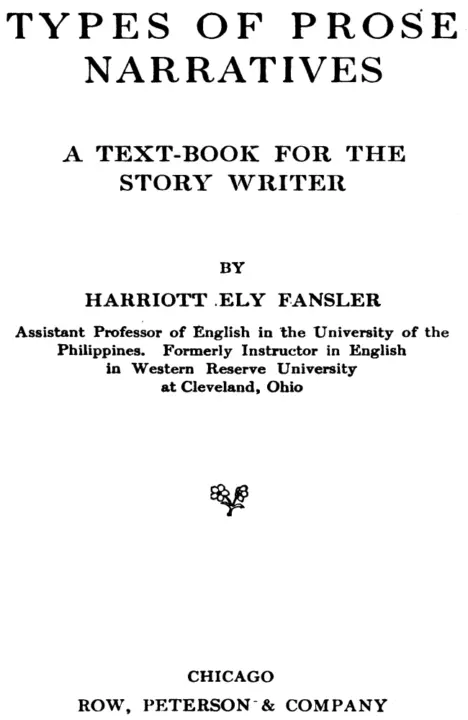
"Types of Prose Narratives: A Text-Book for the Story Writer" by Harriott Ely Fansler is a comprehensive guide intended for aspiring writers, likely written in the early 20th century. This work focuses on the different types of prose narratives, exploring their structures, characteristics, and functions. Fansler aims to educate writers about the historical context of storytelling, helping them understand the evolution of narrative forms and providing practical tools for crafting their own stories. At the start of the textbook, the author introduces the core premise: narratives are essential to both our understanding of literature and our capacity to create. Fansler emphasizes that storytelling is not a spontaneous act but rather a craft that draws upon the collective traditions of the past. The opening lays out the intention to guide readers through various narrative types, from myths and legends to modern fiction forms, encouraging a methodical approach to writing. Fansler connects the importance of historical context to contemporary storytelling, highlighting how understanding these foundational elements can inspire new authors and boost their confidence in creating original work.
Introduction adapted from the source catalogue; source summaries may be automatically generated.
Free to read · English · 190,507 words · No account needed
MAKE TIME FOR A GOOD BOOK
On by default. Untick to stop anonymous reading totals. Each page counts after 10 seconds in view. How this works.
Anonymous counting is on unless you have switched it off.
Obviously the character-events story is different from the character-place story just in the emphasis and because of it. The personality of the chief actor of a story of events, does not necessarily spring from the scene of action. In fact, the personality very often is in strong contrast with the place. A soldier for instance by some chance may be left stranded on an oasis in the desert; the purpose of the writer in having him there may be to set forth a number of strange occurrences that bring out his character, or the author may wish to demonstrate some truth about wild animals. A woman may be on a Pullman car bringing her dying husband home with her from Denver to New York. The author will then be concerned with an analysis of the woman's mind as events come to her. A person may be standing at the prisoner's dock and may tell his life. Place will concern the author a great deal in a certain sense, but it will be not the character-making place, but the event-making place,--the battle-ground, the cricket field. If a different character met the same events in the same place, he might act otherwise. It is the conjunction of character and events that the author is revealing and the reader watching. Let us name over a few of the great stories and collections of this kind to see if the titles suggest anything: "The Necklace" by Maupassant; "The Father" by Björnson; "The Siege of Berlin" by Daudet; "The Substitute" by Coppée; "The Insurgent" by Halévy; "Mateo Falcone" by Mérimeé; "The Shot" by Pushkin; "The Greater Inclination," "Crucial Instances," "The Descent of Man, and Other Stories," by Mrs. Wharton.
[Component elements of this type]
We might say that the representative short-story of this type is a combination of romanticism, realism, metaphysics, and modern journalism. A concentrated extract of the work of Scott, Jane Austen, Thackeray, George Eliot and Reade. The list suggests the history of the novel since Fielding's day and the elements it acquired and transmitted to the short-story. You have probably studied how Scott, when Lord Byron out-ran him, turned from metrical to prose romance; how Scott created with the "Waverley Novels" (which of course are not novels in the usual sense) a new romance, the historical, which immediately took its place as a permanent type of literature. On the side of stirring events our present short-story often epitomises Scott. He said himself he wrote for soldiers, sailors, and young people of bold and daring dispositions. There is no limit, therefore, in choice of events. The record may be the most startling. It usually, however, is not extravagant beyond what a healthy and cheerful imagination can enjoy. Our temperance is due no doubt to the restraining influence of Jane Austen and her late followers in realism. She tried to teach her own age to laugh at itself good-naturedly and to bridle romance with common sense. "Northanger Abbey," written in 1798, was a direct satire of the terror school, which was popular before her day and Scott's. Moderns have enthroned Jane Austen as a perfect artist, and all good fiction writers have learned the lesson she taught. In general, her work belongs with the story that emphasizes manners and environment; but her most popular novel, "Pride and Prejudice," has in addition to the reflection of environment a sequence of interesting events and a spiritedness that together make it an extended prototype of the story that emphasizes both character and happenings. To Scott's boldness and Jane Austen's satiric restraint, time added George Eliot's metaphysical curiosity. Since her day we are all interested in duty, destiny, freedom of will, mind-habit. She showed us how a neighborly man becomes a miser, how a miser becomes once more a neighborly man; how a lovable but morally and physically timid man becomes a scoundrel. Most of our short stories now-a-days display an element of such analysis; many of them are wholly constituted upon an inquiry; some, beginning just in front of the crisis, give us a feeling of past complicating events, and with one flash show us the present tangle; others with a swift relentlessness pile happening upon happening until, panting for breath, we stumble upon the momentous climax. Very often, too, at the end, we are left in an atmosphere of pessimism--sometimes it is only a companionable little chill like that Thackeray used to give us, wherein, laughing and chattering, we shake hands with our brothers to keep warm; sometimes, it is like Maupassant's, a hard, dull bitterness of cold--
Your reading position is saved on this browser. Take it to another device with a library code. Reading pages adapt to text, rather than matching a printed edition.
BEHIND THE BOOK
This eBook is for the use of anyone anywhere in the United States and most other parts of the world at no cost and with almost no restrictions whatsoever. You may copy it, give it away or re-use it under the terms of the Project Gutenberg License included with this eBook or online at www.gutenberg.org. If you are not located in the United States, you will have to check the laws of the country where you are located before using this eBook. Read the source licence.
The original source file, including credits and licence, is retained by this library. Request an original-format copy at no charge. Please include the book title and Project Gutenberg identifier #64210.
KEEP YOUR CURIOSITY GOING
Charles G. (Charles Griffith) Ross
Hannah Webster Foster

Emily Lawless
Edwin Hamlin Carr

Charles De Lano Hine
Andrew Ure