
The Writing of News A Handbook with Chapters on Newspaper Correspondence and Copy Reading
Charles G. (Charles Griffith) Ross
THE CLASSIC COLLECTION · 1911
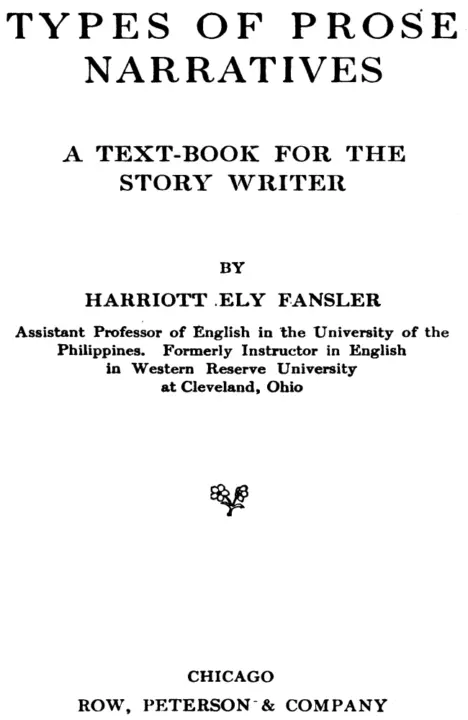
"Types of Prose Narratives: A Text-Book for the Story Writer" by Harriott Ely Fansler is a comprehensive guide intended for aspiring writers, likely written in the early 20th century. This work focuses on the different types of prose narratives, exploring their structures, characteristics, and functions. Fansler aims to educate writers about the historical context of storytelling, helping them understand the evolution of narrative forms and providing practical tools for crafting their own stories. At the start of the textbook, the author introduces the core premise: narratives are essential to both our understanding of literature and our capacity to create. Fansler emphasizes that storytelling is not a spontaneous act but rather a craft that draws upon the collective traditions of the past. The opening lays out the intention to guide readers through various narrative types, from myths and legends to modern fiction forms, encouraging a methodical approach to writing. Fansler connects the importance of historical context to contemporary storytelling, highlighting how understanding these foundational elements can inspire new authors and boost their confidence in creating original work.
Introduction adapted from the source catalogue; source summaries may be automatically generated.
Free to read · English · 190,507 words · No account needed
MAKE TIME FOR A GOOD BOOK
On by default. Untick to stop anonymous reading totals. Each page counts after 10 seconds in view. How this works.
Anonymous counting is on unless you have switched it off.
Seth, or Typhon--the brother of Osiris, and his chief opponent. He represented physical evil; he was the enemy of all good. His consort was Nebti.
Thoth--the god of letters, the clerk of the underworld, and the
keeper of the records for the great judge, Osiris. The chief
moon-god.
Ptah--the Egyptian Hephaestus, the divine architect.
Ma-t--the goddess of truth. She is characterized by the ostrich feather, the emblem of truth, on her head.
Anubis--the jackal-headed, presided over tombs and mummification.
The Sphinx--a beneficent being who personified the fruit-bearing earth, and was a deity of wisdom and knowledge.
Hindoo Gods
Dyaus--the most ancient name for the supreme god. Dyaus, the heaven, married Prithivi, the earth, and they became the father and mother of the other Hindu gods. Dyaus is also the god of rain.
Indra--the rain-bringer. The son of Dyaus. He is a strong, impetuous warrior, drives a chariot drawn by pawing steeds, bears a resistless lance that is lightning.
Vishnu--one name for the sun; second god of the Hindu triad,
literally the Pervader. (Brahma and Siva are the other two of the
trinity.)
Vishnu is represented as being of blue color. His sacti, or wife, is Lakshmi, the goddess of wealth.
Mitra--another name for the sun-god.
Rudra--the father of the storm-gods, the Maruts.
Maruts--the storm gods. "They overturn trees, destroy whole forests, they roar like lions, are swift as thought. In the Maruts we see blind strength and fury without judgment."
Vayu--sometimes the wind was thought of as a single personality. He
was called Vayu.
Agni--the fire-god. Considered the messenger between the Hindus and heaven. He carried their offerings to Dyaus-pitar.
Varuna--the noblest figure of the Vedic religion. The supreme god at one time. Sometimes he was the All-Surrounder. Later he was ruler of the seas.
Yama--the judge of the dead. He had a dog with four eyes and wide nostrils, whom he sent to earth to collect those about to die.
Vritva--an evil snake which had stolen some treasure and a maiden, Ushas. She was rescued by Indra.
Ushas (Ahana)--a pure, white-robed being from whose presence every dark thing fled away. Ushas never grows old, but she makes others old. (Same as Eos, Greek; Aurora, Latin.) She is the dawn; is also known by the name of Dahana.
Rita--a word to signify the all-pervading law of nature. It was the power that settled the path of the sun. The abode of Rita was in the east, and finally every good thing traveled in the path of Rita.
Your reading position is saved on this browser. Take it to another device with a library code. Reading pages adapt to text, rather than matching a printed edition.
BEHIND THE BOOK
This eBook is for the use of anyone anywhere in the United States and most other parts of the world at no cost and with almost no restrictions whatsoever. You may copy it, give it away or re-use it under the terms of the Project Gutenberg License included with this eBook or online at www.gutenberg.org. If you are not located in the United States, you will have to check the laws of the country where you are located before using this eBook. Read the source licence.
The original source file, including credits and licence, is retained by this library. Request an original-format copy at no charge. Please include the book title and Project Gutenberg identifier #64210.
KEEP YOUR CURIOSITY GOING
Charles G. (Charles Griffith) Ross
Hannah Webster Foster

Emily Lawless
Edwin Hamlin Carr

Charles De Lano Hine
Andrew Ure