
Last letters from the living dead man
David Patterson (Spirit) Hatch
THE CLASSIC COLLECTION · 1778
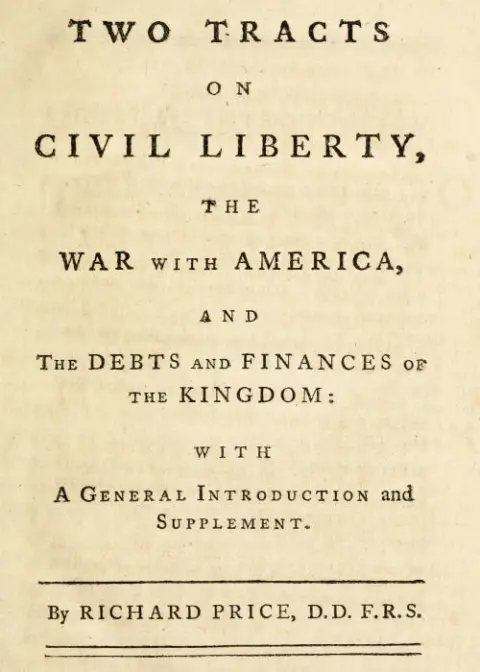
"Two Tracts on Civil Liberty, the War with America, and the Debts and Finances of the Kingdom" by Richard Price is a historical treatise written in the late 18th century. The work comprises two tracts that explore the concepts of civil liberty and the implications of the American War for Independence, as well as the financial implications of these issues for Britain. Price delves into the philosophical underpinnings of government and the nature of liberty, emphasizing the importance of representation and consent within a just society. The opening of this treatise presents an introduction to the fundamental arguments for civil liberty that Price aims to make. He contrasts two competing views of government: one that establishes authority through the people's consent and another that derives authority from divine right. Price articulates his belief that legitimate government must be founded on the principles of freedom and equality, where laws are a reflection of the collective will. Furthermore, he addresses the growing tensions between Britain and America, arguing that the rights and liberties of the American colonies must be acknowledged, warning that attempts to subjugate them could lead to a broader conflict that undermines the values of civil liberty he cherishes. The matters discussed set the stage for his detailed exploration of political philosophy and practical governance as the historical context unfolds.
Introduction adapted from the source catalogue; source summaries may be automatically generated.
Free to read · English · 84,822 words · No account needed
MAKE TIME FOR A GOOD BOOK
On by default. Untick to stop anonymous reading totals. Each page counts after 10 seconds in view. How this works.
Anonymous counting is on unless you have switched it off.
NOTE (9)—BANK LONG ANNUITY. See page 122.—This annuity consists of 128,250l. per ann. for 99 years, given in 1761, as a premium to the subscribers of 11.400,000l. at 3 per cent; and of 120,000l. per ann. for 98 years, given in 1762, as a premium to the lenders of twelve millions at 4 per cent. See page 95 and 100. It is charged, together with the loans to which it was annexed, on the Sinking Fund.—Its value in the Alley is about 25 years purchase; but the remaining term is really worth 27 years purchase, reckoning interest at 3½, (or the 3 per cents. being at 85¾.) But when interest is at 4 per cent. or the 3 per cents. are at 75, it is worth only 24 years purchase.—When this annuity is called a premium, it must not be imagined, that no compensation was given for it. Government received the value of it; but, at the same time, made itself a debtor for that value. And, what is very surprizing, this has been uniformly practised with respect to all the premiums or douceurs granted by government; and the consequence has been, that great and needless increase of the public debt explained in the 3d section of the 2d Part.
NOTE (10).—SOUTH-SEA STOCK AND ANNUITIES. See page 122.—These four capitals amounting to 25.984,684l. 13s. consist almost entirely of the remainder of debts contracted in the reigns of King William and Queen Anne. The following account will probably give sufficient information concerning them.
In 1711, Lord Oxford being minister, the proprietors of certain navy, army, ordnance and transport debts, to the amount of 9.177,968l. including arrears of interest, and half a million for the current supplies, were incorporated into a company for trading to the South-seas. They were allowed 6 per cent. interest for this debt, with 8000l. per ann. for management; and the duties on wine, tobacco, East-India goods, candles, &c. were made perpetual, and granted as a Fund (ever since called the South-sea Company’s Fund) for paying the interest. This kept up public credit at the time, and has been called the Earl of Oxford’s master-piece.—By the 1st of Geo. I. 822,032l. consisting chiefly of interest payable on the Company’s capital, was added to the capital, in consequence of which it was increased to TEN MILLIONS, (ever since called their original capital) bearing 6 per cent. interest.—In 1717, they agreed to take 5 per cent; and this was the first great reduction of interest, which in conjunction with the same reduction of the other redeemable debts almost all carrying 6 per cent. laid the foundation of the SINKING FUND established in this year. But it is remarkable, that so fast did interest fall at this time, that the price of South-sea stock, notwithstanding this reduction, rose from 101 to 111.—In 1719, the South-sea capital was increased to 11.746,844l. bearing 5 per cent. interest (with an addition of 1,397l. 9s. to their former allowance for management) by advancing to government 544,142l. and by the proprietors of 94,329l. 12s. lottery annuities for 32 years granted in 1710, accepting in lieu of them 1.202,702l. South Sea stock.—In 1720, the agreement was made by government with the South Sea Company, which produced the great SOUTH SEA BUBBLE.—There existed at that time long annuities to the amount of 666,821l. 8s. and short annuities, for 32 years from 1710, to the amount of 127,260l. 6s. The proprietors of these annuities were allowed to subscribe them into the South Sea trading stock; and the Company, for every 100l. of the long annuity which should be subscribed, were to receive from government an addition to their capital of 2000l. bearing 5 per cent. interest till 1727, and afterwards 4 per cent. till redeemed: and for every 100l. of the short annuities, they were to receive an addition to their capital of 1400l. bearing the same interest.—They were besides to take in the redeemable debts to the amount of 16.546,482l. and to receive an addition to their capital of 100l. for every 100l. subscribed.—By the subscription of the long and short annuities which followed this agreement, a capital due from government to the Company was created, which was greater by 3.034,769l. than the original sum advanced for the annuities subscribed. And as much of these annuities and of the redeemable debts were subscribed, as increased the South Sea trading capital to 37.802,203l.—In 1722, four millions of this capital was purchased by the BANK, (See Note 3.) which reduced it to 33.802,203l.—By 9 Geo. I. 1723, this remaining capital was divided into two equal parts, one of which alone (or 16.901,101l.) was ordered to be the trading capital of the Company, and the other part was directed to be called South Sea Annuities.—In 1733, the South Sea trading capital had been reduced by payments at different times to 14.651,137l. 12s. By an Act of Parliament in that year, this remaining stock received a farther division; and only a fourth part, or 3.662,784l. was allowed to be the Company’s stock; and the other three parts, or 10.988,353l. were directed to be called NEW South Sea Annuities, in order to distinguish them from the former annuities, which have ever since gone under the name of OLD South Sea annuities.—From 1733, to the present time, SOUTH SEA STOCK has continued the same; but the capital of the OLD South Sea annuities has been reduced, by redemptions, to 11,907,470l. and of the NEW South Sea annuities, to 8.494,830l. And of the whole South Sea debt, which in 1722 was 33.802,203l. there has, since that year, been paid off in all 9.737,119l. This should have reduced it to 24.065,081l. but it is in reality 25.984,685l. The reason of this is, that the diminution just mentioned of the South Sea debt was made in part with money borrowed in 1751, to pay off such proprietors of South Sea annuities as had refused to consent to the reduction of interest proposed to them in 1749. The sum borrowed for this purpose was 2.100,000l. bearing 3 per cent. with 1181l. 5s. for management. This debt is now reduced by redemptions to the sum specified in the preceding account; or to 1.919,600l.
Your reading position is saved on this browser. Take it to another device with a library code. Reading pages adapt to text, rather than matching a printed edition.
BEHIND THE BOOK
This eBook is for the use of anyone anywhere in the United States and most other parts of the world at no cost and with almost no restrictions whatsoever. You may copy it, give it away or re-use it under the terms of the Project Gutenberg License included with this eBook or online at www.gutenberg.org. If you are not located in the United States, you will have to check the laws of the country where you are located before using this eBook. Read the source licence.
The original source file, including credits and licence, is retained by this library. Request an original-format copy at no charge. Please include the book title and Project Gutenberg identifier #57970.
KEEP YOUR CURIOSITY GOING
David Patterson (Spirit) Hatch
Cécile Tormay

Moritz Busch
Coulson Kernahan
John L. Ransom

Ralph Waldo Emerson